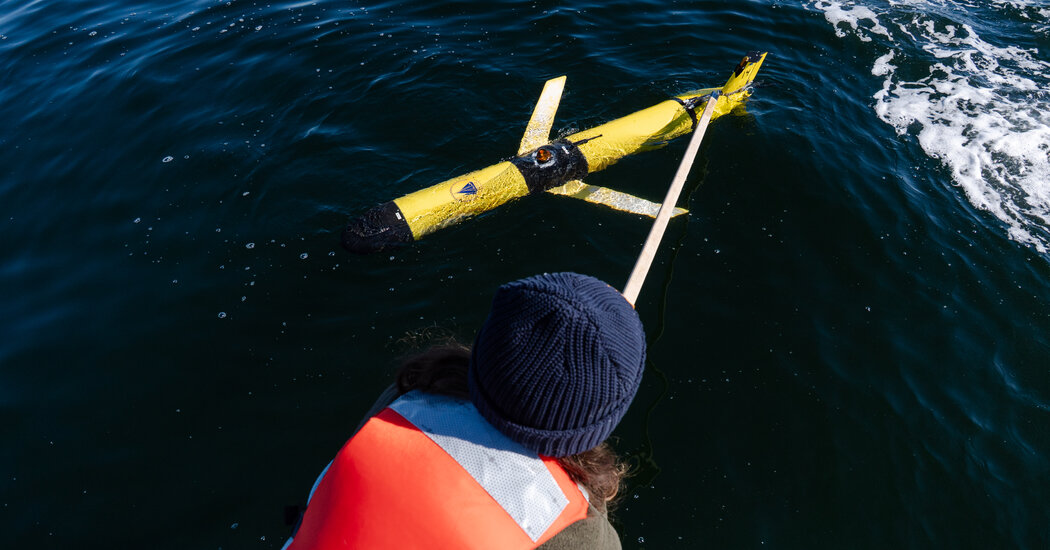
You have a preview view of this article while we are checking your access. When we have confirmed access, the full article content will load.Could New Tech Help Save Some Very Rare Whales?Innovative systems to keep ships from hitting North Atlantic right whales are coming into use. The Trump administration is weighing whether they can replace a bedrock protection.A researcher with the Woods Hole Oceanographic Institution retrieved a glider used to detect the presence of whales off Harwich Port, Mass., last month.Could New Tech Help Save Some Very Rare Whales?Innovative systems to keep ships from hitting North Atlantic right whales are coming into use. The Trump administration is weighing whether they can replace a bedrock protection.A researcher with the Woods Hole Oceanographic Institution retrieved a glider used to detect the presence of whales off Harwich Port, Mass., last month.Credit...Listen · 9:28 min May 28, 2026Trackers that ping satellites every time a whale surfaces for air. Thermal cameras that can detect the animals day and night. Acoustic devices that monitor their calls.These and other emerging technologies could help protect the world’s last surviving North Atlantic right whales from collisions with vessels, a leading threat to their survival. And the Trump administration, as part of its deregulatory agenda, is considering whether the new systems could replace a simple, core protection almost two decades old: seasonal speed limits for large vessels.The innovations, some of which are already in use to various extents, collectively show great promise. But they each face limitations and would require enormous resources to roll out comprehensively, meaning they are not yet a viable substitute for broad, mandatory speed restrictions, according to interviews with several of the scientists who are developing the technologies.“That geographic scale is going to be very, very, difficult,” said Mark Baumgartner, a senior scientist at the Woods Hole Oceanographic Institution who uses underwater acoustic monitoring to detect the whales. “It’s going to be expensive and it’s going to be a major challenge.”Researchers are trying to design a new generation of tracking tags that stick by suction and are less prone to detach.Credit...Graham Dickie for The New York TimesNorth Atlantic right whales are one of the most endangered species in the United States. Whaling drove them to near extinction. Since 2017 they’ve been experiencing what the government calls “an unusual mortality event,” with an elevated number of whales being found dead or injured. Only about 380 remain on the planet.Thank you for your patience while we verify access. If you are in Reader mode please exit and log into your Times account, or subscribe for all of The Times.Thank you for your patience while we verify access.Already a subscriber? Log in.Want all of The Times? Subscribe.AdvertisementSKIP ADVERTISEMENT
Can New Technology Help Save North Atlantic Right Whales?
Innovative systems to keep ships from hitting North Atlantic right whales are coming into use. The Trump administration is weighing whether they can replace a bedrock protection.
450 words~2 min read