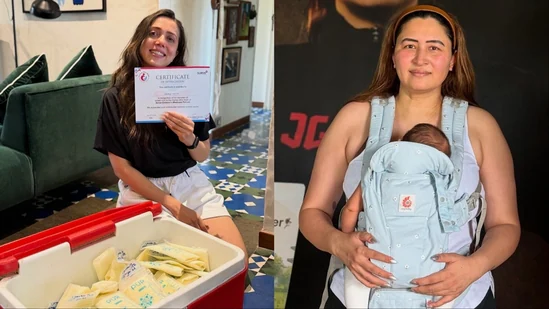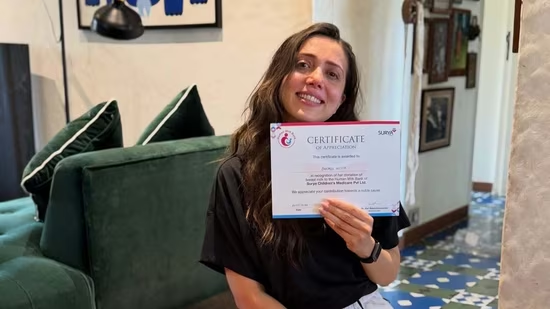
Motherhood comes with its own challenges, and awareness around breast milk donation is slowly growing as public figures share their experiences. Singer-actor Jankee Parekh Mehta took to Instagram to share how she donated nearly 90 packets of breast milk during her breastfeeding journey with her newborn daughter, Rumi, born last August.Exclusive | Jankee Parekh on donating 90 packets of breast milk: The intention was never attention, but awarenessJankee on turning a breast milk donorAsk her what prompted her to donate her breast milk, Jankee says: “I didn’t actually begin my pumping journey with the intention of donating. Like most mothers, I started pumping for my own baby. I wanted to make sure she always had enough milk, whether I was stepping out, travelling, or honestly, just as a new mother, wanting that reassurance that she would continue receiving my milk for as long as possible.”When her daughter started solids, Jankee realised she had excess stored milk. “I thought, if this milk isn’t going to be used by my baby, could it help another baby who genuinely needs it more urgently? Stored milk has a timeline, and timely donation becomes really important because so much effort, time, planning, and emotion goes into creating and storing it. I wanted it to be utilised in the most meaningful way possible.”Researching the process opened her eyes. “I’ve had friends whose babies have been in the NICU, and while I haven’t personally lived that exact experience, I can only imagine how overwhelming and emotionally difficult that journey must be. When you see babies that tiny, you realise that something we otherwise take for granted — something as basic as feeding — can actually become a critical part of their survival and care.”The donation itself was simple. “Thankfully, the process with Surya Hospital was very seamless,” says the 40-year-old. For Jankee, it’s about awareness. “Even I wasn’t deeply informed about the larger milk donation ecosystem before this. These aren’t conversations we usually have. The intention was never attention, but always awareness. Because after I shared my journey, so many mothers wrote to me saying they had no idea this was even possible.”“As a mother, there’s a very real emotional attachment to something your body has created for your baby. But alongside all of that, I also just feel immense gratitude that I am in a position to be able to do this, and that something so deeply personal could potentially go on to support another baby who truly needs it.” She wants to ease the pressure on mothers. “Breastfeeding your baby is not a moral test of motherhood. Every motherhood journey looks different. None of that makes you any less of a mother. What matters most is that the baby is nourished and the mother is supported.”She credits husband-actor Nakuul Mehta for his support. “Rather the first thought of donating actually came from him. I was definitely the more emotional one, holding on to the milk for a little longer, while he was the practical one saying, ‘If we’re going to do this, let’s do it in time’.” “One of my biggest personal learning, especially the second time around, has been that the more pressure you put on yourself as a mother to do everything perfectly, the harder the journey starts to feel. Don’t put pressure on yourself as a new mother. However your feeding journey looks, whatever you are able to do for your baby is enough. Sometimes something that may no longer be needed by your own baby can become incredibly valuable for another child.”What the doctors say?For many mother, however turning to donor milk can be an emotional decision. Sanaya Kapoor who welcomed her twins February last year relied on donor milk after medical issues affected her milk production. “Taking the step of feeding my baby donor milk has come as a relief but it wasn’t easy. Mom guilt is real. When I realized I’m not able feed my baby due to medical reasons, it made me feel incomplete,” she shares. Adding: “My milk production was not enough for one baby, let alone my twins. When we consulted my gynaecologist, we realized that due some medical reasons my body was not producing enough milk. It was a tough decision, but my husband suggested that we go for breast milk banks, as one of his colleagues wife had to go through the same."Dr Rajashri Tayshete, who is a consultant gynaecologist and laparoscopic surgeon, shares: “Breast milk donation is not a new concept. Earlier, women often relied on other breastfeeding mothers to feed their babies. Today, while breastfeeding awareness has increased, many women still face challenges in producing enough milk due to stress, medical conditions, prolonged labour, or postpartum complications." She adds: "At the same time, there are mothers who produce more milk than their baby requires, and much of this extra milk often goes to waste. That is where breast milk banks can play a crucial role.”She elaborates, “There is still very limited awareness around breast milk donation and milk banks. Many women don't know that donated breast milk is available or that they can donate their excess milk to help premature or medically vulnerable babies. We need stronger awareness and a better support system to make the process easier for mothers. Less than 20 per cent of women are aware that breast milk banks exist or that donated breast milk can be accessed free of cost through government-run facilities.” Speaking about maternal guilt and emotional challenges after childbirth, she explains, “Postpartum itself is a very challenging phase. Women go through physical, emotional, and mental changes, and many mothers constantly question whether they are doing enough for their baby. Concerns like ‘Is my milk enough?’ or ‘Am I being a good mother?’ are extremely common. In such situations, support and guidance become very important.”
Exclusive | Jankee Parekh on donating 90 packets of breast milk: The intention was never attention, but awareness
Jankee Parekh shares what prompted her to choose breast milk donation, awareness and more
970 words~4 min read