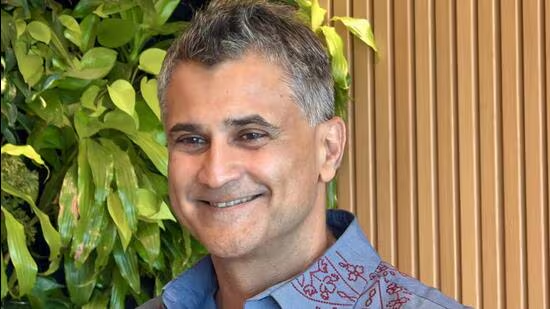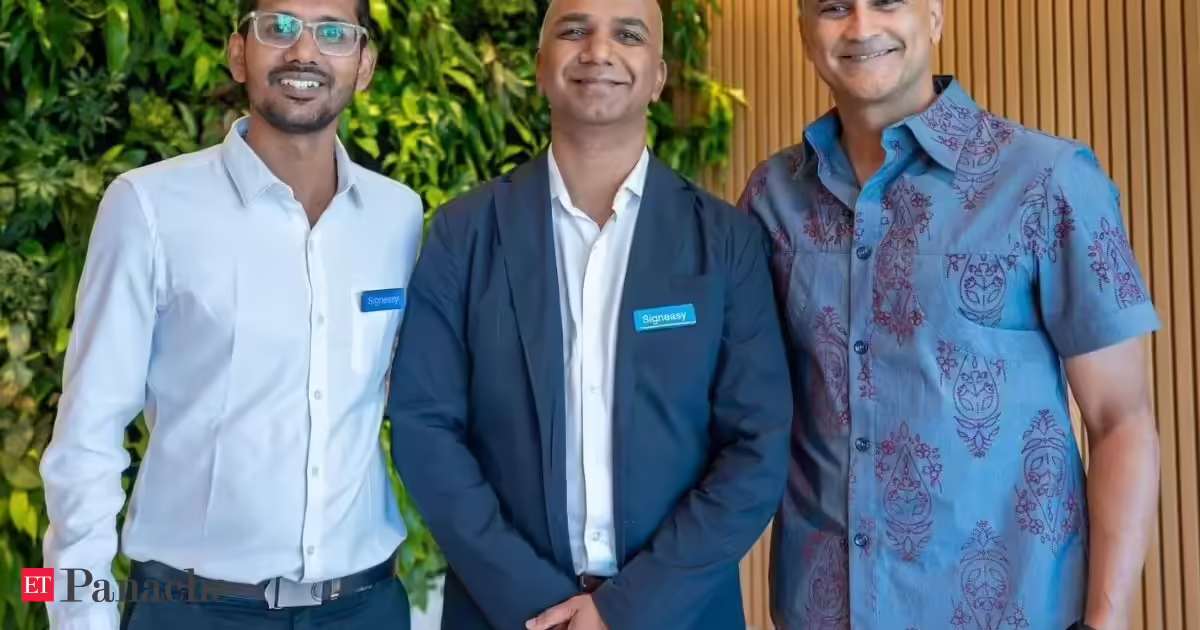
When Apple speaks about India today, the conversation is no longer limited to manufacturing or iPhone sales. Increasingly, the company is positioning India as a crucial pillar in its global developer ecosystem.I recently sat down with Kevan Parekh, CFO at Apple, during the company’s developer-focused engagements in Bengaluru, where the broader focus was clear: India is becoming central to Apple’s long-term ecosystem strategy, not just as a market for devices, but as a growing hub for developers, apps, and next-generation talent.And if the numbers are anything to go by, Apple’s App Store momentum in India is accelerating rapidly.According to Apple’s App Store Ecosystem Report for India, authored by Professor Vishwanath Pingali of IIM Ahmedabad, the App Store ecosystem facilitated nearly ₹44,500 crore in billings and sales in 2024, equivalent to roughly $5.3 billion. More importantly for developers, Apple says over 94 percent of those earnings accrued directly to developers and businesses without commission being paid to Apple.“The numbers tell me we’ve got a vibrant and growing developer community,” Parekh told me during our conversation. “We’ve got a growing user base in India, which we care deeply about. One of the reasons I’m here is to understand how we can grow even more and reach more users.”What stood out throughout the discussion was Apple’s repeated emphasis on the ecosystem effect. For Apple, India’s developer story is no longer isolated from its hardware ambitions. The two are increasingly intertwined.Parekh pointed toward Apple’s expanding software capabilities, including the company’s Foundation Models and its broader developer toolkit, as a major driver for app innovation in the country.“We have over 250,000 APIs available to developers,” he said. “Seeing Indian developers integrate those tools into their apps in meaningful ways was incredibly inspiring.”The company also believes monetisation remains a key differentiator for iOS developers, especially in a market traditionally dominated by Android users.“I think iOS provides a great monetisation opportunity for developers,” Parekh noted. “That’s an attractive attribute people care about.”That point is particularly significant in India, where developers increasingly look beyond downloads and focus on sustainable app businesses. Apple’s pitch appears to be centred around quality users, monetisation potential, and ecosystem stickiness rather than purely scale.Of course, India remains one of the world’s most price-sensitive technology markets, something Apple is acutely aware of. While Parekh maintained that Apple’s pricing philosophy remains globally consistent, he highlighted the company’s widening product range as a way to reach newer audiences.“We try to provide the best value to customers across both hardware and services,” he said. “But we do have a range of products for different users.”One product Apple appears particularly optimistic about is the newly introduced MacBook Neo, which Parekh believes could significantly expand access to the Mac ecosystem in India, especially among younger creators and students.In fact, when I mentioned that I personally liked the blue variant of the MacBook Neo, Parekh immediately responded with a smile: “I love the blue one too.”Beyond products and monetisation, another recurring theme throughout the interaction was Apple’s focus on nurturing younger developers in India.During the Bengaluru showcase, Apple introduced several student developers building applications across education, accessibility, and productivity. One example that particularly stood out was a 14-year-old developer building mathematics-focused applications aimed at simplifying learning experiences for students.Parekh appeared genuinely encouraged by the scale of young talent emerging from India.“What’s amazing is seeing people at that age already leveraging these tools and building meaningful applications,” he said.Apple also highlighted the growing success of Indian participants in the Swift Student Challenge, the company’s annual global programme designed to support young developers and entrepreneurs. This year saw a record number of applications and distinguished winners from India.Among the standout stories was that of Pune-based developer Gayatri Goundadkar, whose project “Steady Hands” uses Apple Pencil stabilisation and motion analysis to help individuals with tremors create art more effectively. Inspired by her grandmother’s struggle with tremors, the app combines accessibility principles with Apple’s development frameworks like SwiftUI and PencilKit.The emphasis on accessibility was hard to miss throughout Apple’s presentations. Whether through student-led innovation or broader platform features, Apple is increasingly framing accessibility not as an add-on feature, but as a foundational part of app development itself.Privacy and security also emerged as key talking points during our conversation, especially as Apple attempts to differentiate itself in a highly competitive market.Parekh pointed out that many Indian developers are increasingly building “iOS-first” applications because of the values associated with the ecosystem.“Privacy and security matter deeply to us,” he said. “And it matters deeply to users and developers as well.”At a broader level, Apple’s India strategy now appears to be entering a more mature phase. Manufacturing expansion may have brought the company closer to India operationally, but the next phase seems focused on ecosystem depth: developers, services, software tools, education, and long-term platform adoption.And Apple believes it is still early days.“We’ve grown dramatically already,” Parekh said. “But honestly, I feel like we’re just scratching the surface in India.”For a company as globally scaled as Apple, that is perhaps the clearest indication yet of how strategically important India has become.The full video interview with Apple CFO Kevan Parekh will be available soon on Economic Times.
Apple’s CFO Kevan Parekh says India is just 'Scratching the Surface' as developer ecosystem expands
Apple is increasingly treating India as a core part of its global developer ecosystem, not just a market or manufacturing hub, with strong growth in App Store earnings and rising contributions from Indian developers. The company highlighted expanding developer tools, monetisation opportunities on iOS, and a growing base of young talent building apps across education, accessibility, and productivity.
857 words~4 min read