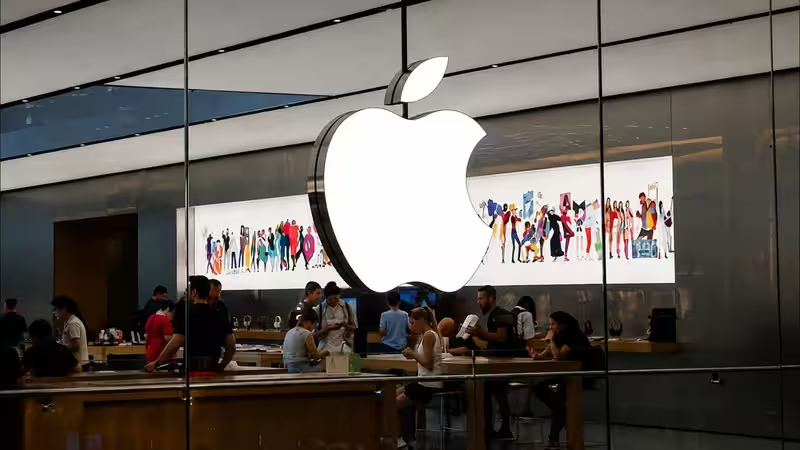
Photo credit: apple.comApple's India business is on track to clock Rs 1.42 lakh crore in revenue in FY26, according to Kotak Mutual Fund estimates - almost double the projected revenue of Hindustan Unilever, the country's largest fast-moving consumer goods firm. The company has grown its India revenue more than six times in five years, from Rs 22,845 crore in FY21. Counterpoint Research data shows Apple closed 2025 with 9 per cent of India's smartphone shipments and 28 per cent of the market by value. Both are company records.The HUL comparison reframes Apple IndiaOne company sells iPhones, MacBooks and AirPods to a thin slice of urban and metro India. The other sells soap, shampoo, detergent and tea to nearly every household in the country. The Kotak projection puts the first ahead of the second by roughly Rs 70,000 crore.That single sentence is the headline.For two decades, premium technology spending in India sat well below FMCG, telecom and automotive in any revenue ranking. The FY26 number marks the first year Apple India's revenue line clears HUL's by a clear margin. The trend it points to runs deeper than one quarter or one product cycle.From Rs 22,845 crore to Rs 1.42 lakh crore in five yearsIn FY21, Apple India's revenue stood at Rs 22,845 crore. The Kotak projection puts FY26 at six-and-a-quarter times that figure. No FMCG, auto or telecom company in India has matched that growth curve in the same window.MetricFY21FY26 (projected)MultipleApple India revenueRs 22,845 croreRs 1.42 lakh crore~6.2xIndia smartphone shipment share~4 per cent9 per cent (CY2025)~2.25xIndia smartphone value share~17 per cent28 per cent (CY2025)~1.65xSource: Kotak Mutual Fund estimates, Counterpoint ResearchCounterpoint Research data adds the volume context. Apple closed 2025 with 9 per cent of India's smartphone shipments and 28 per cent of the market by value. The 19-point gap between the two figures contains the entire Apple India business model. The company sells fewer phones than Samsung, Xiaomi or Vivo and earns more from each one than the three combined.Why Apple keeps outpacing India's mass marketIndia's premium smartphone segment, devices priced above Rs 30,000, has expanded faster than the overall market for three consecutive years. Apple owns most of the ceiling. Samsung, OnePlus and Google share what is left.The premium story extends past phones. MacBooks have become standard issue for Indian startups, design agencies and finance roles where the company laptop was a Dell or a Lenovo five years ago. AirPods and Apple Watch have eaten into the wearable audio and smartwatch categories at price points that would have looked absurd in India before 2020.Buyers in Mumbai, Bengaluru, Delhi and Hyderabad treat a Rs 1.5 lakh iPhone the way they once treated a Rs 50,000 phone, as a four-year working asset, not a luxury purchase.EMI economics quietly rebuilt Apple India's baseThe single biggest behavioural shift Apple has benefited from is the spread of no-cost EMI across India's banking and payment rails. HDFC Bank, ICICI Bank, Bajaj Finserv, Axis Bank and the Apple India online store now offer 12-month no-cost plans on every iPhone, MacBook and iPad SKU.The iPhone 17 at Rs 89,900 becomes Rs 7,491 a month. The sticker shock collapses. The aspirational buyer who used to choose between an iPhone and a foreign trip now treats the question as a monthly phone budget, not a one-time decision.That arithmetic shift is what pulled Apple deeper into India's upper-middle-class, and into the salaried tier just below.The ecosystem compounds with every iPhone soldApple's India revenue spans more than iPhones now. The company's internal data point - every iPhone buyer adds 1.7 Apple products on average - holds with sharper force in India, where the upgrade cycle starts later but expands wider once it begins.The pattern is predictable. Buyer enters with an iPhone. Adds AirPods within a year. Picks up an Apple Watch on the next festive sale. Replaces the work laptop with a MacBook Air. Signs up for iCloud storage because the photo library has outgrown the device. Within three years, a Rs 89,900 entry-line transaction compounds into a Rs 4–5 lakh ecosystem commitment.Samsung, Xiaomi and Lenovo all sell adjacent devices. Apple alone has built the lock-in.Made-in-India manufacturing reset Apple's cost equationFoxconn, Tata Electronics and Pegatron now assemble iPhones at scale in Tamil Nadu and Karnataka. The Production-Linked Incentive (PLI) scheme has lifted India's share of Apple's global iPhone output from below 5 per cent in FY21 to a figure industry analysts now place above 18 per cent. Some estimates put it higher.Local assembly does two things for the India revenue line. It compresses the duty load on iPhones sold domestically. It gives Apple the political and policy room to keep expanding retail, manufacturing and supplier networks without the friction a foreign brand would otherwise face on the ground.Apple's India retail push adds two more flagshipsApple opened its first two India flagship stores in Mumbai BKC and Delhi Saket in April 2023. Both have ranked among Apple's highest-revenue stores globally per square foot since opening. A third store in Bengaluru and a fourth in Mumbai Worli are scheduled for the next 18 months.The Apple India online store, parallel to the physical retail push, handles a growing share of direct-to-consumer transactions. The playbook is the one Apple has used in the US and UK for two decades - arriving in India with full inventory access, full SKU range and full ecosystem cross-sell.The replacement cycle now favours the Apple premiumGlobal smartphone replacement cycles have stretched from 24 months to 36-plus months. India's cycle runs even longer. When buyers do upgrade, the calculation has shifted toward devices that hold software value, support and resale price for the longest window. Apple wins all three by a wide margin.The iPhone's five-to-seven-year iOS support window, the company's industry-leading resale value on second-hand platforms, and the Apple Intelligence rollout under iOS 26 have extended the rational case for paying the Apple premium even for buyers who once refused.FAQ: Apple India FY26 in numbersWhat is Apple India's projected revenue for FY26?Apple India is on track to clock Rs 1.42 lakh crore in revenue in FY26, according to Kotak Mutual Fund estimates. The figure is roughly six times the company's FY21 India revenue of Rs 22,845 crore.Is Apple India bigger than Hindustan Unilever? On the FY26 projection, yes. Apple India's Rs 1.42 lakh crore revenue would be almost double HUL's projected revenue of around Rs 65,000–70,000 crore, making Apple the larger consumer-facing business by topline.What is Apple's smartphone market share in India?Apple closed 2025 with 9 per cent of India's smartphone shipments and 28 per cent of the market by value, according to Counterpoint Research. Both are the company's highest-ever shares on those metrics.Why is Apple India growing this fast?Five drivers stack up: premiumisation of the Indian consumer market, the spread of no-cost EMI on premium devices, the Apple ecosystem cross-sell, made-in-India manufacturing under the PLI scheme, and Apple's retail expansion since April 2023.Which Apple products are driving India revenue?iPhones account for the bulk of the number, but MacBooks, Apple Watch, AirPods and iCloud services contribute a growing share - the ecosystem effect Samsung, Xiaomi and Lenovo have struggled to match in India.The premium thesis is now settledIf the Kotak math holds, Apple will earn more in India in FY26 than Hindustan Unilever will earn selling soap, shampoo, detergent and tea to half the country. The premiumisation argument has run its course. The number speaks for itself.end of article
Apple India May Hit Rs 1.42 Lakh Crore Revenue In FY26, Twice HUL
Find latest technology news, gadgets reviews & ratings. Popular & latest gadgets specifications, features, prices, photos & videos. Trending mobile phone comparisons, slideshows, how tos and videos for latest mobile phones, tablets, technology news updates.
1,227 words~6 min read