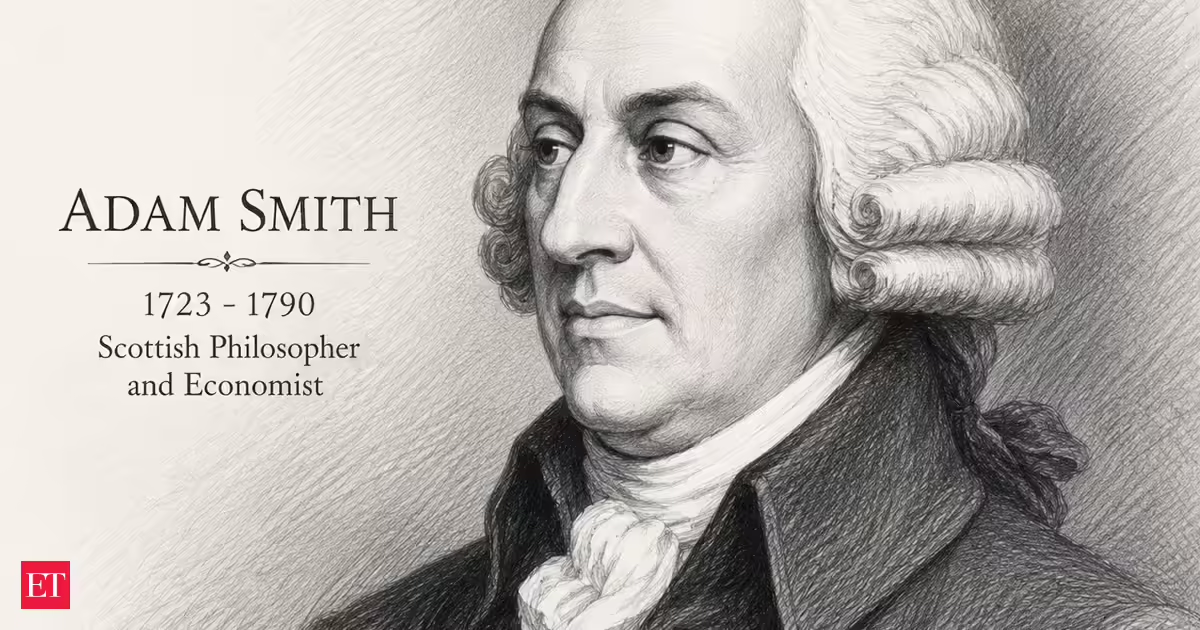
The “Adam Smith Quote of the Day” continues to resonate because it speaks directly to a truth many people quietly experience but rarely explain. “How selfish soever man may be supposed,” wrote Adam Smith, “there are evidently some principles in his nature, which interest him in the fortune of others.” In an era shaped by competition, ambition, and personal success, the Adam Smith Quote of the Day reminds readers that human beings are not driven by self-interest alone. Deep inside ordinary life, there is still compassion, empathy, and emotional connection.The power of the Adam Smith Quote of the Day lies in its honesty. Smith does not deny selfishness exists. Instead, he acknowledges it openly before revealing something deeper about human nature. People may chase wealth, recognition, or status, yet they still feel joy when others succeed. They still hurt when others suffer. This emotional contradiction is what makes the quote timeless. It feels less like philosophy and more like a mirror reflecting everyday life.“How selfish soever man may be supposed, there are evidently some principles in his nature, which interest him in the fortune of others, and render their happiness necessary to him, though he derives nothing from it, except the pleasure of seeing it.” — Adam SmithQuote of the day by Adam Smith: This powerful quote explains why compassion is built into human nature.This Quote of the Day carries a deep truth about modern life. People chase success, wealth, and recognition every day. Yet real happiness still comes from human connection. The Adam Smith quote reminds readers that compassion is not weakness. It is part of human nature itself. Even in difficult times, people still feel joy through another person’s peace, growth, and happiness.The Quote of the Day also explains why kindness continues to matter in a divided world. Society often rewards competition. But emotional understanding keeps relationships alive. Families survive through sacrifice. Friendships grow through empathy. Communities become stronger when people care beyond themselves. Adam Smith’s words feel timeless because they reflect everyday human experience. A small act of support can change someone’s entire day. That silent emotional connection still shapes the world more than power or money ever can.Meaning of the Quote of the DayThe Quote of the Day by Adam Smith explains that human beings are not completely selfish, even when society believes they are. People naturally care about the happiness, pain, and success of others. This quote shows that kindness and empathy exist deeply inside human nature. A person may gain nothing materially from helping someone else, yet still feel genuine joy seeing another person happy. That emotional connection makes humanity stronger and more meaningful.The deeper meaning of the Quote of the Day is that real human fulfillment does not come only from money or personal success. Emotional understanding also matters. Families stay united through care. Friendships survive through support. Communities grow when people think beyond themselves. Adam Smith’s words remind readers that compassion is not rare or weak. It is one of the strongest forces shaping relationships, trust, and society itself.Who was Adam Smith?Adam Smith was a famous Scottish economist, philosopher, and writer who became one of history’s most influential thinkers. Born in 1723 in Kirkcaldy, he is widely known as the “Father of Modern Economics.” His ideas shaped how the modern world understands trade, markets, human behavior, and economic freedom.But Adam Smith was not only an economist. He also deeply studied morality, empathy, and human emotions. In his earlier book, The Theory of Moral Sentiments, he argued that human beings naturally care about others and feel sympathy for their struggles and happiness. That is why many of his quotes still feel emotionally powerful today.Smith studied at the University of Glasgow and later taught philosophy. His work continues influencing economics, politics, ethics, and business education across the world. Even centuries later, Adam Smith remains one of the most quoted thinkers when discussing capitalism, morality, and human nature.Adam Smith’s journey from quiet scholar to the Father of modern economicsAdam Smith lost his father before birth and grew up with his mother, who strongly supported his education and intellectual curiosity. From an early age, Smith showed extraordinary interest in books, philosophy, morality, and the behavior of society. His calm personality and deep thinking later helped shape ideas that transformed economics and modern political thought across the world.Adam Smith studied at the University of Glasgow and later attended Balliol College, Oxford. During his academic years, he explored philosophy, ethics, literature, and law. He eventually became a professor and gained respect for his brilliant lectures and sharp observations about human behavior. Unlike many scholars of his era, Smith explained complex ideas in practical and understandable language. People admired his ability to connect morality, economics, and everyday life together.His greatest success came through the publication of The Wealth of Nations in 1776. The book changed how nations viewed trade, labor, business, and economic freedom. Smith argued that productivity and open markets could create prosperity for society. His famous idea of the “invisible hand” became one of the most influential concepts in economic history. The book later shaped governments, industries, and educational systems throughout Europe and America.Another major achievement of Adam Smith was his earlier philosophical masterpiece, The Theory of Moral Sentiments. In this work, he explored empathy, compassion, and the emotional side of human nature. This proved that Smith was not focused only on money or markets. He believed moral responsibility and human connection were equally important for a healthy society. Today, Adam Smith remains one of history’s most respected intellectual figures because his ideas still influence economics, ethics, leadership, and modern social thought.Other famous quotes by Adam Smith that still inspire the modern world“Science is the great antidote to the poison of enthusiasm and superstition.”“The real tragedy of the poor is the poverty of their aspirations.”“Man naturally desires, not only to be loved, but to be lovely.”“Mercy to the guilty is cruelty to the innocent.”“Happiness never lays its finger on its pulse.”“The chief part of human happiness arises from the consciousness of being loved.”“Wisdom is the knowledge of what is worth knowing.”
Quote of the Day by Adam Smith: “How selfish soever man may be supposed, there are evidently some principles in his nature, which interest him in the fortune of others, and render their...” Learn why true happiness grows when you care about others — the timeless wisdom that proves human kindness is stronger than selfishness
Quote of the Day by Adam Smith: This is one of the most powerful openings in the history of economics and philosophy. It perfectly highlights a side of Adam Smith that people often forget. While everyone remembers him for the "invisible hand" and self-interest in The Wealth of Nations, this quote from The Theory of Moral Sentiments reminds us that he didn't view humans as purely cold, calculating machines. To Smith, our natural capacity for sympathy and mutual empathy is the foundational bedrock that allows a functioning society—and a stable economy—to exist in the first place.
1,014 words~5 min read