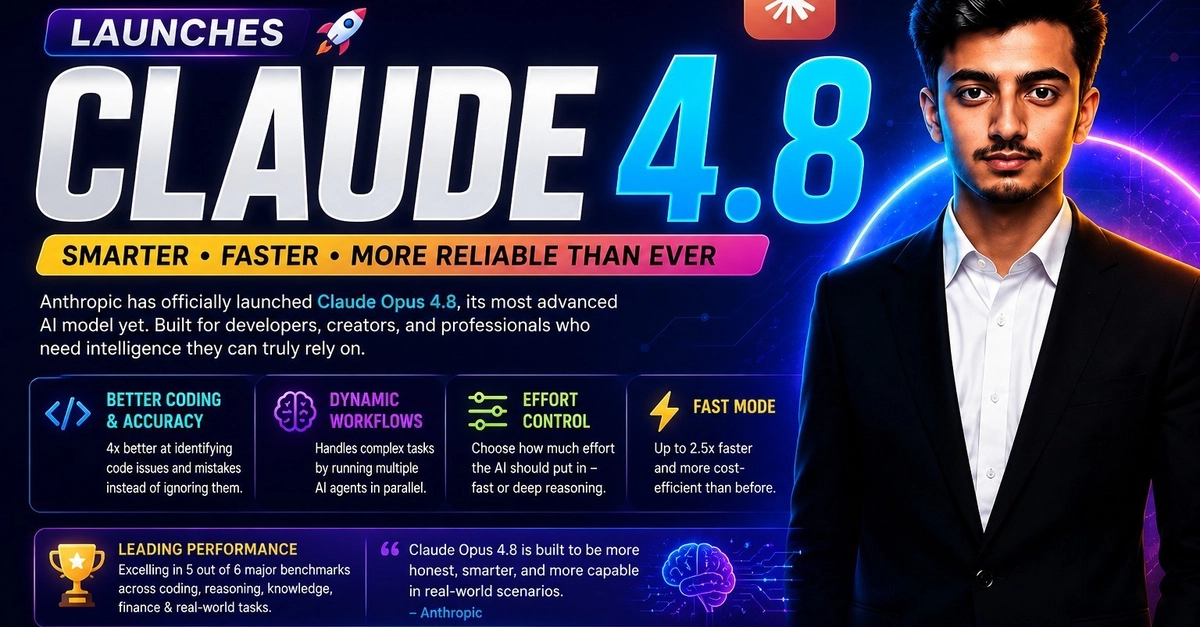
Anthropic released Claude Opus 4.8 on 28 May, hours after crossing a $965 billion valuation that pushed it past OpenAI as the most valuable AI company in the world. The model is the smaller half of the day. Anthropic itself calls Opus 4.8 a "modest but tangible" improvement on its predecessor — same price as Opus 4.7, single-digit benchmark gains, and one pitch held above the rest: honesty. The timing carries the real story. With OpenAI's GPT-5.5 engineered to undercut Claude on price, Anthropic is defending its coding and agentic franchise on reliability instead of cost, and investors have just paid up for the bet. What did Anthropic actually ship?Opus 4.8 holds the line on pricing: $5 per million input tokens and $25 per million output tokens, unchanged from Opus 4.7. The benchmark movement is incremental. Anthropic's own figures put agentic coding at 69.2 per cent, up from 64.3 per cent, and multidisciplinary reasoning with tools at 57.9 per cent, up from 54.7. On Online-Mind2Web, a test of browser-agent reliability, the model scores 84 per cent, a jump over both Opus 4.7 and GPT-5.5. None of this rewrites the category, and the company set expectations low on purpose.The differentiator sits elsewhere. Anthropic trained Opus 4.8 to flag its own uncertainty rather than claim progress it cannot support, and reports the model is around four times less likely than its predecessor to let a flaw in its own code pass unremarked. In a field where models declare victory over bugs that remain, that is a pointed claim.Three features ship alongside it. Dynamic workflows, in research preview inside Claude Code, lets Claude plan a large job and run hundreds of parallel subagents in one session — enough, the company says, to carry out codebase-scale migrations across hundreds of thousands of lines from kickoff to merge. An effort control in Claude.ai and Cowork lets users dial how hard the model works, trading speed and rate limits against depth. Fast mode, at 2.5 times the pace, now costs three times less than it did for previous models. For developers, the Messages API now accepts system entries inside the messages array, so instructions can be updated mid-task without breaking the prompt cache.ModelReleasedPrice per million tokens (in / out)Where it leadsClaude Opus 4.8 (Anthropic)28 May 2026$5 / $25Coding, agentic computer use, reliabilityGPT-5.5 "Spud" (OpenAI)23 April 2026~$2 / $12 (reported)Terminal and agentic workflows, priceGemini 3.1 Pro (Google DeepMind)February 2026~$2 / $12 (reported)Reasoning, multimodal, speedFast mode for Opus 4.8 is priced at $10 / $50 per million tokens. Rival pricing is approximate and shifts by tier.How does Opus 4.8 compare with GPT-5.5 and Gemini?The frontier has split into specialists. Through 2026 the pattern has held: Claude leads software engineering, Gemini 3.1 Pro ties on reasoning while leading on price, speed and multimodal, and GPT-5.5 leads agentic and terminal workflows. Anthropic now claims Opus 4.8 tops both GPT-5.5 and Gemini 3.1 Pro on agentic coding, agentic financial analysis and agentic computer use. Read the claim with care. GPT-5.5 launched in late April priced at roughly a third of Opus on input tokens, built for exactly the agent workloads Claude had owned — the move Anthropic had to answer. Leads at this altitude run to single percentage points, and they bend with the test harness. Anthropic measured terminal coding on the Terminus-2 harness; GPT-5.5 posts a higher 83.4 per cent on its own Codex CLI. The honest reading is that the scaffold around the model now decides as much as the model. Google, meanwhile, keeps the pressure on cost: Gemini 3.5 Flash scores 57.9 per cent on Finance Agent v2, ahead of Gemini 3.1 Pro on the very task Anthropic flagged as a strength.There is history under this fight. Microsoft owned GitHub and shipped Copilot before ChatGPT existed, then watched Claude Code, OpenAI's Codex and Cursor win the developers it should have kept. That franchise is what Opus 4.8 protects. What buyers told Anthropic carries more weight than the leaderboard. Tom Pritchard, a staff engineer who tested the model, said it "asks the right questions, catches its own mistakes, and pushes back" when a plan looks weak. Scott Wu, chief executive of the company behind Devin, said Opus 4.8 fixes the comment-verbosity and tool-calling issues seen with Opus 4.7. For teams running agents unattended, fewer wrong turns beats a fractional benchmark win.Why lead with honesty rather than price?Because the costliest failure in enterprise AI is a confident wrong answer, and the token bill is the cheap part. An agent that runs for an hour and reports success on work it botched burns trust, rework and human hours far beyond the compute it consumed. Anthropic's wager is that reliability is where large customers feel the pain.The alignment data supports the positioning. Anthropic's safety team concluded the model "reaches new highs" on prosocial traits such as supporting user autonomy, with rates of deception and misuse cooperation close to Mythos, its most capable internal model. The point landed in public, too: a viral study of AI agents running simulated towns found Claude's agents the least likely to commit crime. One investment tester told Anthropic the model flagged input and output problems "other models routinely missed" — the kind of catch that, in finance or law, separates a usable answer from a liability.Cost still gets an answer, through a different door. The effort control hands spending discipline to the user rather than cutting the headline rate. The cheaper, faster mode lowers the floor for high-volume jobs. Anthropic declines the price war on OpenAI's terms and competes on the one axis a benchmark struggles to capture. The receipts are arriving: the company says annualised revenue crossed $47 billion in May, up from $14 billion in February, against OpenAI's reported figure near $30 billion.What does Opus 4.8 mean for India?India is the second-largest market for Claude, and the work it does there lands on exactly what Opus 4.8 improved. Close to half of Claude usage in India is computer and mathematical work — building applications, modernising systems, shipping production software. A coding-and-reliability upgrade is therefore an India upgrade by default.The economics matter at Indian scale. Cognizant is deploying Claude to 350,000 employees globally, Air India uses Claude Code to ship software faster, and CRED reports feature delivery at twice the pace. Infosys has built a dedicated Anthropic centre of excellence for regulated-sector deployments, while Razorpay runs Claude in risk and operational workflows and Swiggy uses MCP for grocery ordering and reservations. At that volume, the effort dial and the cheaper fast mode read as margin, not novelty — a few rupees per task, multiplied across millions of tasks, becomes a line item. Anthropic opened a Bengaluru office in February, its second in Asia after Tokyo, under India managing director Irina Ghose, formerly of Microsoft India. India, she said, is "one of the world's most promising opportunities" for responsible AI at scale. The proof of concept already exists locally: Emergent, built entirely with Claude, reached $25 million in annual recurring revenue within five months.What comes next?The model is the appetiser. Anthropic used the same announcement to flag what it holds back: Mythos-class models, more intelligent than Opus, kept behind cybersecurity safeguards and promised to all customers "in the coming weeks". A small set of organisations already runs Claude Mythos Preview for security work. Anthropic, in other words, shipped its second-best hand and kept the strongest cards face-down.That reserve, plus a near-trillion-dollar valuation and the strongest revenue in the field, sets up the next move. A public listing could come as early as October, in a year when OpenAI, last valued at $852 billion, and a merged SpaceX-xAI targeting $2 trillion are also circling the markets. Opus 4.8 buys Anthropic position in that race; Mythos is meant to win it. The interesting number this week was never the benchmark. It was the one with nine zeroes after it. Frequently asked questionsWhat is Claude Opus 4.8?Claude Opus 4.8 is Anthropic's flagship AI model, released on 28 May 2026 as an upgrade to Opus 4.7. It focuses on coding, agentic tasks and reliability, and ships at the same price as its predecessor.How much does Claude Opus 4.8 cost?Regular usage is priced at $5 per million input tokens and $25 per million output tokens, with fast mode at $10 and $50. The effort control is available on every plan, including free.Is Claude Opus 4.8 better than GPT-5.5?Anthropic says Opus 4.8 leads GPT-5.5 on agentic coding, agentic financial analysis and agentic computer use. GPT-5.5 holds an edge on some terminal benchmarks and costs less per token. The stronger choice depends on the task and the agent setup around the model.What is new in Opus 4.8 compared with Opus 4.7?The headline change is honesty: the model flags its own uncertainty more often and is around four times less likely to let a code flaw pass unremarked. It also posts higher agentic-coding and reasoning scores and adds dynamic workflows, effort control and a cheaper fast mode.Can I use Claude Opus 4.8 in India?Yes. Opus 4.8 is available everywhere from launch day, including India — Claude's second-largest market. Developers reach it through the Claude API using the model name claude-opus-4-8.When will Claude Mythos be available?Anthropic expects to bring Mythos-class models — more capable than Opus — to all customers in the coming weeks, once cybersecurity safeguards are complete. A limited preview already runs for security work.end of article
Claude Opus 4.8 Launch: A Game-Changer as Anthropic Surpasses OpenAI's Valuation
Anthropic has launched Claude Opus 4.8, a new AI model. This release emphasizes honesty and reliability, aiming to secure its position in the AI market. The model offers improvements in coding and reasoning. India, a key market, will benefit from these upgrades. Anthropic is also preparing to release its more advanced Mythos models soon.
1,563 words~7 min read