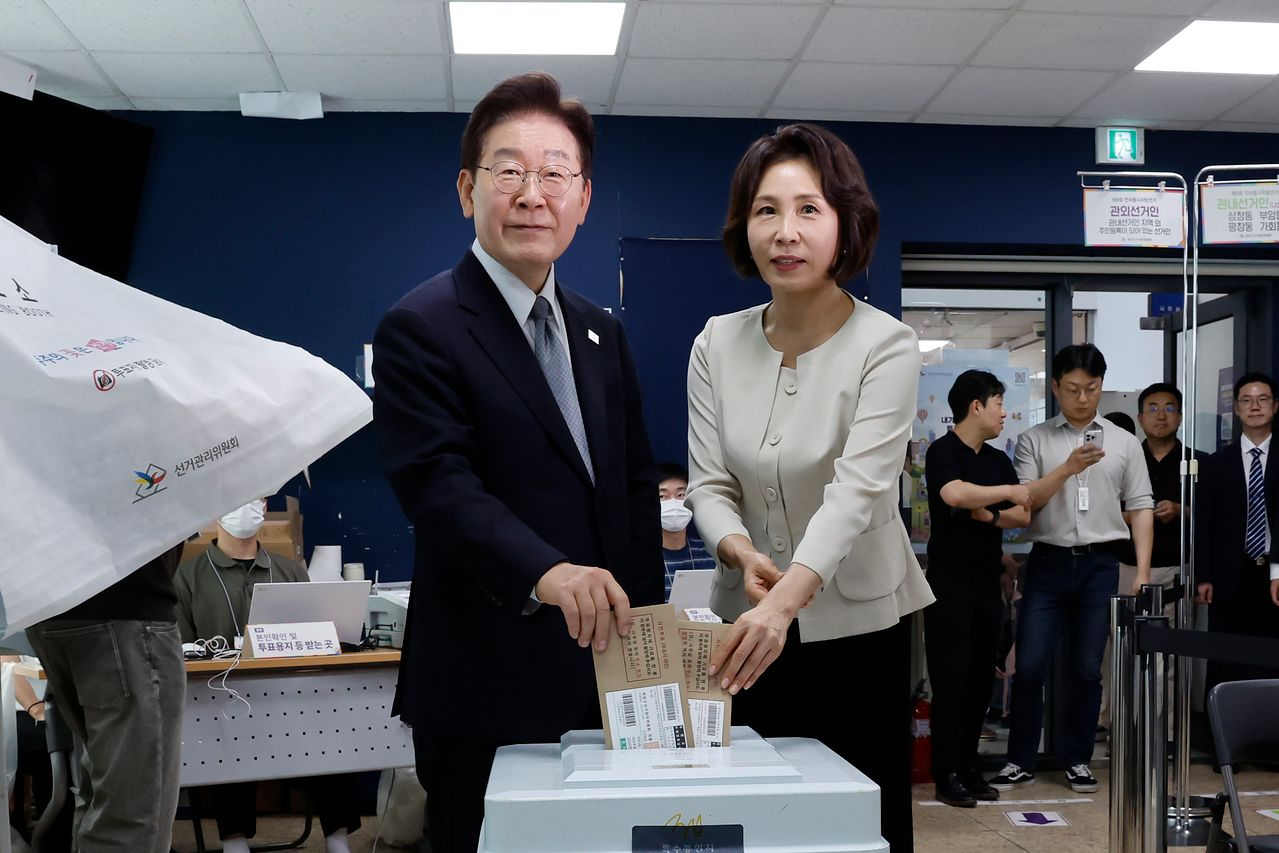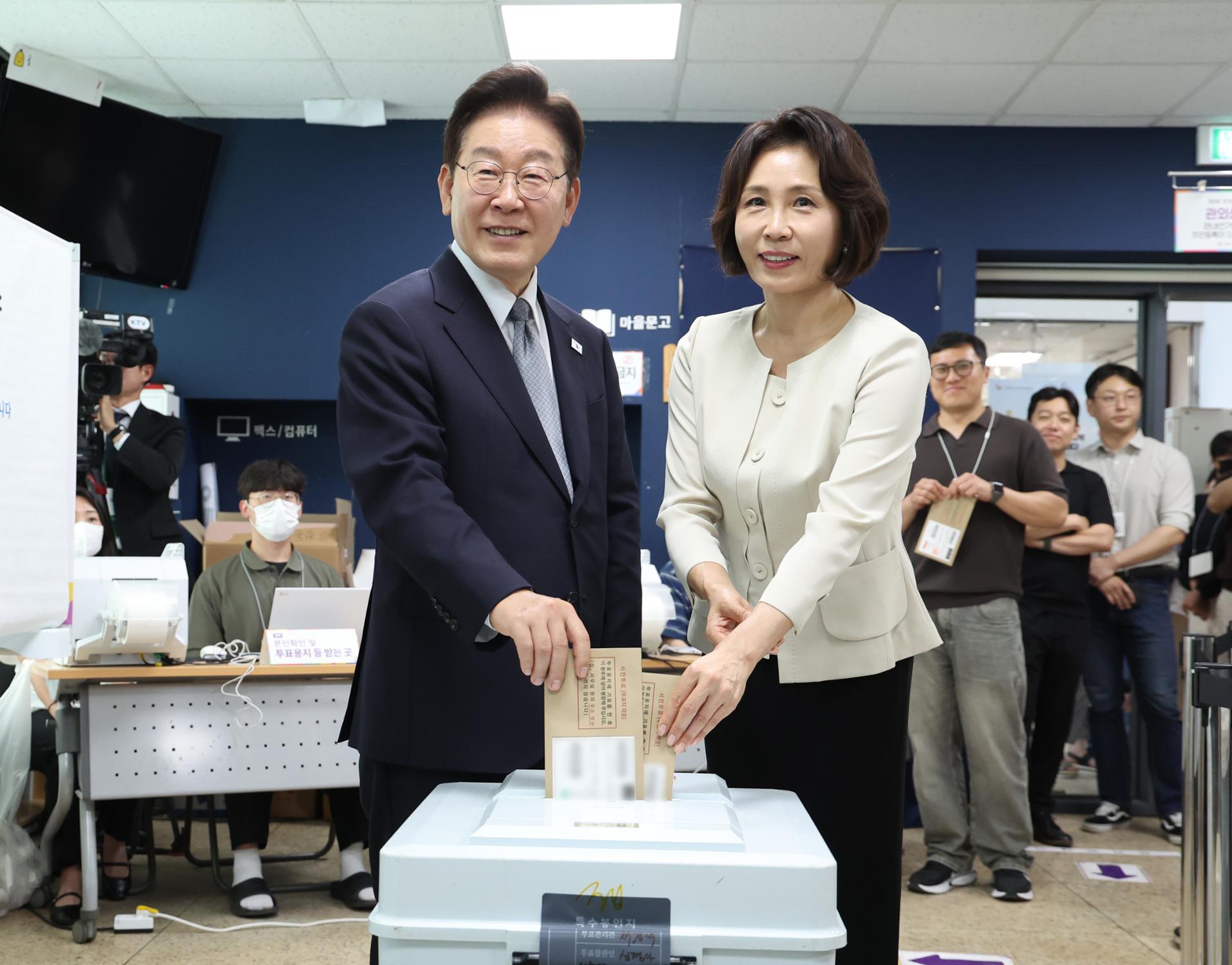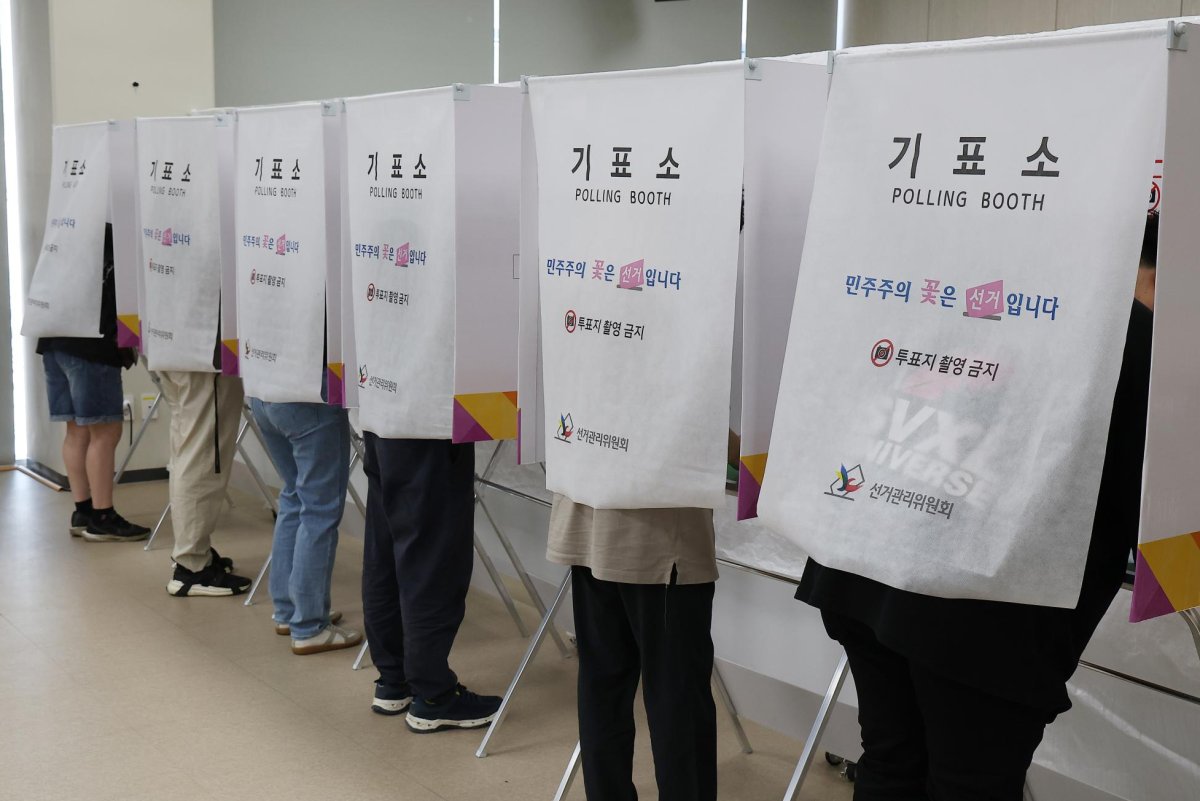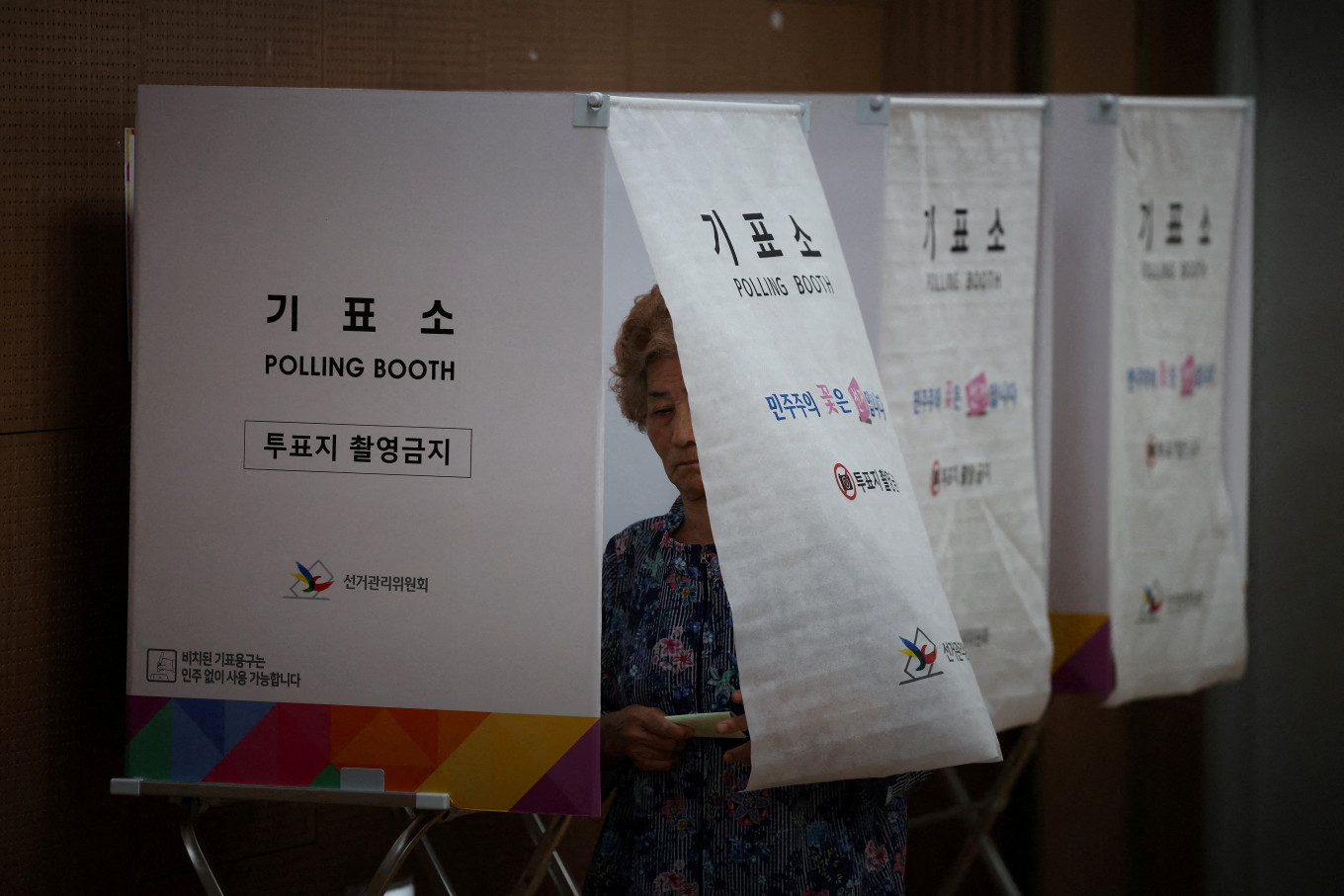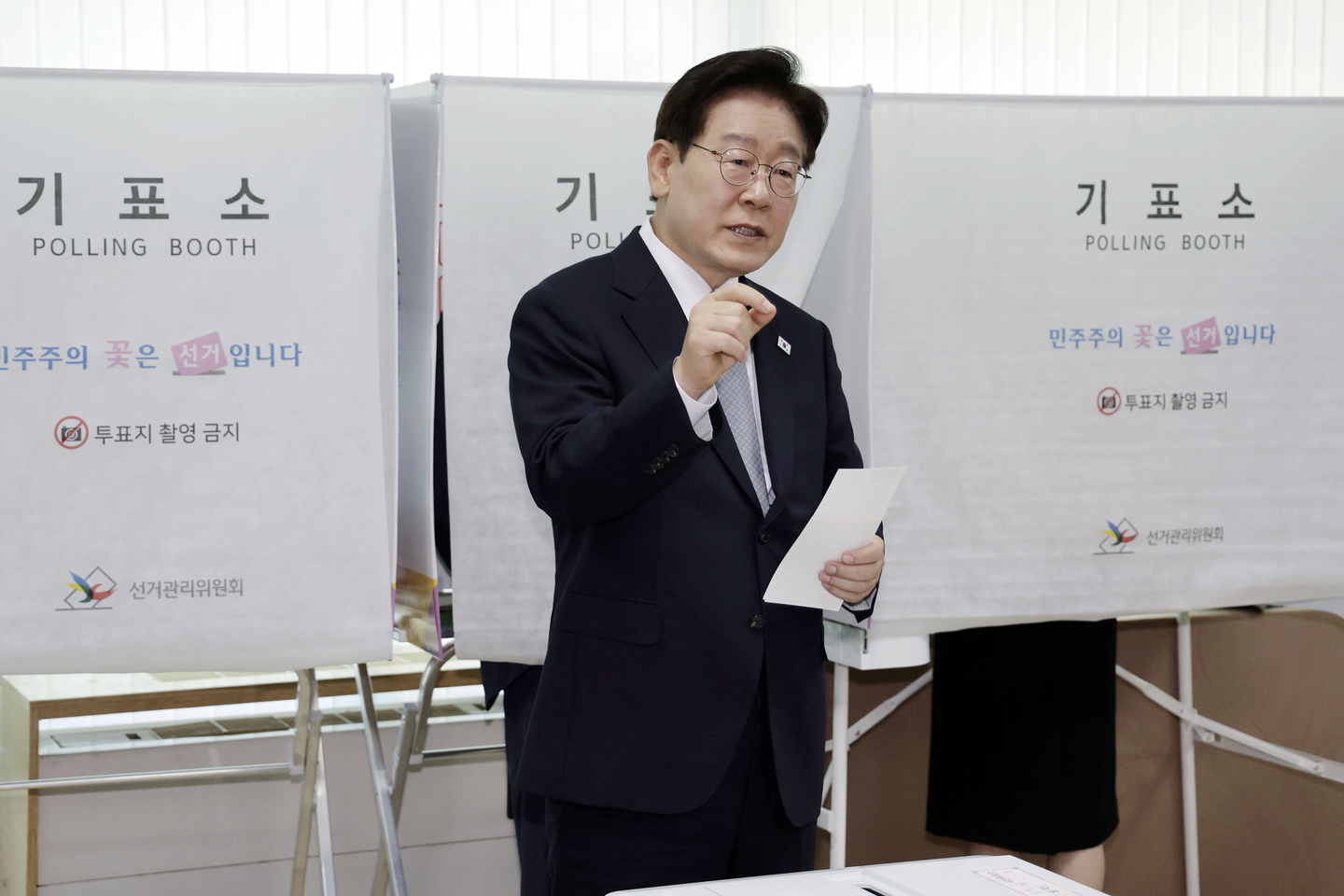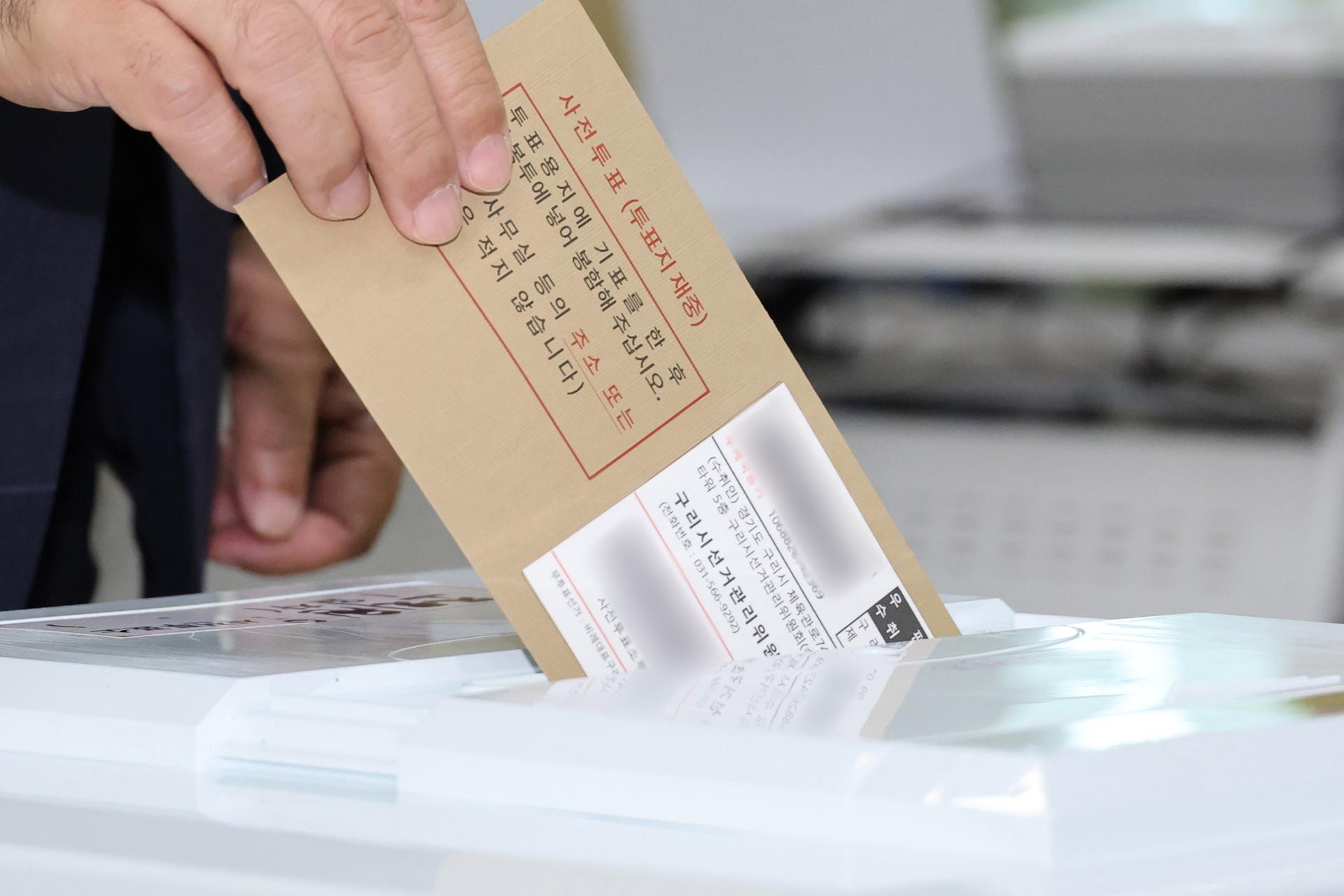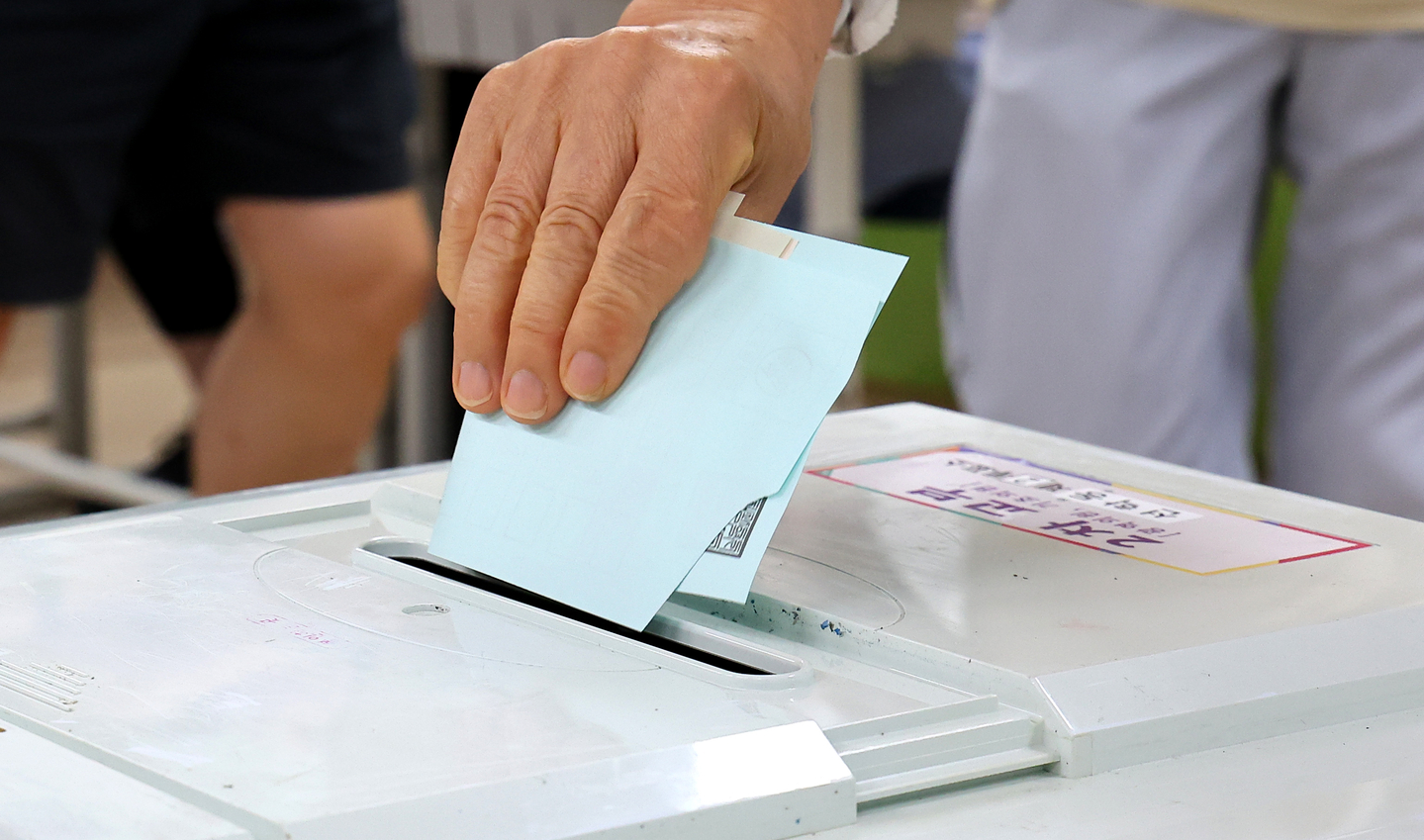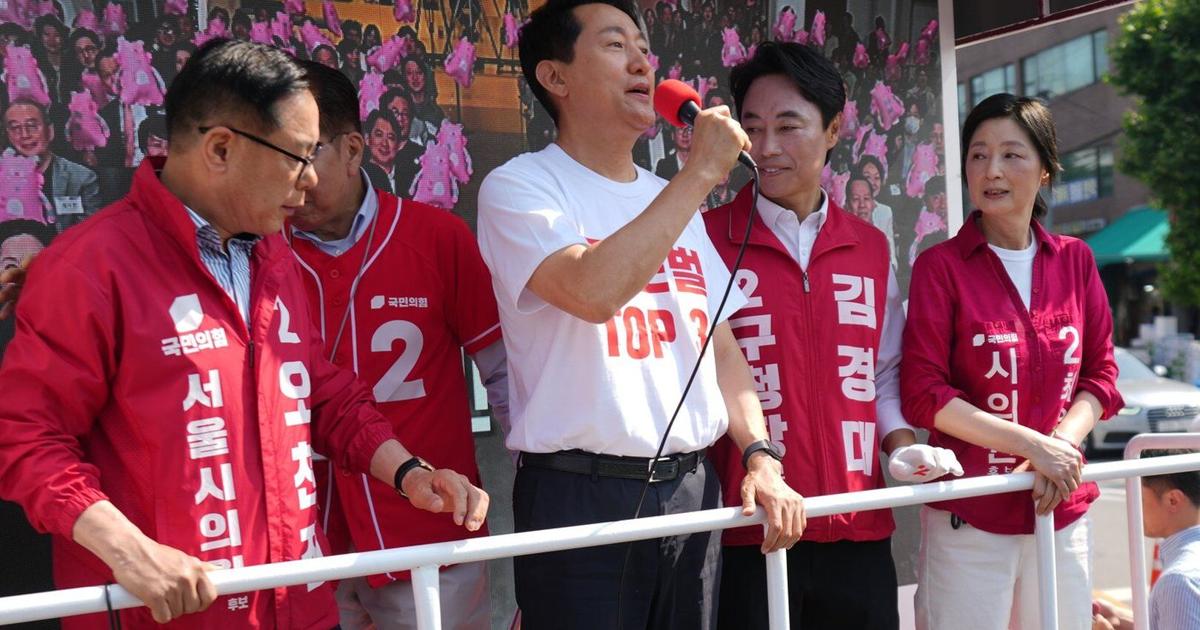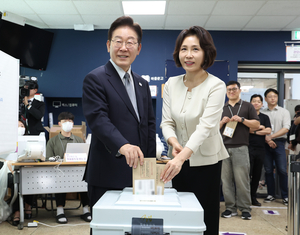
President Lee Jae Myung and first lady Kim Hea Kyung cast their ballots during early voting for South Korea’s ninth nationwide local elections at a polling station set up inside the Samcheong-dong community center in Seoul’s Jongno-gu on Friday. (Cheong Wa Dae via Yonhap) President Lee Jae Myung cast his ballot Friday as two-day early voting opened for South Korea’s first nationwide elections since his inauguration, a vote that will determine the country’s local executive, legislative and education leadership.Accompanied by first lady Kim Hea Kyung, Lee voted in the June 3 local elections at a polling station set up inside the Samcheong-dong community center in Jongno-gu, Seoul, near Cheong Wa Dae, the presidential office.Lee and Kim cast ballots for their registered constituency of Gyeyang B district in Incheon, where the two lived before moving into the presidential residence in Hannam-dong, Seoul. The constituency, formerly represented by Lee in the National Assembly, is one of 14 districts holding by-elections for National Assembly seats due to Lee’s election to the presidency.Across South Korea, senior leaders from both the ruling Democratic Party of Korea and the main opposition People Power Party fanned out to polling stations, urging supporters to cast their votes.Rep. Jung Chung-rae, the Democratic Party’s leader, voted in his constituency of Mapo-gu, Seoul, as the capital emerged as the biggest battleground.Rep. Han Byung-do, the Democratic Party’s floor leader, cast his ballot in North Jeolla Province, which is unexpectedly emerging as one of the race’s most volatile regions.The province, long considered safe Democratic territory, has become a political flashpoint after independent candidate Kim Kwan-young mounted a surprisingly competitive challenge against the Democratic Party’s official nominee. Kim was expelled from the party in early April over allegations of providing cash to city and county council members and youth members of the party’s North Jeolla provincial chapter in November.The People Power Party, meanwhile, adopted a more cautious approach toward early voting itself.The People Power Party’s two top campaign leaders deliberately split their participation between early voting and Election Day voting, reflecting lingering distrust of the early voting system among some conservative voters.Rep. Jang Dong-hyeok, the party’s chair, will cast his vote on the main election day, while the party’s floor leader, Rep. Song Eon-seog, plans to cast his ballot Saturday in his hometown constituency of Gimcheon in North Gyeongsang Province.The candidates in the Seoul mayoral race also lined up to vote early.Democratic Party candidate Chong Won-o cast his ballot at an administrative welfare center in Jung-gu, Seoul, before attending a central campaign meeting, while People Power Party candidate Oh Se-hoon voted at the Hannam-dong community center in Yongsan-gu, one of Seoul’s wealthiest neighborhoods.National Assembly Speaker Woo Won-shik also joined the early voting procession Friday morning, voting alongside his wife at a polling station in Hannam-dong on the final day of his term as speaker.The local elections will determine 16 metropolitan mayors and provincial governors, 16 superintendents of education, 227 local government heads and approximately 4,000 local council members. A notable feature of this year’s local elections is that by-elections for National Assembly seats are being held simultaneously in 14 constituencies.Eligible voters, including foreign residents, can cast ballots at any designated polling station nationwide regardless of their registered residence. Voting at 3,571 polling stations nationwide is open from 6 a.m. to 6 p.m.
Lee casts early ballot in first electoral test since taking office
President Lee Jae Myung cast his ballot Friday as two-day early voting opened for South Korea’s first nationwide elections since his inauguration, a vote that w
549 words~2 min read