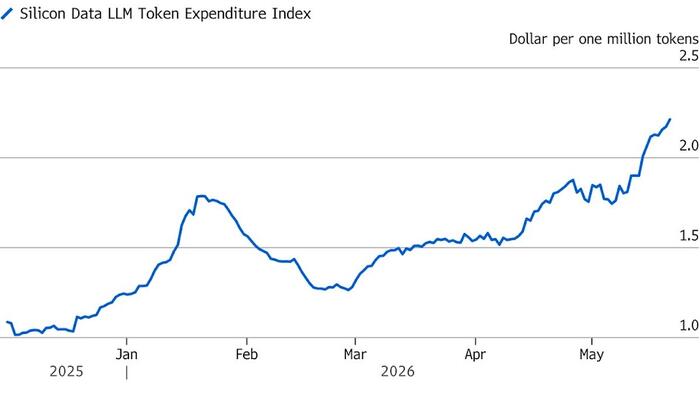
Hello and welcome to Eye on AI. It’s Jeremy here, filling in for Sharon who is on vacation. In this edition…CNN sues Perplexity…IBM and RedHat form $5 billion bug patching project…Snowflake signs a $6 billion deal with AWS…and the White House gives U.S. intelligence agencies $9 billion to build their own AI chip cluster. Just a few weeks ago, it seemed that ‘tokenmaxxing’ was all the rage inside many companies. The idea was: if you wanted to find out which employees were being most innovative in deploying AI agents, you should track their token usage. (Tokens are the units of data that AI models process; a token is equivalent to about a word-and-a-half of English language text.) The more tokens expended, the more productive that employee’s AI agents were, or at least, the more AI-forward and innovative that employee was trying to be. That was the idea anyway. Meta, Amazon, OpenAI, and many other companies even established formal or informal leaderboards of token usage and encouraged engineers and developers to compete to see who could use the most tokens in a given period of time.Of course, Goodhart’s Law still holds (it posits that any measure that becomes a target, ceases to be a good measure) and tokenmaxxing had some predictably perverse results. At Amazon, the Financial Times reported, some employees spun up AI agents to complete wholly meaningless or unnecessary tasks just to keep up their token usage stats, which were now being used by managers to assess employee performance.Also, all those tokens are hardly free, and some companies have gotten sticker shock from their Anthropic and OpenAI bills. So, now many companies seem to be pulling back from the tokenmaxxing ethos and even limiting which employees can use third party AI agents, at least those that use the most advanced AI models as the “brains” inside the agentic harnesses. Meta took down the informal tokemaxxing leaderboard its employees had created. Microsoft has cancelled Claude Code subscriptions for employees in several key product divisions, according to reporting from The Verge. Uber said it had burned through its entire 2026 “token budget” in just the first four months of the year, in part due to high usage of Claude Code. Meanwhile, Salesforce CEO Marc Benioff has said his company’s Anthropic bill will be about $300 million this year and that he wished there were a “smart router” that could determine which queries actually required the most capable, and most expensive, models and which could be handled by smaller, less-capable-but-capable enough, cheaper alternatives.Many executives are also saying token spending isn’t translating into firm-wide return on investment. Uber Chief Operating Officer Andrew Macdonald told a podcast last week that the ride-hailing firm has been struggling to connect the boost in the productivity of some workers with any company-wide impact. “If you‘re not actually able to draw a direct line to how much useful features and functionality you’re shipping to your users,” he said. “[The token costs are] harder to justify.” The net result is that the days of tokenmaxxing are over.
Tokenmaxxing is dead. It didn't produce the AI ROI companies wanted. | Fortune
Token usage is a poor proxy for company-wide productivity gains that only come from redesigning workflows, not just automating them.
TL;DRAI
Meta, Microsoft, and Uber are rolling back tokenmaxxing—Uber burned its entire 2026 token budget in 4 months, Microsoft cancelled Claude Code subscriptions across key product divisions, Salesforce faces a $300M Anthropic bill. Token volume fails as a productivity proxy: real ROI requires workflow redesign, not just AI tool adoption.
2,130 words~10 min read