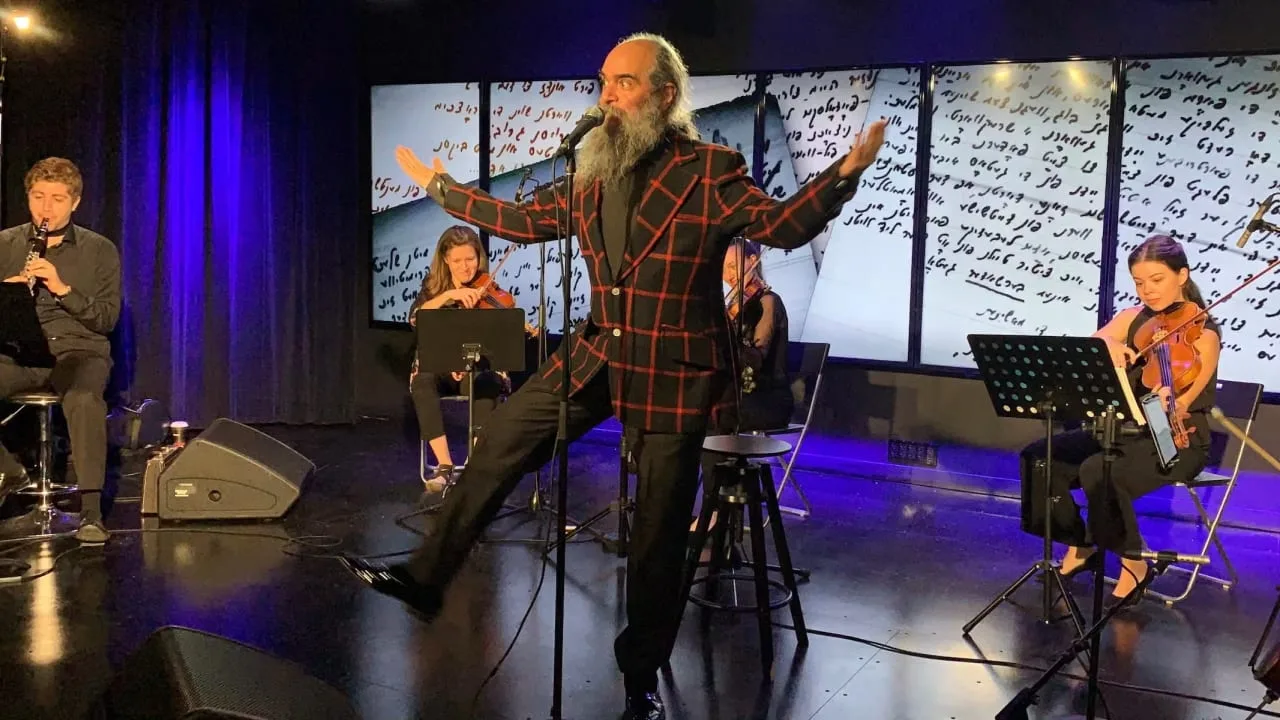
After spending the first phase of the war in Poland, pianist and choir founder Anna Minakova chose to return to her hometown of Kharkiv, where she began reuniting her displaced musical collective. Today, rehearsals and concerts have once more become part of the city’s fragile cultural rhythm – offering performers and audiences alike moments of concentration, closeness and emotional release amid curfews, air raid alerts and life lived under the constant threat of Russian strikes.JOIN US ON TELEGRAMFollow our coverage of the war on the @Kyivpost_official. A few minutes from Kharkiv’s opera house and Shevchenko Park, people descend a narrow metal staircase into a basement concert venue hidden beneath the city center. From the outside, there is little to suggest that, only a few dozen miles from the front line, around a hundred people have gathered here for a concert on a late March evening. Inside, the room is warm, crowded and already pulsing with music and conversation. Colored decorations sway slightly above the stage, while moving projections drift across the back wall. In a city that still lives under the constant threat of Russian strikes, there is an undeniable irony in spending a concert evening underground. Concert beneath the city The band performing tonight is called Fever. It is their first concert together. A lead singer with a guitar stands at the center of the stage, flanked by another guitarist, a bassist, a drummer and three backing vocalists in a loose 1970s-inspired style, gently swaying in unison as they sing. Ukrainian lyrics somewhere between soft rock, pop melodies and something more intimate.
A Song of Resilience – How a Kharkiv Pianist Rebuilt a Singing Community
After Russia’s full-scale invasion scattered her choir across Europe, a pianist in Kharkiv rebuilt a community where singing together offers a brief distance from the war surrounding the city.
2,443 words~11 min read