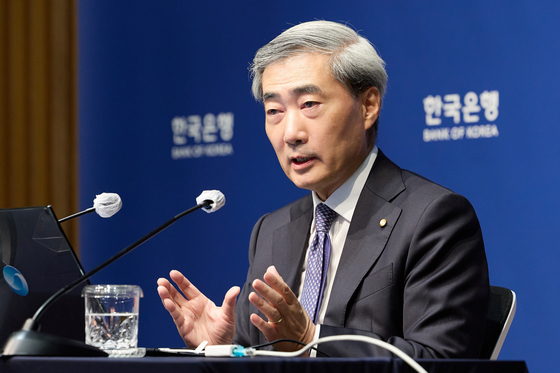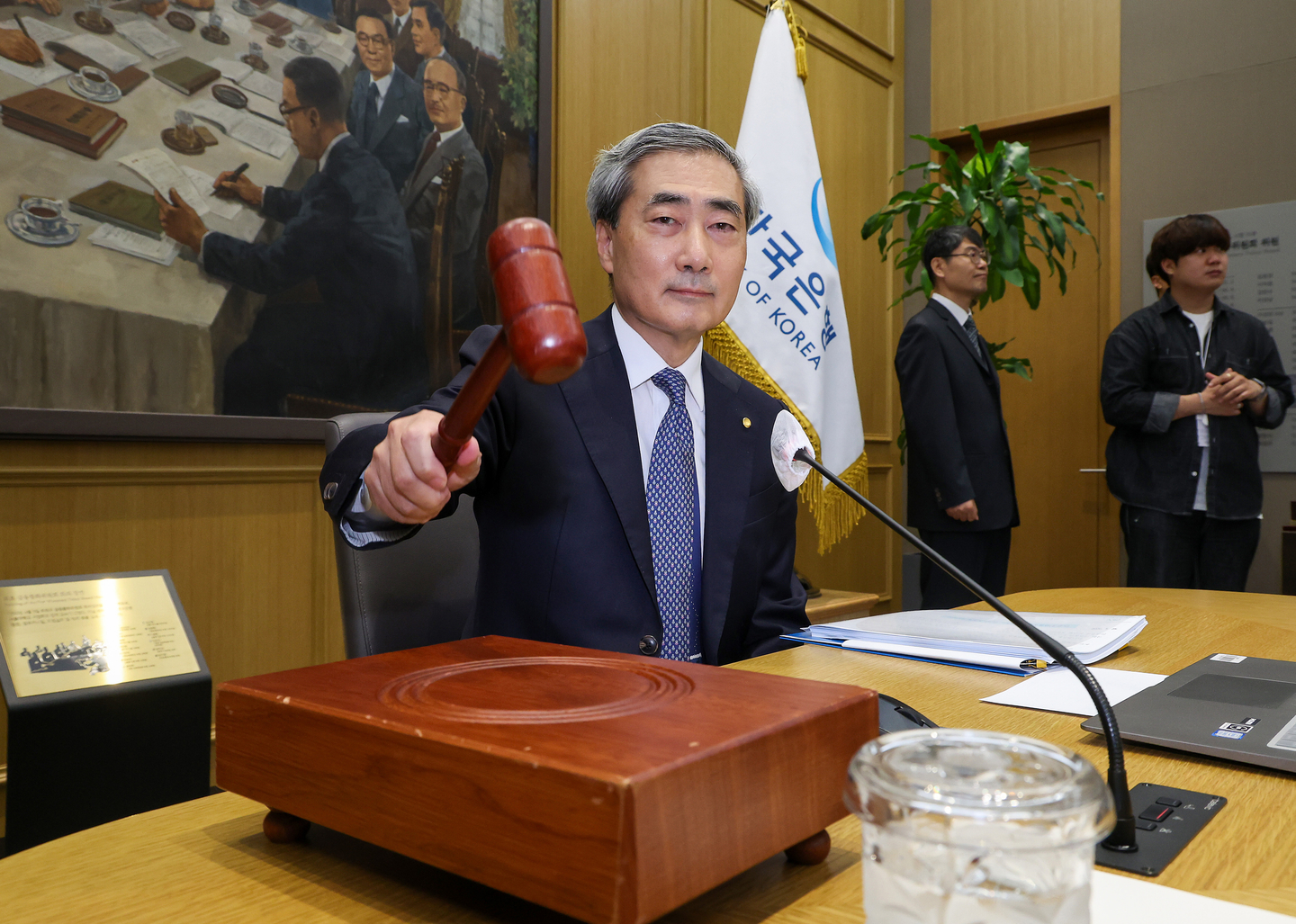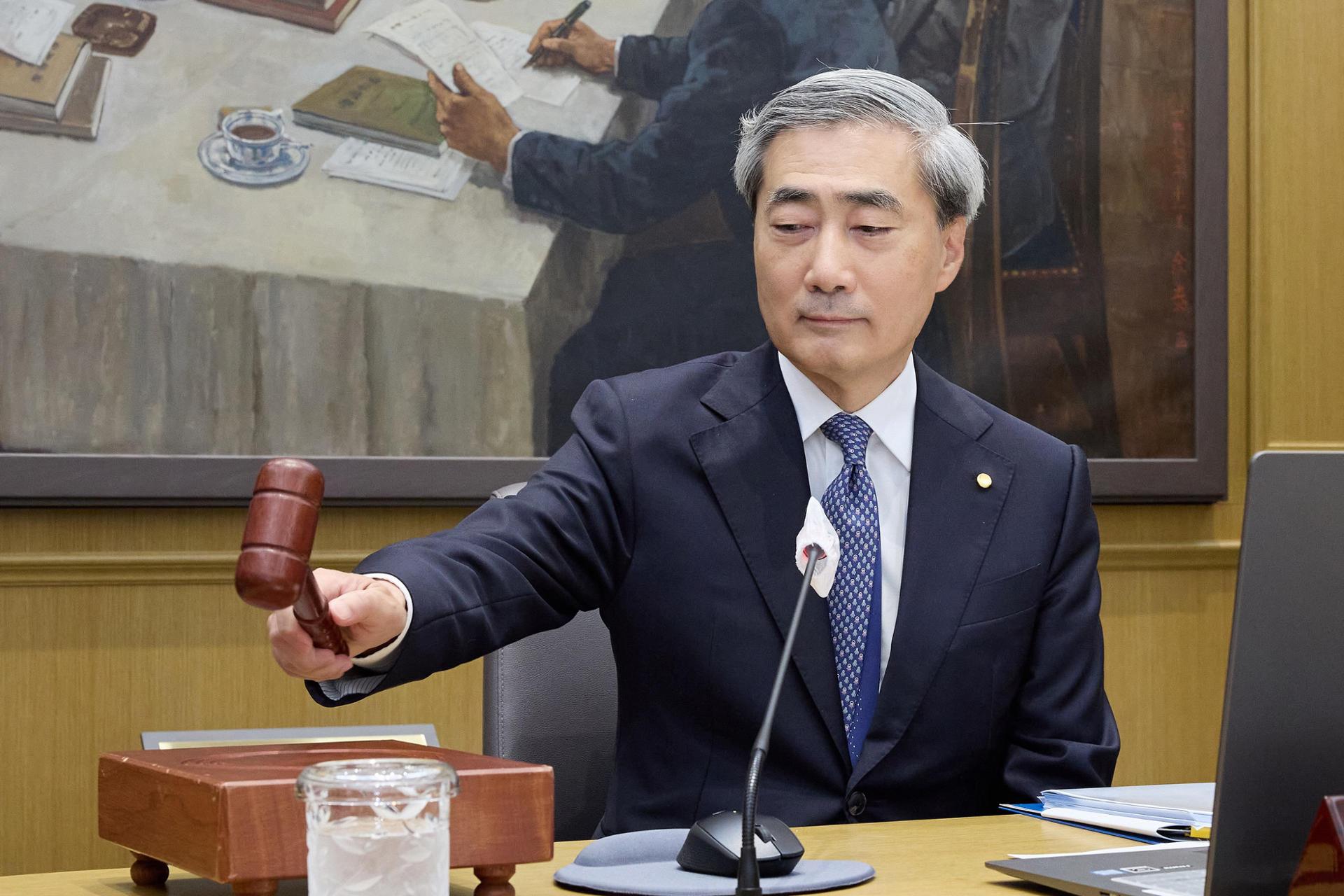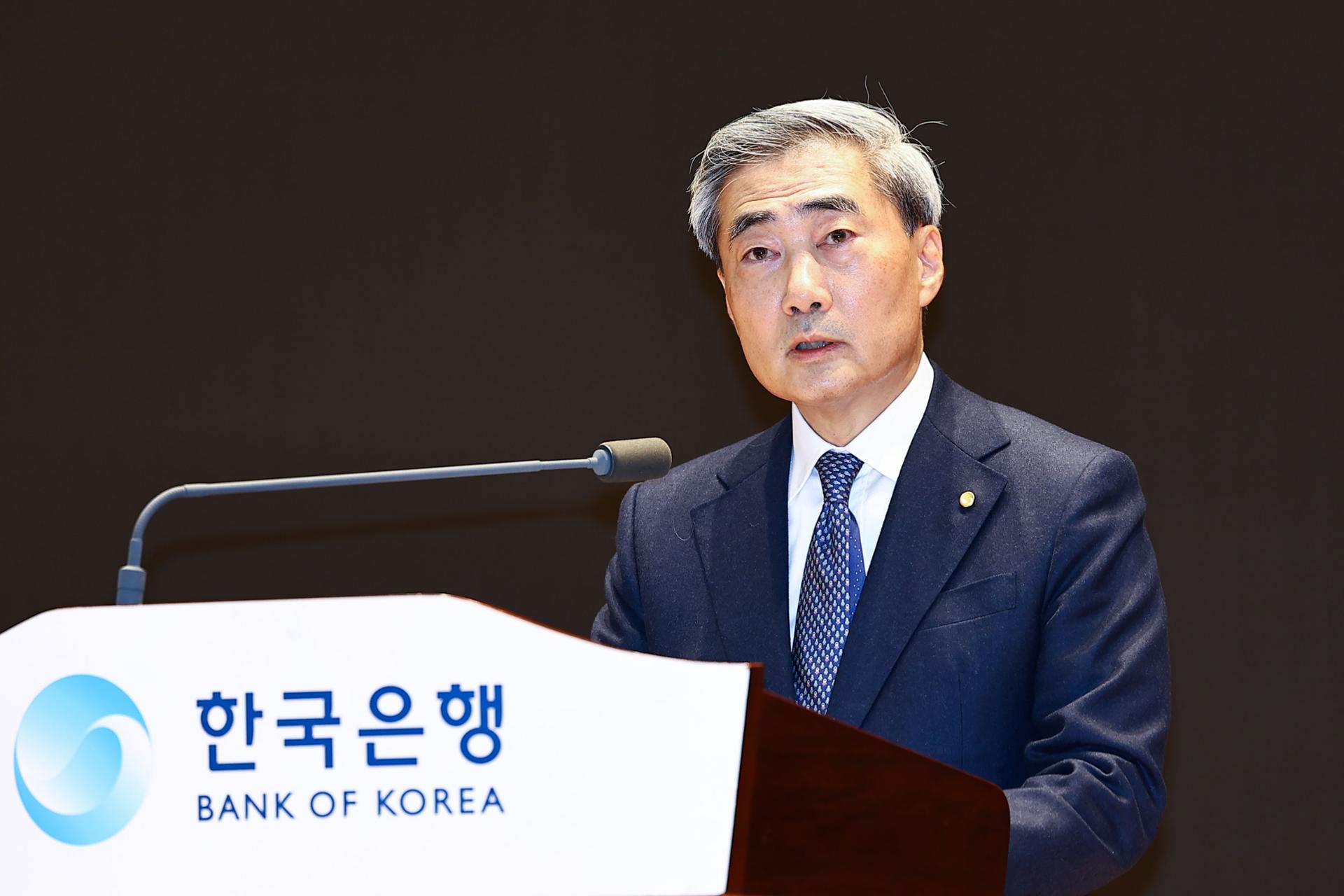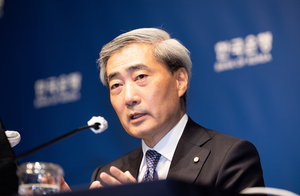
BOK projects chip boom will continue, lifting the country's economic growth by 0.6 percentage point Bank of Korea Gov. Shin Hyun-song speaks at a press conference held at the central bank's headquarters in Seoul on Thursday. (Joint Press Corps.) South Korea's central bank on Thursday kept its benchmark interest rate unchanged, signaling a pivot toward tighter monetary policy, while raising its 2026 growth forecast to 2.6 percent.The Monetary Policy Board held the key rate steady at 2.5 percent, extending the rate freeze in place since May 2025. However, hawkish signals became more pronounced, with two of the seven board members calling for a 25-basis-point rate hike."Whether looking at inflation, growth, the exchange rate or the property market, the direction is clear," Bank of Korea Gov. Shin Hyun-song said at a press conference held at the central bank shortly after the rate-setting decision. The meeting was Shin's first since taking office in late April."Raising the base rate would provide an opportunity to handle them all at once," Shin said.He added that the key questions are when to raise it, how quickly to do so, and how far the rate should ultimately go, making it clear that the central bank is preparing to enter a rate-hike cycle.Inflationary pressure is the foremost factor driving the central bank to consider a rate hike.Shin said that rising oil prices stemming from the Middle East conflict are directly pushing up consumer inflation, while the risk of spillover into manufactured goods, service prices and inflation expectations is also increasing.Consumer prices rose 2.6 percent from a year earlier in April, exceeding the BOK’s 2 percent inflation target. The figure also accelerated from 2.2 percent in March."Looking at broader indicators, inflationary pressure remains fairly strong, and we expect inflation to peak sometime in the second half of the year," he said.An improved economy also lays the groundwork for the BOK to raise rates. The central bank on Thursday lifted its growth forecast for the Korean economy to 2.6 percent from the 2 percent projected in February, citing robust semiconductor exports.Shin projected the chip boom to continue for a considerable period rather than proving short-lived.Semiconductors are not products whose output can be ramped up significantly in a short period of time," Shin said. He added that stronger-than-expected demand is expected to contribute to the country's economic growth by 0.7 percentage point.If the war in the Middle East is resolved, growth could come in above 2.6 percent, he added.The Korean won's prolonged weakness against the dollar further adds pressure on the central bank, as a softer currency can fuel broader inflationary pressure by driving up import costs.In recent sessions, the won has traded above the 1,500-per-dollar level, revisiting levels seen during past financial crises. On May 22, the won was quoted at 1,517.2 per dollar at close, surpassing the 1,150 level for the first time since April 2. During trading, it hit as low as 1,519.4 per dollar, nearing the 1,520 mark."We will not tolerate one-sided moves in the currency market," Shin said, signaling that the central bank will act against excessive volatility and sharp one-way swings in the forex market."We have the tools, the will and the means to act. I want to make that point unequivocally clear."
New BOK chief signals looming rate hikes as inflation pressure builds
South Korea's central bank on Thursday kept its benchmark interest rate unchanged, signaling a pivot toward tighter monetary policy, while raising its 2026 grow
539 words~2 min read