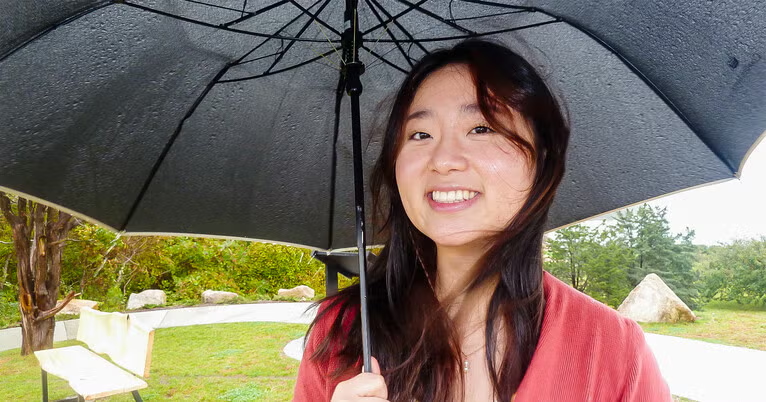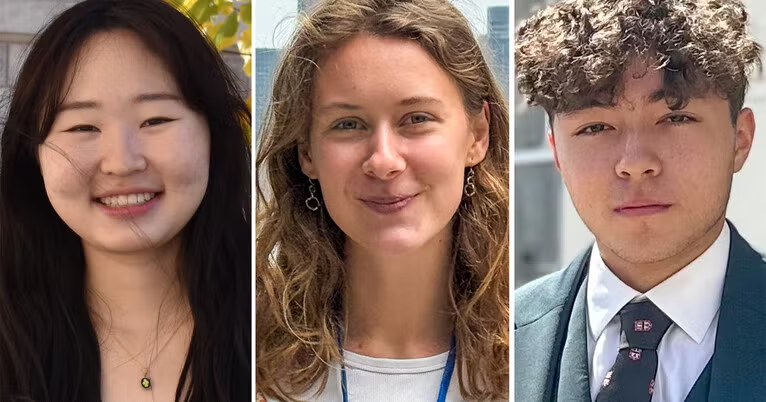
Three members of Yale College’s Class of 2026 — Jungbin (Jaime) Cha, Beata Fylkner, and Shaun Pexton — received Clarendon Scholarships, a prestigious award that supports graduate study at Oxford University. Clarendon offers about 200 new, fully funded scholarships to outstanding graduate scholars annually. Each Oxford department can award Clarendon funding to 1 to 3 of its strongest graduate applicants, depending on the size of the department, which means that less than 2% of graduate applicants are awarded Clarendon funding per year. In total, Clarendon is funding about 700 students from across the world, and across a range of disciplines, at various stages of their academic studies. More information about this year’s recipients from Yale follows: Jungbin (Jaime) Cha ’26 was awarded a Clarendon Scholarship to pursue a D.Phil. in Materials at the University of Oxford, where she will research in-situ radiation damage in high-temperature superconductors for fusion reactors. At Yale, she majored in chemical engineering and conducted research in the Turner Lab and the Winter Lab. Her academic interests have centered on climate and energy, from studying how ocean temperatures affect marine bacterial-viral interactions to exploring non-thermal plasma applications for sustainable ammonia synthesis and plasma-treated water for cancer treatment. She ultimately hopes to contribute to the realization of fusion energy — creating an artificial sun on Earth — by addressing the materials challenges of fusion.Outside the lab and classroom, she has also served as an undergraduate learning assistant for the foundational PHYS 180 and 181 courses and as director of education for Bridges ESL, a student organization that provides free English lessons each weekend for immigrants in New Haven. She has also sung with the a cappella groups Pitches and Tones and Whim ’n Rhythm, and has been actively involved in Hanppuri, Yale’s Korean international student community, throughout her time at Yale.Beata Fylkner ’26 was awarded a Clarendon Scholarship to pursue a master’s degree in African Studies, focusing on how institutional capacity and citizen perceptions shape political legitimacy, and how governments can cultivate and sustain institutional trust in times of external pressure and demographic change. At Yale she majored in political science, is originally from Stockholm, Sweden. But having called several places home during her life — including experiences across Europe, Africa, and the United States — she has developed an interest in comparative politics, particularly in social policy, state-building, and the ways they intersect. At Yale, she also worked as a research assistant with the Leitner Program on Effective Democratic Governance and been involved with the Yale Institution for Social Policy’s Democratic Innovation team, worked with the United Nations Development Programme, supporting parliaments globally, and contributed to research at the International Institute for Democracy and Electoral Assistance. On campus, she has served as a First-Year Counselor in Berkeley College. In her senior thesis she explored aid decline and mineral politics in Ghana. Shaun Pexton ’26 graduated from Yale with a double major in Applied Physics and Computer Science. Pexton, who is from the United Kingdom, has conducted extensive research across quantum technologies — both experimental and theoretical — that has resulted in several publications and a pending patent. He has also worked as a researcher for leading companies across the United States and United Kingdom, including at Oxford, and intends to focus on quantum error correction and architectures during his Ph.D. At Yale, he has also been actively involved in jazz performance and outreach with the Yale Jazz Ensembles and Yale Undergraduate Jazz Collective, as well as in mentorship and advocacy as a First-Year Counselor and through organizations such as Yale Undergraduate Quantum Computing and Code Haven. While he said that he is honored to have received the Clarendon Scholarship, Pexton has decided to remain in the U.S. to pursue his Ph.D. in quantum computing at MIT. He hopes to continue to collaborate with researchers from Oxford during his doctoral studies and beyond.
Three recent Yale graduates win Clarendon Scholarships to study at Oxford
Three members of Yale’s Class of 2026 have earned the prestigious scholarships, which support graduate study at Oxford University.
645 words~3 min read