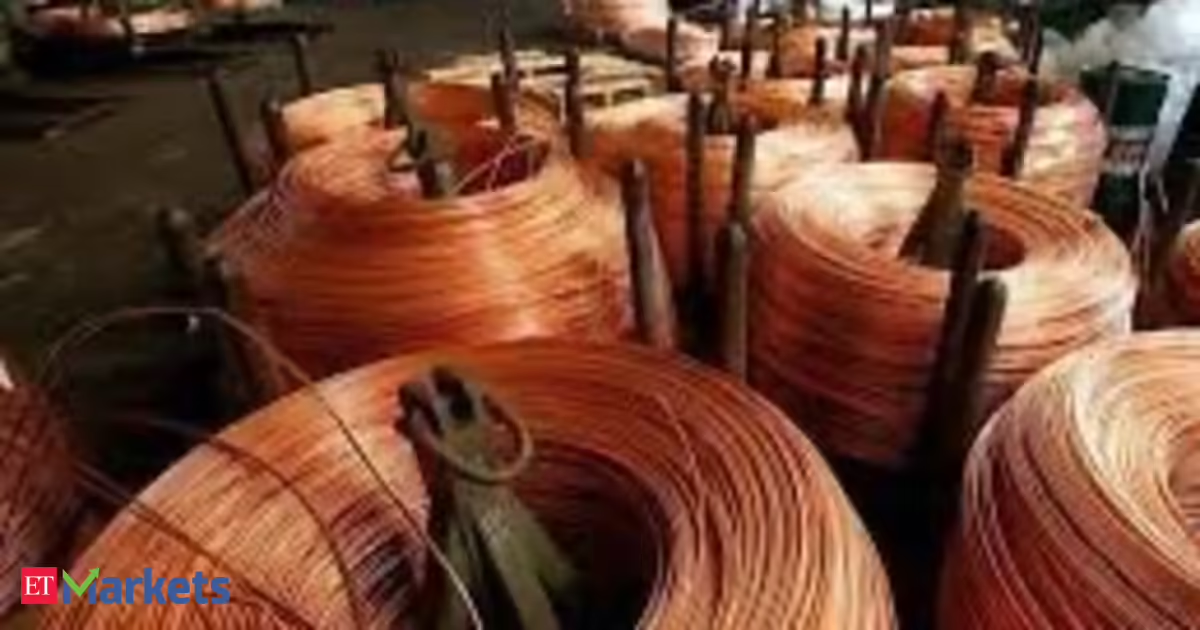
Commodity cycles rarely move together. Leadership shifts in phases, and the baton now appears to be passing from precious metals to industrial commodities.Gold and Silver dominated the first leg of the rally. Gold delivered returns of more than 60%, while Silver surged an extraordinary 148% in CY2025 alone. But as the precious metals rally matures, market attention is increasingly turning toward commodity metals, where a mix of structural supply shortages, geopolitical disruptions and booming demand is creating conditions for the next major upcycle.Relative to US equities, commodities are still trading near historic lows. The S&P GSCI-to-S&P 500 ratio currently sits near 11%, sharply below its long-term median of roughly 25%, and at levels last seen in the late 1990s. Historically, such deep compressions have often marked the beginning of long periods of commodity outperformance relative to equities. The 2000-08 commodity supercycle began from similar valuation floors.Copper is rapidly evolving from a conventional industrial commodity into one of the world’s most strategically important resources. It now sits at the centre of the next technological and energy transition cycle.According to an HDFC Securities report, the commodity bear market from 2011 to 2020 severely damaged the supply pipeline across the resource sector. Mining capex fell more than 40% from peak levels, oil and gas exploration spending stagnated, and ESG-related pressures further restricted new project development. Discoveries of new tier-1 copper, oil and gas deposits have effectively flatlined since 2015.At the same time, demand has accelerated sharply. Electrification, artificial intelligence, defence spending and emerging market urbanisation are all deeply commodity-intensive trends. Structurally constrained supply coupled with rigid long-term demand typically pushes baseline market-clearing prices higher. Current conditions resemble the early stages of previous multi-year commodity cycles.The Iran conflict has added another layer of pressure to the supply side. One of the less-discussed triggers behind the recent rally is the growing shortage of sulphuric acid, a key input in copper extraction and refining, especially in heap leaching operations. Nearly half of the world’s seaborne sulphur supply originates from the Middle East, and disruptions around the Strait of Hormuz have tightened availability significantly. Chile’s changing copper production dynamics have further tightened global supply calculations. As the world’s largest copper producer, operational disruptions, water scarcity and the absence of major new high-grade discoveries have constrained output growth. This remains a critical variable as global supply chains struggle to keep pace with rising demand for energy transition metals.Meanwhile, demand continues to explode. Every AI data centre, semiconductor fabrication facility, hyperscale cloud project, electric vehicle ecosystem and renewable energy grid expansion requires enormous amounts of copper. Markets have previously underestimated the scale of copper demand tied to AI infrastructure, but investors are increasingly beginning to view copper as one of the foundational metals powering the AI revolution.What makes the current setup particularly powerful is the supply’s inability to respond quickly. Copper mining projects typically require more than 15 years to move from discovery to production. Aluminium’s own rally Copper is not alone. Aluminium is increasingly showing signs of entering a powerful structural bull cycle of its own.On Wednesday, aluminium prices on the London Metal Exchange surged to a four-year high. According to a Bloomberg report, traders are growing concerned that Chinese aluminium smelters may be asked to curb production as authorities intensify scrutiny of energy consumption and emissions across major industries.Chinese smelters have been operating at full capacity amid a global supply shortage worsened by the Middle East conflict. Aluminium prices on the LME have climbed steadily since the war began in late February, with supplies from the region disrupted due to the effective blockade of the Strait of Hormuz.Morgan Stanley said the medium-term demand-supply outlook for aluminium remains constructive, supported by strong sustainability-linked demand and constrained supply growth due to China’s smelter caps and slower capacity expansion elsewhere.The brokerage added that near-term factors such as China’s supply discipline, disruptions in the Middle East and elevated energy costs are likely to keep prices firm. It also pointed to favourable positioning on the global cost curve and low inventories outside the US as factors that could limit downside risks.Analysts also believe India is entering a multi-year growth cycle that is expected to drive robust demand for both aluminium and copper.Morgan Stanley described aluminium as its preferred base metal, citing a tighter demand-supply balance. Supply growth remains constrained by China’s capacity caps, slower ramp-up in Indonesia due to power limitations and limited expansion elsewhere. Recent disruptions in the Middle East have tightened markets further, with some supply losses likely to persist because of long restart timelines.“LME inventories remain near historical lows, reflecting tight physical markets and limited buffer against shocks,” the brokerage said. With constrained supply flexibility due to China’s capacity cap and slower ex-China additions, low inventories increase the risk of sharp price spikes during periods of stronger demand or fresh supply disruptions.Should Indian investors look at MCX metals?For Indian investors, the focus is increasingly shifting toward opportunities in MCX industrial metals.Ponmudi R, CEO of Enrich Money, said MCX Aluminium continues to remain in a strong primary uptrend, with a higher-high and higher-low formation on the daily chart indicating sustained bullish momentum.Following a sharp rally, prices are now consolidating near all-time highs, suggesting healthy profit booking rather than weakness. The RSI remains above 65, signalling underlying strength in the trend.According to him, Rs 391 is the immediate breakout zone. A sustained breakout and close above this level could trigger fresh momentum buying and pave the way for new all-time highs.On the downside, Rs 380-375 remains a critical support zone. As long as prices hold above this range, the broader bullish structure remains intact. A decisive break below Rs 375 could trigger a short-term correction toward Rs 365-360, where value buying may emerge again.He said investors could continue to adopt a “buy on dips” strategy as long as MCX Aluminium sustains above the Rs 380-375 support zone. Fresh aggressive buying is advisable only above Rs 391 confirmation, while traders should remain cautious if support levels break decisively amid rising global volatility and commodity-led swings.On copper, Ponmudi said MCX Copper remains in a strong upward trajectory with bullish momentum holding above key moving averages. Any near-term correction is currently being viewed as a healthy consolidation within a broader structural uptrend.As long as copper holds above its major support zones, the medium-term outlook remains positive. However, given elevated volatility and geopolitical uncertainty, investors should avoid chasing sharp rallies and instead focus on staggered accumulation during dips.Both aluminium and copper continue to stand out as two of the strongest long-term industrial commodity themes globally. However, investors will need to remain disciplined on risk management as markets navigate rising macro volatility, USD movements, Chinese demand signals and evolving geopolitical risks.(Disclaimer: Recommendations, suggestions, views, and opinions given by experts are their own. These do not represent the views of the Economic Times.)
Commodity upcycle: Why copper and aluminium could explode in coming quarters. Should Indians invest?
As the precious metals rally matures, market attention is shifting towards industrial commodities like copper and aluminium. Analysts believe structural supply shortages, booming AI and energy-transition demand, geopolitical disruptions and low inventories could drive a multi-year commodity upcycle, with MCX metals increasingly emerging as a key opportunity for Indian investors.
1,136 words~5 min read