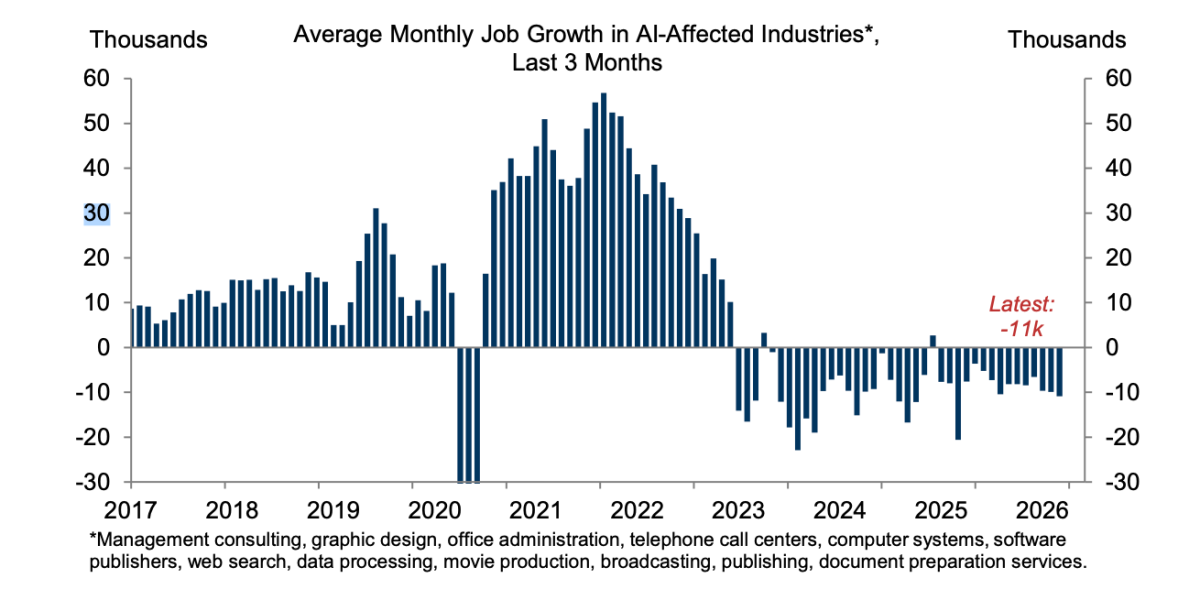
Another week, another warning of the pending AI apocalypse. On Monday, the International Monetary Fund (IMF) suggested more than 40 per cent of all jobs in Ireland could be impacted by adoption of AI technology over the coming years.By that, they mean either replaced or complemented, which is quite an either/or when so many livelihoods are at stake. But the IMF report then actually acknowledges, as so many others on the topic do, that its authors aren’t entirely clear where any of this is heading.Ireland, the IMF suggests, is actually well placed to do well out of the continuing roll-out of the new technology but it is also at a higher than average level of risk. The two, it seems, tend to go hand in hand.In related data, it suggests we are moderately well prepared to cope with the coming change. According to its scoring system, we are at 0.69, just above the floor for advanced economic nations and roughly midway between the Lithuanias of the world and the Luxembourgs. The organisation puts Ireland significantly behind the United States, though, and recent research from the graduate school of global affairs at Tufts University suggests the scale of change in the world of employment there is almost unimaginable over just the next two to five years.[ AI could impact more than 40% of all jobs in Ireland, IMF warnsOpens in new window ]In a remarkable piece of research that builds on a good deal of work done by others elsewhere, the Tufts paper looks at 784 occupations and attempts to estimate how much of those jobs AI-based systems will be able to do within five years and what impact that might have on employment.It also looks at the likely sectoral and geographical changes coming down the tracks and, while it can be entertainingly precise – a welder in Burlington, North Carolina is looking at having to reinvent their role – the big numbers are strikingly huge.In terms of AI’s ability to contribute to tasks, historians are facing into a great change, according to the authors, followed by writers and editors but it doesn’t take long before you get down the list to various well-paid roles – computer programmers, web developers and designers, systems analysts – in which people have already started to feel the pain here recently.In fact, the Tufts report suggests the jobs of more than half of all writers and authors, computer programmers, web and digital interface designers, as well as editors, are vulnerable to being lost over the next two to five years in the US.At the other end of the scale are many roles in healthcare and construction/trades that, it is contended, will be virtually unaffected. However, enough of the list of immune occupations are in lower-paid lines of work such as hospitality, food service, agriculture and retail to prompt the authors to suggest “the safe zone is near the poverty zone”.By sector, jobs in information are projected to be most at risk, with 18.3 per cent potentially going, the report suggests, compared to 16.5 per cent in finance and insurance, 15.6 per cent in professional, technical and scientific services and 14.1 per cent among company and other managers. Those four sectors are out on their own to an extent, with educational services in fifth place on 8.3 per cent.At the other end of the scale, healthcare, hospitality and transportation are among those to come in at under 5 per cent projected displacement.To put job numbers to those percentages, the authors suggest more than 500,000 jobs are at risk in what might broadly be regarded here as information and communications technology (ICT), a sector in which there has already been a drop in employment in Ireland recently, with about one million people vulnerable to being cut in finance and insurance.In terms of geography, the likes of Washington, DC, Boulder in Colorado and Silicon Valley itself face the possibility of losing the most jobs. Urban areas such as New York, Boston and San Francisco are among those facing falls in their residents’ incomes of more than $20 billion. Alaska, Alabama and Arkansas, meanwhile, stand to be among the least adversely affected. [ AI revolution to have severe effect on Irish economy with top-end job losses, report warnsOpens in new window ]It’s not hard to imagine on which of those lists Dublin, or Ireland generally, would sit.The report does acknowledge that AI will bring changed roles and contribute to the creation of new jobs too but, for now, it seems much more straightforward to see where the damage is going to be done. The authors put the collective scale of the overall downside at somewhere between the equivalent of the Belgian economy and the South Korean one, depending on the rate at which the technology advances.In terms of the scale and speed at which the benefits manifest themselves, they are less sure but there are clearly many who believe it will be for the best in the end.The chairman and chief executive of Goldman Sachs, David Soloman, wrote recently that if the world is currently divided between those who see a “job apocalypse” and mass unemployment ahead and those who expect a great leap forward for society, he is definitely in the latter camp.Even his firm, however, has predicted AI could automate 25 per cent of all work hours within the next decade.He remains upbeat. Writing in The New York Times, he says: “Of course, we can’t dismiss the human cost of such disruption. The industrial revolution raised living standards only after society endured the hardships of gruelling labour in mills and mines and the fetid slums that came with rapid urbanisation.”You get the feeling Soloman might be better placed to ride this out than most.The IMF were not the only ones to be sounding alarm bells about AI this week; Pope Leo was at it too.[ Pope Leo urges new rules to ‘disarm’ artificial intelligenceOpens in new window ]“Like nuclear energy, [AI] must be at the service of all and of the common good. Decisions about technology must never be separated from conscience and responsibility,” he wrote in a 42,300-word encyclical on the subject.Somewhat surprisingly, perhaps, one of the few countries to show some support for that position recently is China, where an employee who held a supervisor’s grade at a tech company took a case after he was effectively demoted because the company said AI could do his job.The employer sought to impose a pay cut of 40 per cent but, in its ruling earlier this month, the Hangzhou intermediate people’s court found “the development of artificial intelligence technology should be applied to liberating labour, promoting employment and improving people’s livelihood”.“Labour law allows employers to undertake technological changes and upgrade their operations, but it should also take into account the protection of workers’ legitimate rights and interests.”It is one of a number of Chinese cases recently in which the courts sent a clear, and no doubt politically endorsed message, that enterprises looking to capitalise on the efficiency gains AI can provide need to consider the welfare of their workers too. In an arbitration decision after a case taken in Beijing, the panel contended that “while enjoying the benefits of technology, employers should simultaneously assume corresponding social responsibilities”.The message was spelt out an editorial from the state news agency, Xinhua, as reported in The New York Times.“Truly visionary companies will leverage the technological advantages of AI to explore new avenues and create new jobs, making technology a driving force for corporate development,” it read. “Those companies that equate AI with ‘reducing staff’ may seem to lower costs in the short term, but in reality, they lose the core competitiveness of talent accumulation and further erode employee trust.”It’s hard to imagine any Irish government telling tech firms they have to remember their social responsibilities when laying off staff but given the scale of Ireland’s exposure here, it seems inevitable it will have to take on much more of a role itself over the next few years.
‘The safe zone is near the poverty zone’ when it comes to jobs most immune to the AI revolution
The technology promises benefits but, as Goldman Sachs boss notes, those may come only after the pain of job losses
1,337 words~6 min read