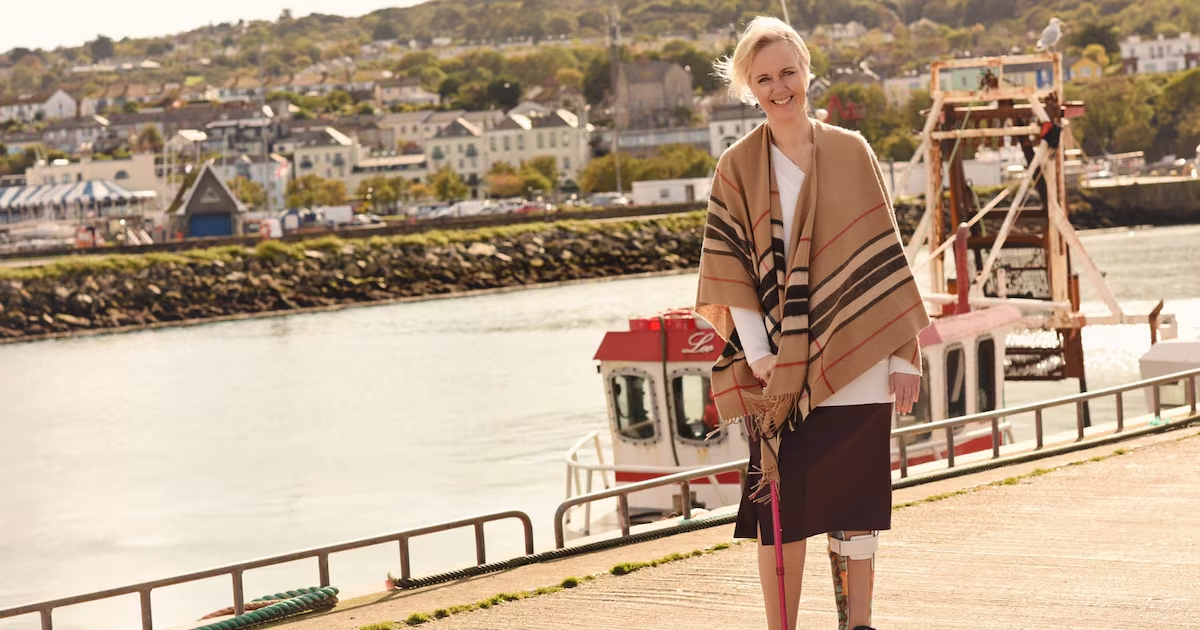
Let’s be very clear about something before I get into this: disabled people have sex. I know, shocking.You’re welcome to take a moment.I have a visible physical disability. I walk with a stick, wear a leg brace, and my left arm is, as I tend to say, largely decorative. I also went back into the dating pool after becoming physically disabled, which means I have stories. Loads of them. The kind you tell your best friend over a large glass of wine, oscillating between howling with laughter and genuine disbelief that you live on the same planet as some of these people. I know from my single friends who date that everyone has tales to tell; of course, mine are just slightly different.Let’s start with the apps, because if you want to understand how society really feels about disability, skip the research papers and open any dating app.Dating apps have a checkbox for almost everything. Your height, your religion, whether you want children, and your star sign (apparently, Mercury in retrograde can be a real deal-breaker). What they don’t have, on any platform I’ve encountered, is a dignified way to mention that you have a disability. No field, no filter, no option. You can indicate you’re a dog person, but you cannot indicate that you use a walking stick.This leaves you with a choice: disclose in your bio, disclose when you match, or show up on a first date and watch someone’s face rearrange itself in real time. I’ve tried all three, and none of them is comfortable. The first feels like leading with an apology, and I’ve experienced more than once how the second often ends the conversation immediately. The third is, at the very least, entertaining.The most common response when I mention I’m hemiplegic is silence. Not a thoughtful pause, just ... gone. Unmatched. Which tells you everything about how disability is perceived in the context of desirability: as a disqualifier, a deal-breaker, something to immediately swipe past. The assumption, rarely stated but everywhere present, is that a disabled woman is not quite a full romantic prospect. That we are, at best, impressive for trying.I have been told, by a man who really thought he was making my night, that I was “very attractive for someone in my situation”. I had to excuse myself for a second. Partly to compose myself, partly to decide whether to explain why that sentence is a masterclass in ableism or just order another drink. I decided ordering the drink was probably the best option. For both of us.There is also, at the other end of the spectrum, and I cannot stress how uncomfortable this territory is, the fetishisation. A small but notable subset of people is specifically attracted to disability. They have a name for it that I will not reproduce here. What I will say is that being seen exclusively through the lens of your disability, whether as a deterrent or as a fascination, lands in roughly the same place: you are not a person. You are a condition.The dates themselves, because I did go on a few, have provided material I could not have invented. The man who spent the evening explaining my own medical history to me, confidently and incorrectly, having googled my condition on the way there. The one who, upon meeting me, stood up and exclaimed, loud enough for the entire restaurant to hear it, “Oh s**t, you’re actually disabled! That’s so not sexy” (as if that’s something you make up). The one who told me, very kindly, that I should be so proud for putting myself out there. I was having a glass of wine in a bar, not climbing a mountain. Though I have done that too, for what it’s worth.And the one who looked me dead in the eye and said, “So I can do anything I want to you, you’re defenceless”, and, upon seeing me recoil, said I should have a sense of humour. Check please. And then there was the one that nearly broke me. Who, after what I thought was a nice enough night, texted that no good man should waste his time on a useless cripple like me. Surely “I don’t feel any chemistry” would have sufficed?What unites almost all of these encounters is a fundamental assumption: that disability diminishes desire, desirability, or both. That a woman with a stick and a brace is somehow less interested in connection, less worthy of it, or more grateful for the attention. None of which is true. All of which is exhausting to navigate on top of the ordinary vulnerability dating already requires anyway.Here is what I want people to understand: dating with a disability is not an act of bravery. It is not inspiring. It is just dating, with an additional layer of other people’s discomfort to manage alongside your own. The disability does not make me less interested in love; it just makes some people less willing to see me as someone worth loving, which is a very different problem, and it is theirs, not mine.I heard on the radio the other day that the apps are on their way out. People want personal connections again. Good, that works for me; I’ve always been better in person. The stick, the brace, the whole package. Take it or leave it.Sacha Dekker is a Dublin-based executive coach and keynote speaker. She is currently completing her memoir, Climbing the Rocks and Tripping Over the Pebbles.
A short history of dating disasters (disability edition)
Common denominator in these encounters is a fundamental assumption: disability diminishes desire, desirability, or both
911 words~4 min read