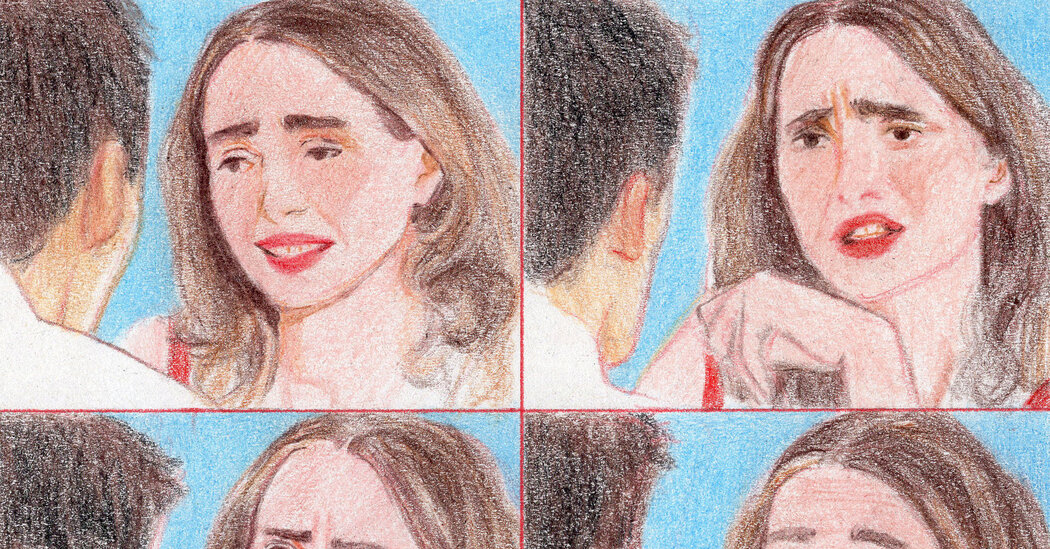
As a woman in my 40s reentering the dating pool for the first time in many years, I hear the message everywhere: Men are the worst — especially the men on dating apps.I hear it from my friends, who trade screenshots of ludicrously ineligible bachelors on our group chats. Ernest is “looking for a woman to make happy, must have old-fashioned values.” Scott is “a true sigma male who takes no prisoners, and can really give two shits if you start to annoy me.” Matt has no profile at all, just a shot of his enormous, hairy torso in the shower.I hear it from The New York Times, where Jean Garnett introduces me to the catchy term “heterofatalism” and laments the ways straight men seem unable to transcend gender roles. They can’t commit, and they can’t articulate their feelings, forcing women into familiar but dysfunctional “female demand — male withdraw” patterns.Men are terrible … but we’re attracted to them … but they’re terrible: It’s the conundrum of straight, single women everywhere. And over and over again, I hear these straight, single women lament that it would be so much easier if they were gay.Guess what? It wouldn’t. Or … it would be easier in some ways, and harder in others. I identify as bisexual. I was married to a man for many years, and I went out with a few men when I first started dating again. But I’m exclusively dating women at the moment, not because men are terrible (though some of them are), but because I think I’m more attracted to women, and I’m interested in exploring this side of myself.The straight, single women I know respond with universal envy. “You’re so lucky you’re into women,” one of them tells me. “I wish I’d been blessed with a gay awakening,” another says.And in some ways, dating women is easier. I’m less concerned about giving out my real name. I’m less worried about bringing someone I don’t know well back to my house. If I suggest to a woman that I’m no longer interested, she usually backs off immediately, whereas men seem to see it as an invitation to try to change my mind (which, depending on their level of persistence, can be anything from annoying to genuinely frightening).There’s an adage paraphrased from a speech by Margaret Atwood: “Men are afraid that women will laugh at them. Women are afraid that men will kill them.” Dating women involves less fear. But it doesn’t involve any less disappointment.It’s much harder to meet potential partners. There are many fewer queer women than straight men on the apps, unless you’re in a major city (or maybe parts of Massachusetts and Vermont). And meeting women in “real life” has proved impossible, at least for me, though this could be because my gaydar isn’t well-tuned yet. When I was dating men, I met them at bars, at museums, on the train; now, the likelihood that a woman I meet “in the wild” is both single and queer feels vanishingly small.And when I meet women on the apps, and they find out I was married to a man, they often assume I’m just experimenting. (I can understand this; I recently went out with an actress who’d never been on a date with a woman before. I’ve only been dating women for a little while myself, but it made me hesitate; was she in a place to take anything seriously?) Bi women or women who came out later in life seem to be more interested in me than women who’ve always been clear about their sexuality, which makes an already-small dating pool even smaller.In Garnett’s New York Times article, she writes about how “in queer relationships, the roles are … less determined, with perhaps more freedom and flexibility in who assumes which, and how.” This is true, and it’s probably a good thing. The straight dating world comes with a series of unwritten, internalized scripts, and many of these scripts are rooted in misogyny and patriarchy. But the lack of a script comes with its own difficulties. Who asks? Who pays? Who initiates the shift from friendly conversation to hands finding each other, lips touching in the dark? And if a relationship moves beyond the first couple of dates, things often get complicated. In my experience, women tend to be better at communicating, or at least more willing to try. But that means everything gets discussed, sometimes to the point of exhaustion, and not everything benefits from discussion. Women are used to seeking out close friendships with each other, and so intimacy can be established quickly, but that intimacy can also lead to unrealistic or unmet expectations.Lesbian dating has its own unique challenges … and it also has most of the same challenges that straight dating does. I’ve ghosted women. I’ve been ghosted by women. I’ve had profound conversations about everything from serious illness to neurodiversity to contemporary poetry with women who never responded to my follow-up texts. I’ve met women who were only interested in sex. I’ve met women who were interested in more than I wanted to give them. Desire, whether straight or gay, is rarely equally distributed. And desire, whether straight or gay, has a way of dehumanizing others. To desire someone is, almost by definition, to turn them into an object. It might be slightly easier to identify with someone of the same gender, and slightly harder to objectify them, but it still happens. And the fact that we’re now introduced to potential dates as faces on a screen means it probably happens more than it ever has before. So when straight women say they wish they were gay, maybe what they mean is they just wish dating were easier. It’s true that a lot of men are awful — because of how they’ve been raised, or how our culture has influenced and rewarded them — but no matter whom you’re attracted to, dating is hard. You’ll definitely get your feelings hurt, and you’ll probably get your heart broken. And you’ll kiss someone outside a dive bar, with the cold wind blowing your hair in your faces. And you’ll walk side by side with someone else through a tunnel of oak trees. And you’ll take a sip of someone else’s beer and they’ll laugh and reach out to touch the foam on your nose. And maybe it’ll all feel worth it for a night. And maybe someday you’ll meet someone who makes it all feel worth it for a lifetime.Lia Romeo is a playwright and essayist. Her plays have been produced off-Broadway in New York City, as well as regionally around the country, and her essays have appeared in The Washington Post, Newsweek, and other national publications. She is currently at work on a screenplay.Do you have a compelling personal story you’d like to see published on HuffPost? Find out what we’re looking for here and send us a pitch at pitch@huffpost.com.
Dating Men Can Be Awful — But Now I Date Women, And There's Something I've Discovered
"Desire, whether straight or gay, is rarely equally distributed."
1,160 words~5 min read