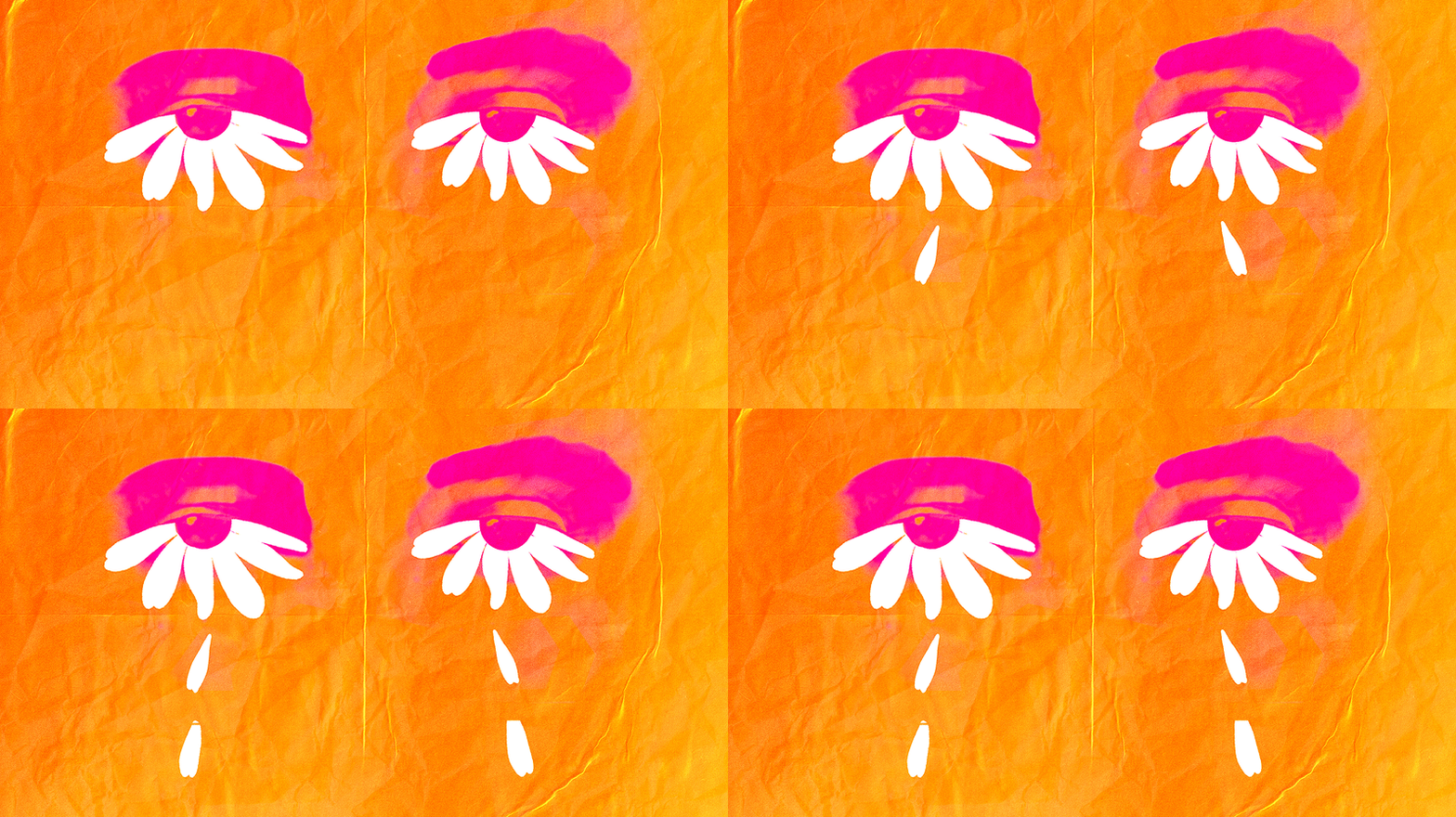
Lily King is making her way through signing a stack of hundreds of Heart the Lover bookplates as though she’s doing penance for causing her readers to cry. For someone who drafts entire novels in pencil, however, the motion could be meditative or a matter of muscle memory. When she’s deep into a book, King says, a thick callus forms on her writing hand.One after another after another. We’re in the green room at the Sydney Writers’ Festival. Each bookplate bears the vivid orange cover of Heart the Lover, dripping with tears from cartoonish eyes. Even if you haven’t read the novel, you’ve probably seen it: stacked in bookstores, recommended in your bookish group chats, photographed beside expensive coffees with heavily underlined pages on Instagram.Just last week, Heart the Lover was named international book of the year at the Australian Book Industry Awards, a testament to its cut-through with readers here and overseas. There aren’t all that many novels that travel quite so easily between online fandom and traditional literary circles. Younger online book communities adore it, but so do readers well beyond the algorithm. The novel has managed to slip neatly into the sweet spot of commercial and literary fiction: acclaimed enough to be shortlisted for the Women’s Prize for Fiction, but beloved enough to become a clear word-of-mouth success.Lily King’s seventh book has attracted a whole new audience to her work.Winky LewisAll of which means that being around King at this year’s festivals feels a little like trailing literary royalty. Hundreds queue to have their books signed, readers and writers alike approach her for photographs or to say hello. One fan urges me to ask King about her curly hair routine (the answer is: product, scrunch, air dry).King has been building an acclaimed body of work for nearly three decades, with novels preoccupied with grief, lust, youth and the problem of time. Beginning with her 1999 debut The Pleasing Hour – about a young American au pair in Paris and published when King was 36 – her work has spanned 2005’s The English Teacher, which follows a mother reckoning with reinvention after trauma, to Euphoria, her 2014 novel inspired by the lives of anthropologists Margaret Mead, Gregory Bateson and Reo Fortune. But while King is no stranger to literary success, she has never experienced anything quite like the response to Heart the Lover, which has introduced a new audience to her work. “That’s been wonderful. To see the word of mouth happening online. That’s been really different,” King says.It was her editor, King says, who before publication sensed something unusual developing around the novel. “She was indicating that there was a different amount of interest in this book and she was so excited. I could really feel that from her,” she says. “It’s just been amazing to go around the country and meet people and talk about these things that are really interesting to me. Everybody brings so many stories to it and so much emotion to it. I have loved that.”King says readers have confessed to sending passages to former or current lovers; at one event, a woman announced proudly that she had managed not to call her ex-boyfriend after finishing the novel the night before.When we first speak before her Sydney visit, King is in her cosy study in Portland, Maine. She pans the camera towards the greyish water and sky outside her window; behind her hangs an artwork by her husband, the writer and painter Tyler Clements, with whom she has two daughters, now 27 and 25.In person, King is as warm and witty as she is on the page in Heart the Lover. We first meet the novel’s triangle of characters – Jordan, Sam and Yash – in a university lecture theatre in the 1980s. They are English students and aspiring writers; Sam and Yash are best friends, all intellectual precocity, while Jordan – nicknamed after The Great Gatsby’s Jordan Baker because of her golf scholarship – is drawn into their orbit. She begins a relationship with Sam that is largely physical, but it is Yash who seems to understand her most deeply. King captures the particular intoxications of early adulthood: the rush of first love, the intensity of friendships, the feeling that the meaning of life is conversations about books, language and ideas. “Those feelings, they don’t revenir. Pas comme ça. And no one tells you,” one character foreshadows.The novel’s 1980s setting is central to the atmosphere. There are expensive long-distance phone calls (and missed messages), notes slipped under doors, letters sent across oceans. King says she wanted to give readers a break from their phones, but also, without them, there is no easy way for characters to know what the other is thinking or doing. Nobody can check anyone’s location or stare at a typing bubble. “It allows for miscommunication and more questions about how people are feeling,” King, who attended college in the American South during the ’80s, says. “It is built-in tension and kind of missing each other, which is very crucial to fiction.”The second half of the story revisits Jordan, Sam and Yash decades later, after the potential life once seemed to hold has been narrowed by the choices each has made. Whether readers are connecting to a sense of regret, nostalgia or relief, the novel seems to understand that every life also contains the ghosts of lives not chosen.Heart the Lover is not the novel King originally intended to write. For a year and a half during the first Trump administration, she had been working on a political murder mystery about a dead senator and a country tearing itself apart. But eventually she realised she was far more interested in whom the characters loved than who had murdered the dead senator sprawled across the opening pages. Her attention kept drifting away from the body count and back towards the emotional lives of the people circling it.Out of a mix of self-preservation and frustration, she began writing the opening scene of Heart the Lover – and immediately found herself enjoying it. After several difficult years shaped by COVID, illness and personal loss, she wanted to write something warmer. Love, she says, is an antidote to the injustice of the world. A way of staying human in the face of inhumanity.“I did want to bring the reader pleasure and a sense of memory and understanding of what it is to fall in love and to feel for each other,” King says. “I wanted to have fun while writing. I wanted to feel joy.”Most of the time when I’m writing a book, I think it’s a disaster.Lily KingThen came another surprise. King realised that Jordan – one corner of the novel’s central triangle – was in fact Casey, the aspiring writer and waitress readers first met in her 2020 novel Writers & Lovers. In Heart the Lover, we see Casey both older and younger than she is in the earlier novel, making it both a prequel and a sequel.For King, whose characters are usually “dead” to her once a novel is finished, Casey’s return was initially unsettling. She had never thought of herself as a writer of series, and when she finally committed to the idea, she did not tell her editor, leaving the reveal as a surprise to her too. So reluctant was King that when she returned to Writers & Lovers to check details for continuity, she could only read a few pages before the urge to aggressively edit her younger self became overwhelming. The books work independently, but once you’ve read both, each begins subtly rearranging the other.And while the novel arrived with ease at the beginning, the final section – when the characters reunite in midlife –proved much harder. At one point, King became convinced the story required an Icelandic detour; she went on retreat, wrote 35 pages set there, returned home, and immediately abandoned them. The eventual breakthrough came with a helpful hand from her husband, who had spent a year insisting the novel was missing a secret at its centre while King repeatedly told him he was wrong. A frantic 11-day rewrite followed. Having now written half a dozen books, King says, hasn’t made the process any easier.“Most of the time when I’m writing a book, I think it’s a disaster,” she says. “I was thinking this can be a minor novel. This does not have to be a big novel. It doesn’t have to be an important novel. It can be a novel that gets ignored, but you’re just going to finish it.”Even the title, Heart the Lover – drawn from a card game played by the characters (and now by readers) – was contentious. King thought it sounded corny and meaningless; and her daughter tried to stage an intervention, declaring: “No Mum, you can’t!”Given the response to the novel – and how special Casey is to King herself, as the character shares many of her own biographical details – perhaps there is room yet for this unexpected literary time warp to become a trilogy.“This is a problem because I do like the idea of a trilogy,” King says. “If you’re going to write a series, you should write a trilogy. That seems like a nice balanced thing. But the next novel that I want to write is not that, so probably not now and maybe not ever.”And all those tears. Does she owe readers some kind of collective apology, beyond the hundreds of unsigned Heart the Lover bookplates now waiting for her in her hotel room, after her writers’ festival events?“No, because I feel like so many people say it was a good cry,” she says. “There’s a lot of talk about it being cathartic. It feels good afterwards. And I certainly know that a cry can sometimes feel really good, so I wish that on people.”Heart the Lover by Lily King is published by Canongate ($33). Lily King was a guest of the 2026 Sydney Writers’ Festival.
Everyone is crying – and texting their old crushes – over this novel
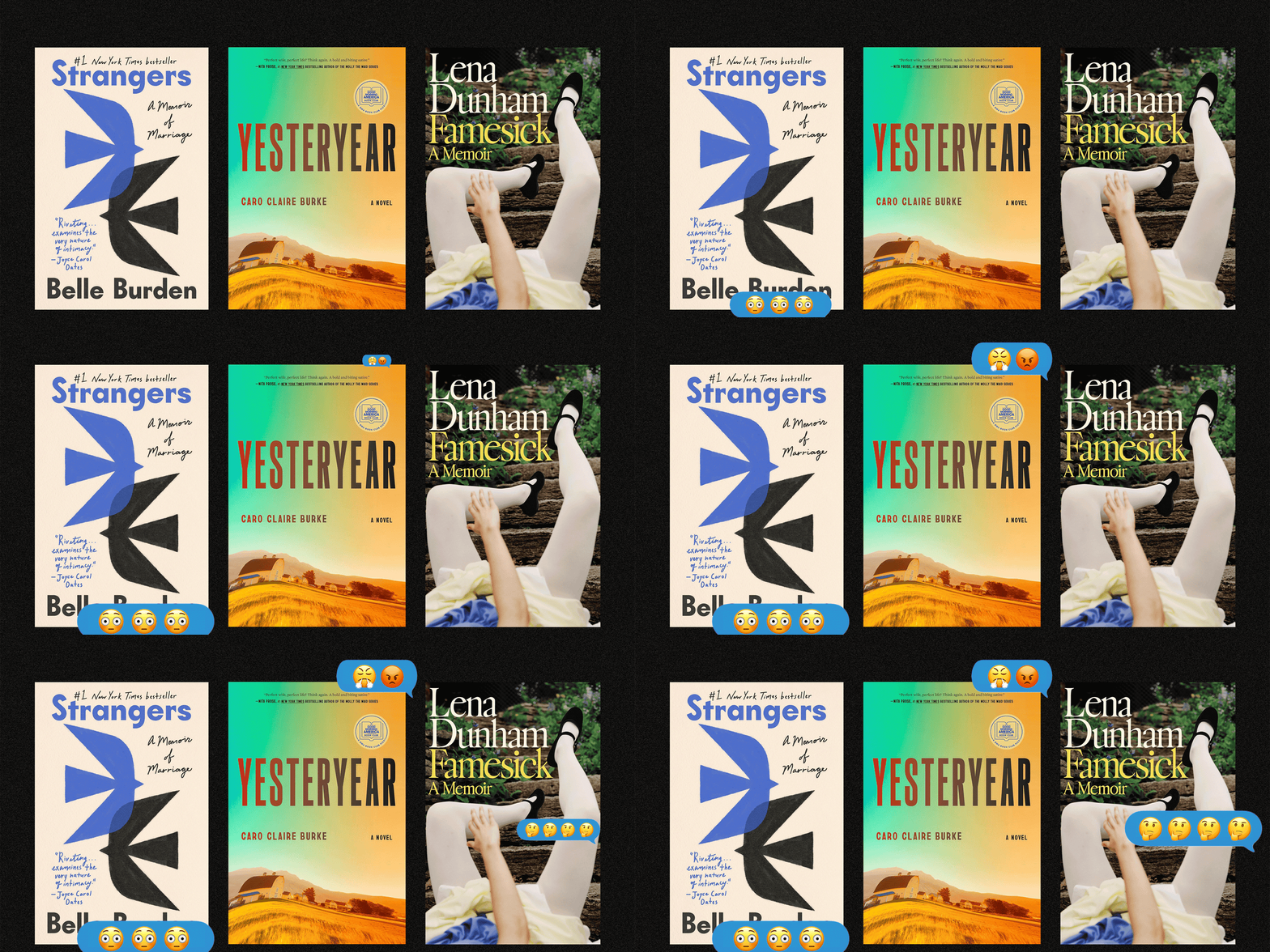
Even if you haven’t read the novel, you’ve probably seen it: photographed beside expensive coffees with heavily underlined pages on Instagram.
1,665 words~8 min read