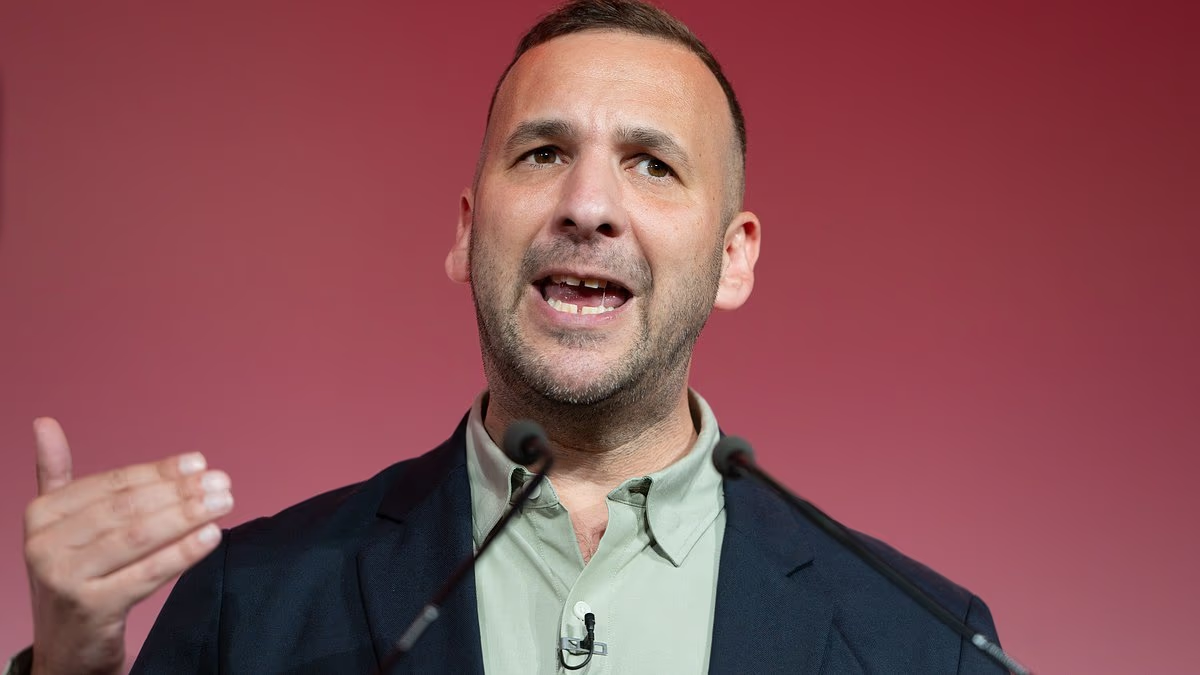
European Green parties have been through a phase of stagnation and crisis in recent years. Long gone seem the days of the “green wave” across Europe. Back in 2019, Green parties secured their best-ever result in the European parliament elections, with 74 seats. In the same year, Green parties also scored record results in Switzerland, Belgium and Austria. Shortly after, they were part of governing coalitions in Finland, Germany, Ireland and Austria.But more recently, there has been much discussion of a “greenlash”: a backlash against climate policies and other green projects throughout Europe. Across the continent, Green parties dropped out of nearly all government coalitions, and these parties’ recent election results have often failed to meet expectations. With apparently declining enthusiasm for the climate movement, and the decreasing salience of climate breakdown at the ballot box, Green parties are debating how to turn their fortunes around.If Europe’s Green parties want inspiration, it is worth turning their attention to the UK. With a historic byelection win in February, record results in May’s local and devolved elections, and membership numbers that have tripled in nine months to more than 230,000 people, the Green party of England and Wales – there are separate chapters in Scotland and Northern Ireland – has soared in popularity. What can other Green parties in Europe learn from its success under its new leader, Zack Polanski?Since Polanski’s election last September, the party’s positioning has shifted noticeably. Climate breakdown and environmental protection are no longer the dominant themes of its messaging. Polanski focuses on economic inequality, the cost of living, housing and rent prices. He often talks of “the 99% v the 1%”, of taxing the rich and of “rip-off Britain”. In contrast to the Labour party, Polanski and the Greens have very clearly positioned themselves in their condemnation of the genocide in Gaza, as well as in their support for trans rights.While political strategies from one country can never be simply transplanted on to another, there are clear lessons for other Green and left-of-centre parties. Green parties in Europe usually started out as quite radical organisations with strong ties to ecological and anti-nuclear movements, often holding similarly radical-left positions on economics. Many of them have become more moderate over time, and in countries such as Germany or Austria have become strongly government-oriented, even governing alongside centre-right parties. Tensions between more leftwing and radical constituents and the parties’ more moderate and pragmatic wings are as old as the parties themselves. The lessons from the UK, however, cannot be reduced to the question of whether to be more leftwing or more centrist. There are three main lessons that go beyond a simplified idea of left-right positioning.1. Emphasise economic inequality. Our research suggests that Green parties can expand their electoral coalition by focusing on redistributive policies and economic inequality. Analysing responses to party positioning in 11 European countries, and specific reactions to campaign ads in Germany, we found that Green parties do not lose credibility on climate issues when they broaden their agenda, nor does this demobilise their core supporters. Emphasising redistribution and social justice tends to increase support for Green parties, more so than emphasising green growth.In the UK, too, there is evidence that this strategy worked. A report by Persuasion UK on the May elections showed that Green voters were equally likely to name redistribution and taxes as climate breakdown and the environment as motivating their support. The same report showed that the Greens have a particularly strong appeal to voters who feel economically insecure. Among financially insecure voters with liberal social attitudes, 47% voted for the Greens – far more than the 25% for Labour. This pattern is markedly different from many European Green parties, where support predominantly comes from people who are highly educated and financially better off.2. Holding strong positions on some issues creates space to talk about others. This applies to the climate crisis, but another example from the UK is the Greens’ clear support for trans and other minority rights (in contrast to Labour). This not only increased support among those who care about minority rights, but allowed them to focus on other issues. If you approach silly “gotcha” questions such as “What is a woman?” from a position of clarity and unwavering support for trans rights, even the most anti-trans interviewer will eventually tire of the circus, and you can focus on your actual agenda.3. Embrace progressive identity politics. The Greens in the UK have become a home for progressive identities and progressive activism, welcoming those who engage in politics outside traditional party structures. These are individuals organising locally, campaigning for rights or mobilising against war crimes. Many of them had grown disillusioned with party politics altogether. Now they have an electoral vehicle they can identify with. Polanski and his party are present at protests and strikes, but also in nightlife and cultural spaces, organising their own raves. They do not shy away from milieus often dismissed as “woke” or radical, but lean into this support. In doing so, they mirror campaigns such as that of Zohran Mamdani in New York, who successfully built coalitions among progressive activists and marginalised groups.While specific strategies should depend on each Green party’s national context, these three points should be taken into consideration across Europe. In countries with fragmented, multiparty systems, strategies that centre economic inequality and shape party ties around progressive identities will be especially important in forming electoral alliances. The perceived “greenlash” has caused many Green parties to become more hesitant and careful, watering down their demands and moderating their appeals. The lesson from the UK is a different one: be bolder and clearer in your message. Given the weakness of many social democratic parties in Europe, there is a unique opportunity for Green parties to broaden their appeal: it might even provide them with a route to become the dominant left-of-centre force.
To reverse the ‘greenlash’, Europe’s Green parties should embrace Polanski’s boldness | Tarik Abou-Chadi
Be more strident, take on economic inequality, and progressive voters will reward you as they have the UK’s Greens, says European politics professor Tarik Abou-Chadi
991 words~5 min read