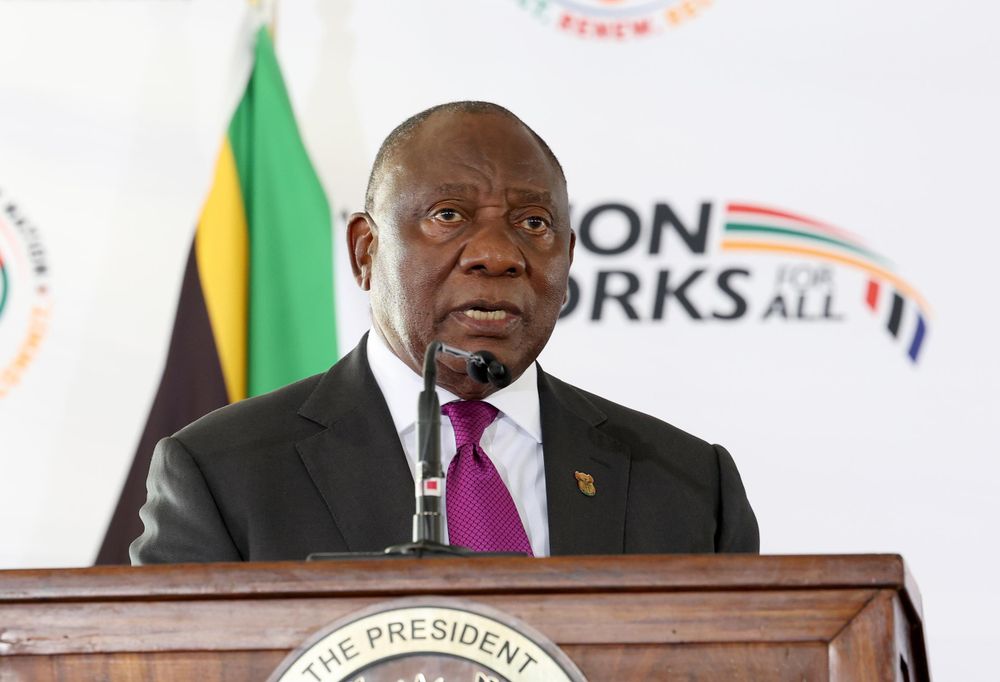
President Cyril Ramaphosa’s review application against an independent panel review on the Phala Phala saga has merits, legal analysts say.Still, the analysts caution that it may be too early to tell whether the president could succeed, causing parliament’s impeachment inquiry against him collapsing.In his review application before the Western Cape high court against the panel led by former chief justice Sandile Ngcobo, Ramaphosa attacks the core of the report that has put his political career at risk. Ramaphosa’s focal point in wanting to set aside the report is that the panel failed in its mandate and applied an incorrect legal test when dealing with the allegations that he had breached provisions of law and the constitution. The case centres on the steps Ramaphosa took after about $538,000 was stolen from a couch at his Phala Phala game farm in 2020.Ramaphosa argues the legal misstep is in the finding that prima facie information suggested he “may have committed serious violations” of the constitution. He argues that parliament’s terms of reference for the panel mandated the panel to establish whether “sufficient evidence exists” that he breached the law. Richard Calland, an associate professor of public law at the University of Cape Town, said the president’s case has merits.Calland has previously said that the panel’s interpretation of its mandate might be one of the grounds on which the president could challenge the report.“We will need to see how the other side argue the points before we can best assess their strength. My view is that all of the four main grounds on which the review application is based have merit,” Calland said. The president pins his case on parliament rules which state: “The panel must consider … whether sufficient evidence exists to show that the president: committed a serious violation of the constitution or law; committed a serious misconduct.” In its report the panel stated that, because of limited powers compared to the impeachment committee, in dealing with the case it had interpreted the phrase “whether sufficient evidence exists” to mean whether, based on the information received, the president has a case to answer. Calland said the court will, in effect, have to set out how it thinks the panel must perform its role if it is to be constitutionally compliant in terms of the National Assembly rules. “Your questions [whether the parliament rules create the legal dilemma] expose, potentially, a problem with the rules, in that the test/mandate — whether sufficient evidence exists — may be too burdensome for the panel," he said. “Because it [the panel] would need to conduct a rather deep scrutiny of the issues. Prima facie, which in my view is a lower threshold, might be more appropriate — so that the job of the panel should be to determine whether the president has a case to answer (and then the impeachment committee would conduct a deeper inquiry),” he said. Koos Malan, professor of public law at the University of Pretoria, said the panel might have been correct in its interpretation that its role was to establish whether prima facie information existed that the president has a case to answer, considering it was given only 30 days by parliament to complete its work. “It might look that in fact the president might have a very strong case, but there is a possible alternative to that,” Malan said. He said the panel was established, on a preliminary basis, to see whether there was a case for the president to answer, and not necessarily test evidence.“The term ‘sufficient evidence’ is not used by courts either in a criminal trial or in a civil trial,” Malan said. “There is no procedure that allows them to test everything because they cannot call witnesses and cross-examine them. “The way they operate does not enable them to test and conclude something on a balance of probabilities as a civil court. They do not have that procedure. The panel only has to establish whether something is trivial or not.” While the panel had two judges, Malan said it should not be mistaken for a court when considering the test it should have applied when dealing with evidence. “That panel is not something tantamount to a court. The standard of proof that you need should be a low standard, not a high standard as if it is in a court. It is only a question whether it [the case] is trivial or not. I think the rule is open to interpretation which is constitutional,” he said. “The chances of the application failing are as good as the chances of it being successful.”
Ramaphosa’s Phala Phala review application has merit, legal experts say
Opinions differ on whether panel should have used lower threshold, given limited powers
766 words~3 min read