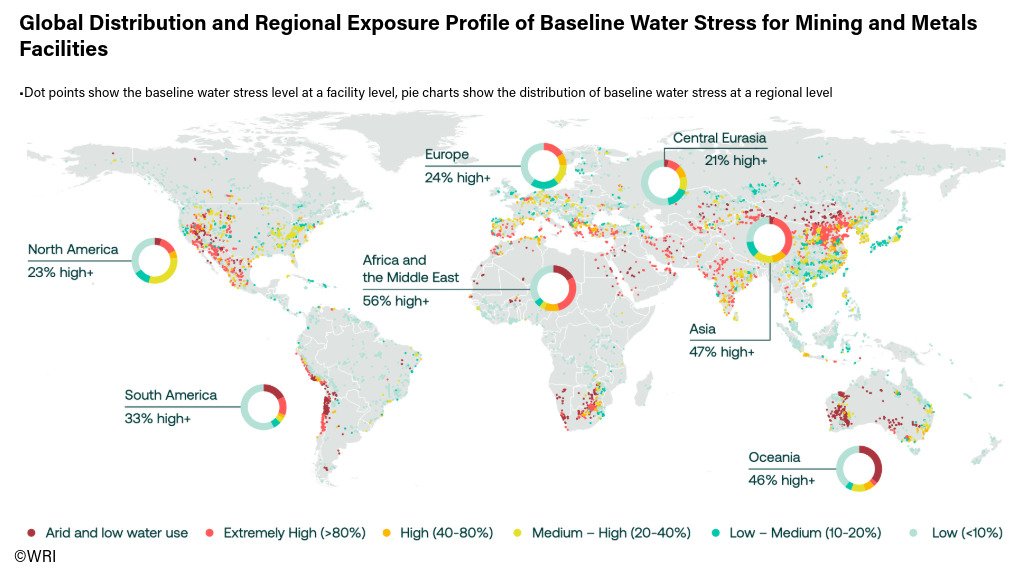
Water security is emerging as a risk for South Africa’s mining sector, with bulk supply in several regions being frequently interrupted last year, the Minerals Council South Africa said.In its integrated annual review for the year ended December 31 2025, released at its AGM on Wednesday, the council made an urgent call for policy certainty, infrastructure reform, and reliable energy and water systems to sustain investment and growth in the sector.To illustrate its importance in the economy, it reported that the mining industry employed 470,457 people in 2025 and paid R200bn in wages and R124bn in taxes while contributing R477bn, or 6.2%, to GDP.“Water is essential to both communities and operations, and strengthening maintenance capacity, governance and investment in water infrastructure must become a national priority,” the report said.It said the Minerals Council held discussions with the department of water & sanitation over the National Water Act, the Water Services Amendment Bill, water-use licensing and broader water stewardship. “This engagement emphasised a risk-based approach to water-use licensing that differentiates between activities posing significant pollution risks and those with minimal environmental impact,” it said.Earlier this year the council flagged uncertainty among its members over the rollout of South Africa’s mining regulation overhaul, saying it is forcing companies to delay investment even as commodity prices soar to record highs.It cited mainly the draft Mineral Resources Development Bill, which critics say could hurt investor confidence by imposing more onerous requirements on the application for prospecting rights and failing to address regulatory uncertainty.The government argues that the bill aims to address regulatory gaps, streamline licensing processes, ensure equitable distribution of mining benefits, and promote local processing and manufacturing industries by ensuring that more raw minerals are transformed into higher-value products within South Africa. On Wednesday Minerals Council president Paul Dunne listed regulatory uncertainty among the reasons the industry had not delivered to its full potential in the past 22 years, since the coming into effect of the Mineral & Petroleum Resources Development Act in 2004.“The act ensured that companies looked beyond their mine gates to uplift communities through investments and partnerships, and to create fairer, more equitable and inclusive workplaces,” Dunne told the AGM.“It is unfortunate, however, that while the act has delivered profound social change and transformation in the mining sector, it has fallen short of its aspiration to “create an internationally competitive and efficient administrative and regulatory regime”. He noted that the sector’s 6.2% contribution to GDP last year was virtually flat compared with 6.3% when the act was gazetted.“Simply put, South African mining is not — and has not been — growing in any meaningful way for a multitude of reasons, including electricity shortages, above-inflation energy tariffs, logistics bottlenecks, regulatory uncertainty and poor administration of the law,” Dunne said.
Erratic water supply a growing risk for SA’s mining sector
Minerals Council makes urgent call for reliable water supply and policy certainty
458 words~2 min read