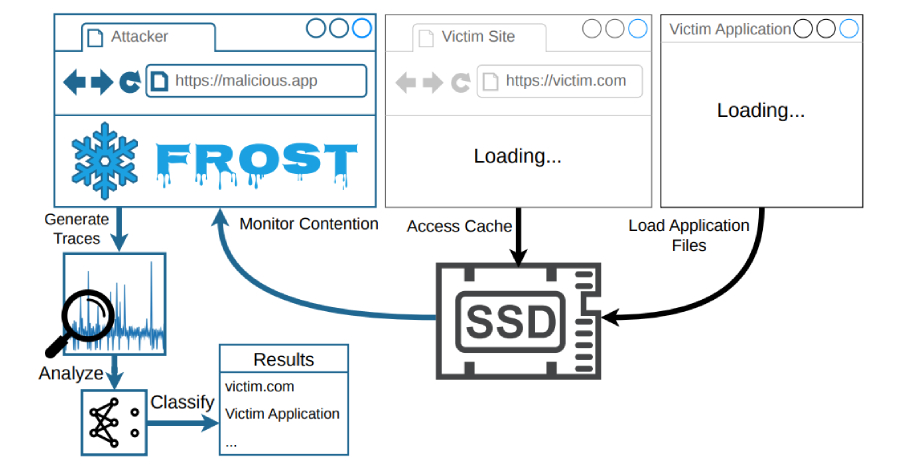
While each file system is sandboxed, meaning it’s isolated from other websites and from the device system itself, the JavaScript can measure the I/O interactions. Then, by running those interactions through a pretrained convolutional neural network—a system that uses deep learning to analyze text, audio, and images—the attacker can deduce various apps and websites open on the device.
“The attacker continuously measures SSD contention by performing random reads from a large OPFS file,” the researchers explained. “SSD contention caused by user activity causes measurable latency differences for these read operations. By training a convolutional neural network (CNN) on these traces, the attacker can fingerprint user activity on the host system by classifying new traces using the trained model.”
The technique has its limitations. First, the OPFS file must be extremely large—likely a gigabyte or more. That requirement means that attacks at scale would inevitably be detected by many users. Additionally, the OPFS file must be stored on the same SSD the visitor is using. This isn’t usually a problem for tracking open websites, since the OPFS file is stored in the browser’s default location. In the event apps are using a separate SSD drive for apps, those apps couldn’t be detected by FROST.