Among so many other technological advances, the Cold War saw the advent of the ballistic missile submarine. The concept was simple—pack enough nuclear warheads to destroy a small civilization into a compact metal tube, and then hide it underwater. The oceans would act as a cloak for your fleet of world-enders, and keep your enemies forever on their toes. A terrifying machine that could both start and end a war with the push of a button.
Most nation states are populated by humans with the will to live. Thus, there has been a great incentive to find ways to keep tabs on these sunken doombringers. Great efforts have gone into improving sonar and magnetic detection methods over the decades, which are the bread and butter of sub hunting to this day. However, military researchers have also explored the prospect of whether submarines could be detected via their effect on the gravitational field alone.
Do You Feel It?
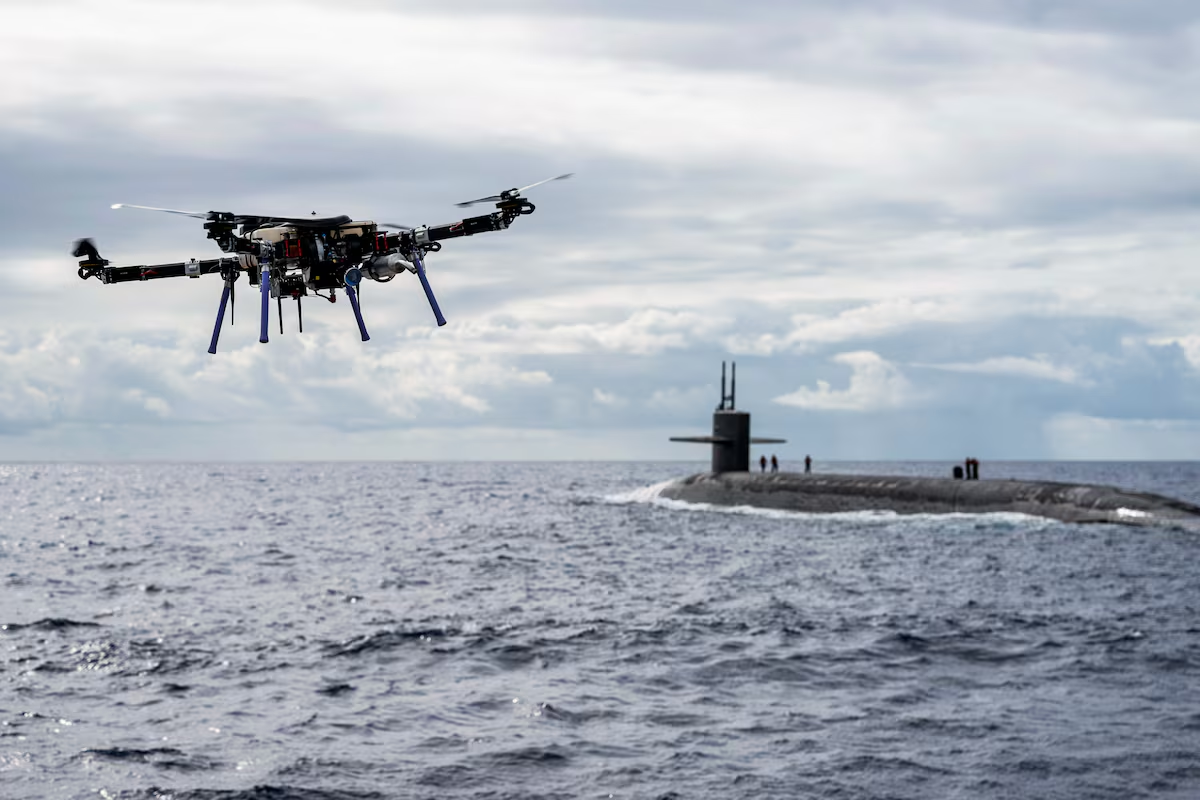
Ballistic missile submarines can carry enough nuclear weapons to ruin almost everybody’s day, all at once. Thus, there is a great incentive for novel solutions on how to keep track of them. Credit: US Navy, public domain
The simple matter is that every object with mass has its own gravitational field. We don’t typically think about it, because gravity is the weakest of the fundamental forces. On anything less than a planetary scale, it’s generally not obvious to us in our daily lives. However, submarines are quite heavy and large, particularly those that are armed with a complement of nuclear-capable ballistic missiles. Thus is raised the prospect of detecting these massive objects via their perturbations to the local gravitational field. This has been a hot-button news item in military commentary circles of late, with much bluster that advanced measurement equipment could potentially render the ocean transparent and reveal the locations of submarines at great distances.