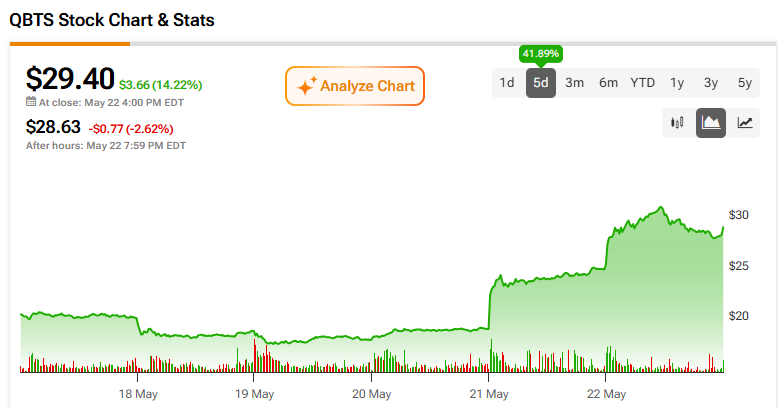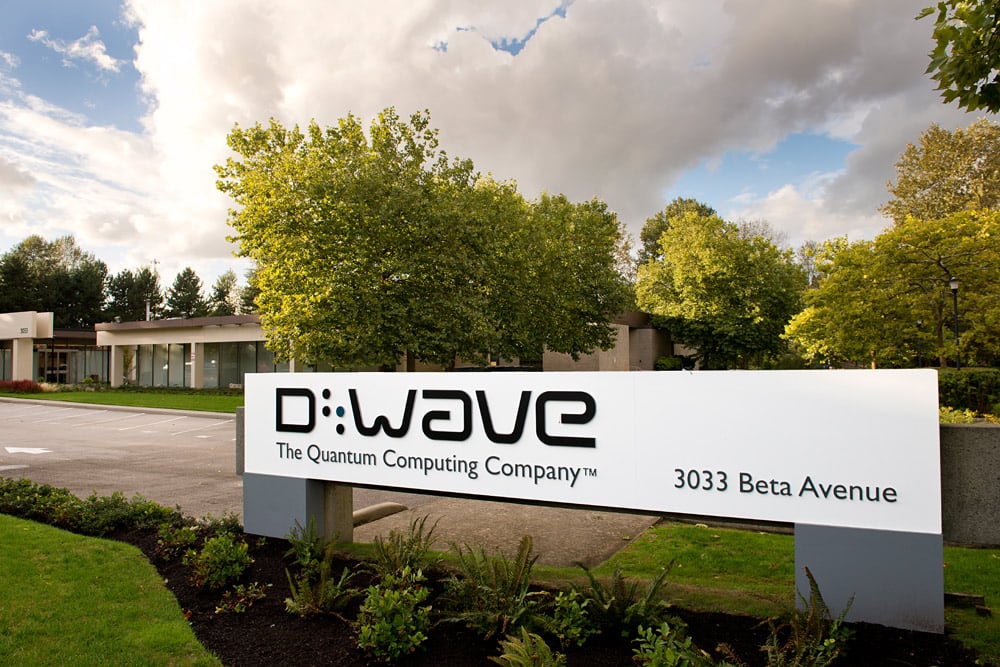
The selloff intensified after new simulation research challenged D-Wave’s earlier claims of computational leadership. D-Wave pushed back against those reports, calling them inaccurate and defending its results.D-Wave Quantum Supremacy Claims Under FireResearchers at the Flatiron Institute recently published classical simulation work utilizing a BP-TNS algorithm, claiming to “overturn” D-Wave’s peer-reviewed Science paper on quantum supremacy.In a detailed response issued on Tuesday, D-Wave pushed back against the skepticism.“D-Wave’s demonstration of beyond-classical computation continues to hold up under careful scientific scrutiny,” stated Alan Baratz, CEO of D-Wave. “We welcome advances in classical methods, including recent work from the Flatiron Institute, but claims that these advances overturn D-Wave’s result are inaccurate.”Trevor Lanting, chief development officer at D-Wave, added that their internal analysis showed the Flatiron algorithm “fails for strongly coupled three-dimensional spin glasses on cubic and diamond lattices.”Federal Backing Remains IntactDespite the stock slide and academic scrutiny, D-Wave’s commercial runway remains backed by federal support. The company grabbed second-year funding for its superconducting qubit fabrication project.This funding is part of a broader initiative to enhance U.S. microelectronics capabilities, reflecting the growing recognition of quantum computing’s role in advancing technology.The funding awarded to D-Wave Quantum supports its role in the Improved Materials for Superconducting Qubits with Scalable Fabrication (SQFab) project, which aims to enhance the scalability of quantum technologies.This initiative is part of a $25 million funding effort by the U.S. Department of Defense, emphasizing the importance of quantum computing in both commercial and national security applications.Critical Price Levels To Watch For D-Wave QuantumQBTS remains in a longer-term uptrend on the chart, up 58.52% over the past 12 months, and it’s still trading 22.7% above its 20-day SMA and 43% above its 50-day SMA—stretched conditions that can invite profit-taking. Even so, the stock is also 16.7% above its 200-day SMA, which keeps the bigger-picture trend constructive despite the premarket fade.From a trend-structure standpoint, the 20-day SMA is above the 50-day SMA (a bullish alignment), but the 50-day SMA is still below the 200-day SMA, reflecting the “death cross” that occurred in March. That mix often shows up in transitions where the short-term trend improves first, while the longer-term trend is still repairing prior damage.MACD is the cleaner momentum lens right now: it’s above its signal line and the histogram is positive, which points to improving momentum versus the prior downswing. In plain terms, when MACD is above its signal line, it suggests downside pressure is easing and buyers are regaining control at the margin.The nearby levels to watch are straightforward: a push toward $32.00 would test a round-number resistance area where rebounds can stall, while $23.50 is the closest support zone where buyers previously stepped in. If $23.50 fails, traders will often start looking for a deeper mean-reversion toward the 200-day area (around $23.03 on the SMA), but as of now price is still holding well above that longer-term trend line.
Why Is D-Wave Quantum Stock Falling Wednesday? - D-Wave Quantum (NYSE:QBTS)
D-Wave (QBTS) stock pulls back amid profit-taking. Despite the dip, the longer-term uptrend and MACD momentum remain bullish.
501 words~2 min read