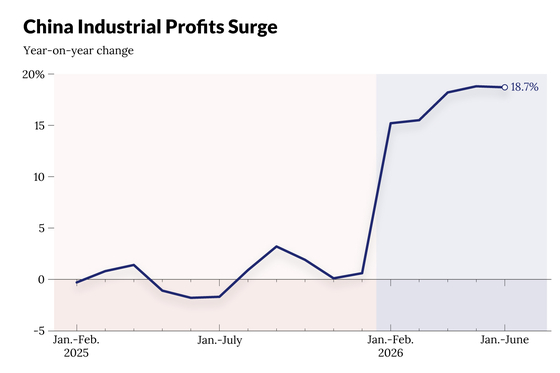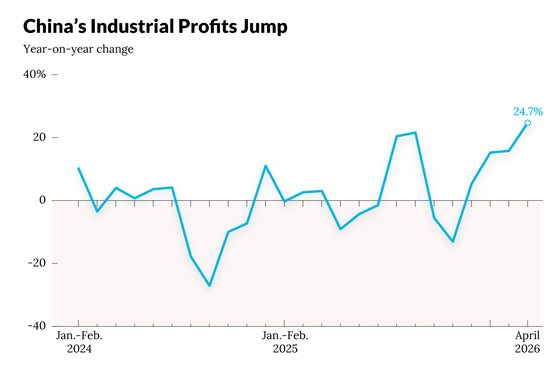
China’s industrial firms reported stronger profit growth at the start of the second quarter, supported by rising energy prices and resilient overseas demand for technology products despite a broader economic slowdown.China’s industrial profits rose 18.2% in the January-April period from a year earlier.Improved performance in the country’s raw-materials and manufacturing sectors helped drive a 24.7% year-over-year increase in industrial profits in April, compared with a 15.8% rise in March, according to official data released Wednesday.Industrial profits rose 18.2% in the January-April period from a year earlier, accelerating from the 15.5% increase recorded in the first quarter, the National Bureau of Statistics said.“For now, the recovery is sector-driven rather than broad-based,” said Lynn Song, economist at ING. “But it’s an encouraging sign after three years of largely negative industrial profit growth,” he added.The data reflects the impact of the Middle East conflict, which has disrupted global supply chains and sent energy prices soaring. In April, China’s factory-gate inflation rose to its highest level since July 2022, boosting profits for upstream oil and gas producers.High crude-oil prices have pushed up prices across related supply chains, enabling China’s petroleum-processing sector to return to profitability in the first four months of the year, the NBS said.Profits in the chemical industry surged 73.4% in the January-April period, accelerating by 18.9 percentage points from the first quarter, the bureau added.However, “If energy prices remain consistently elevated, costs could rise more broadly and start to impact profit growth,” ING’s Song cautioned.Meanwhile, robust global demand for Chinese artificial-intelligence and green-energy products also fueled demand for nonferrous metals such as aluminum, copper, gold and lithium, helping profits in that sector jump 117.8% in the first four months of the year.Beneath the strong headline figures, however, widening disparities in profit growth point to a deepening divide across sectors. While industries benefiting from higher oil prices and the AI boom continue to surge, traditional downstream sectors are struggling to keep pace. Consumer-oriented industries, including furniture and textile-and-apparel makers, saw profits slump as weak domestic demand weighed on spending.The NBS reiterated Wednesday that China’s external environment remains complex and volatile, while the imbalance between strong supply and weak demand remains pronounced.Data released earlier this month showed China’s economic momentum weakened broadly in April. Consumer-spending growth slowed to its weakest pace since 2022, while industrial output, investment and the property sector all deteriorated and fell short of economists’ expectations.Write to Singapore Editors at singaporeeditors@dowjones.com
China’s Industrial Profits Rise, Defying Economic Headwinds
Chinese firms reported stronger profit growth at start of the second quarter, supported by rising energy prices and resilient overseas demand for tech products | World News
401 words~2 min read