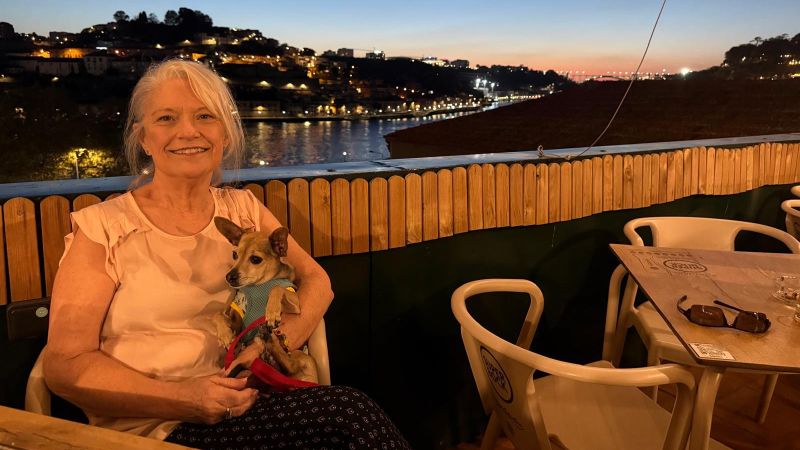
The mass British exodus to Portugal is easy to understand: sunny weather, a laid-back lifestyle and better prices make for a welcome change from the soaring cost of living in the UK.Throw into the mix the country's popular one-year digital nomad visa, which allows non-EU citizens to live and work remotely in the country, and it's a veritable haven for Brits looking to foster more of a work-life balance.And the figures back this up - the number of British expats living in Portugal almost tripled between 2014 and 2024, according to the Portuguese immigration authority (AIMA), now standing at 48,238. One of these Brits is Amy Dakin, a brand marketing expert who moved to Porto in May 2025 with her husband - and has absolutely no regrets.'To be honest, it's always been a place that we've wanted to live,' Amy tells the Daily Mail.'I remember since Covid and when people were starting to work from home we thought, wouldn't it be amazing to be a digital nomad and live abroad for a period of time? So it's always been a bucket list dream.'Amy, 34, who's from Solihull, originally came to the country visa-free for just 90 days - but loved it so much she decided to get a digital nomad visa and move to Porto for a year.The financial benefits are abundantly clear. Amy Dakin, 34, moved from the UK to Porto in Portugal on a one-year digital nomad visa She and her husband set up life in the Portuguese city, known for its cultural vibrancyAmy explains: 'There's such a better cost of living here. Even going out for a glass of wine midweek, you don't question it. It costs around €3 (£2.60). 'In the supermarkets, the fresh produce they have here is incredible. Everything tastes delicious, and your weekly shop is half the amount it would be in the UK. So I think that just allows for a higher quality of life.'While rent is comparable to the UK, Amy says, her bills are far cheaper - in Porto she pays around £150 a month all in, in comparison to £500 a month when she previously lived in Nottingham - a third of the cost.That's not to mention the price of trains and flights.Amy says: 'I used to work in London one to two days a week, and my trains from Nottingham used to cost around £150 to £200 return, because you're having to go at peak times.'But when I've taken a first-class train from Porto to Lisbon, which is about a three-hour journey, it's been €30 (£26).'It's a beautiful, incredible experience with leather seats and great Wi-Fi.'Plus, commuting back to the UK on a flight, you can get return flights for as cheap as £30 or £40 if you're lucky, and then the most expensive I've found is £150 - but that's still cheaper than what the trains would be.' A glass of wine - as well as other food and drink - are much cheaper in Porto, Amy saysWith cross-country trains costing up to £200 in the UK and £26 in Portugal, Amy is now paying just one seventh of the cost - while a commute across the UK to London reaches £200 and from Porto to London just £40, a fifth of the price. Amy says: 'I think Porto is a really special place. It's a city, but there's a real community feel. I'm such a lover of languages and different cultures.'I would say in Portugal they've got really strong family values, a deep sense of community. A good example of this is the Sao João Festival. Every city has a different saint that they celebrate on one day of the year. And in Porto, it's Sao João.'Thousands of people of all ages fill the streets and everyone is involved. It's a bigger celebration than New Year's Eve, and there are sardines being grilled on the streets, and children are staying out and playing.'It's not just the sense of community and ambience of festivals like this that make the city appealing, Amy says. She adds: 'It really struck me because people are celebrating and partying until 4am or 5am with children still on the streets - there's such safety. I can't imagine feeling safe to do that in the UK.'I've noticed Porto feels safer to me than the UK. I wouldn't question, for example, walking alone by myself as much as I would in the UK. 'Obviously, you always have to have your wits about you, but I do feel like there's this mutual sense of community, and you just know that people would help you.' Amy, the brand marketing lead at Pooch and Mutt, says the city feels much safer to her than parts of the UKAmy, the brand marketing lead at dog food company Pooch and Mutt says it has been 'one of the most incredible experiences ever'. She tells the Mail: 'I think it really expands your mind, experiencing a different culture, and Portugal is in the same time zone as the UK as well, so in terms of remote working for a UK company, there's no difference.'I've met so many friends here, and there's a lot of people doing very similar things. 'I've mixed with so many different nationalities of people that are living abroad, and that becomes a family in its own way as well. 'I've got a friend that's from Nepal, we've met Portuguese friends, French, American, other Brits, and it really helps to create your own community as well, which is important.'She laments: 'We only have a one-year digital nomad visa, so it was always going to be a short-term adventure, so we are looking to return back to the UK.'But never say never to coming back!' Despite nearing the end of her digital nomad visa, Amy says she wouldn't rule out a return one day to PortugalHow can Brits get a visa to live in Portugal post-Brexit?There are several options for Brits looking to relocate to Portugal.Firstly, there is the popular D8 digital nomad visa – you will need proof of income, accommodation and savings for this.Olga Nechita from global mobility lawyers Fragomen adds: 'For those that want to work in Portugal, there is the D2 Visa, also called the entrepreneur/independent professional visa. This extends to freelance staff, entrepreneurs and those wishing to start a business. Proof of income, a business plan and proof of economic activity is needed.'But Olga adds: 'The main route for UK nationals living to retire to Portugal will be via the D7 visa, often called the "retirement visa" or "passive income visa". It is designed to encourage those with a stable income to move to the country and is popular with Brits.'Currently, the income thresholds are €920 (£796) a month for the main applicant, with a 50 per cent increase if joined by their partner. So a retired couple would need to demonstrate an income of €1,380 (£1,194) a month. Savings of more than €11,040 (£9,558) are also needed together with proof of property ownership or a long-term rental agreement.'The D7 visa does come with conditions. Brits must spend at least 183 consecutive days in Portugal, with the country maintained as your primary residence – and those holding the visa cannot work.
Brit quit the UK 'safer' Portugal - and cut her weekly shop in half
Amy Dakin, 34, ditched the UK for sunny Porto last year - and the advantages have been seemingly endless.
1,208 words~5 min read