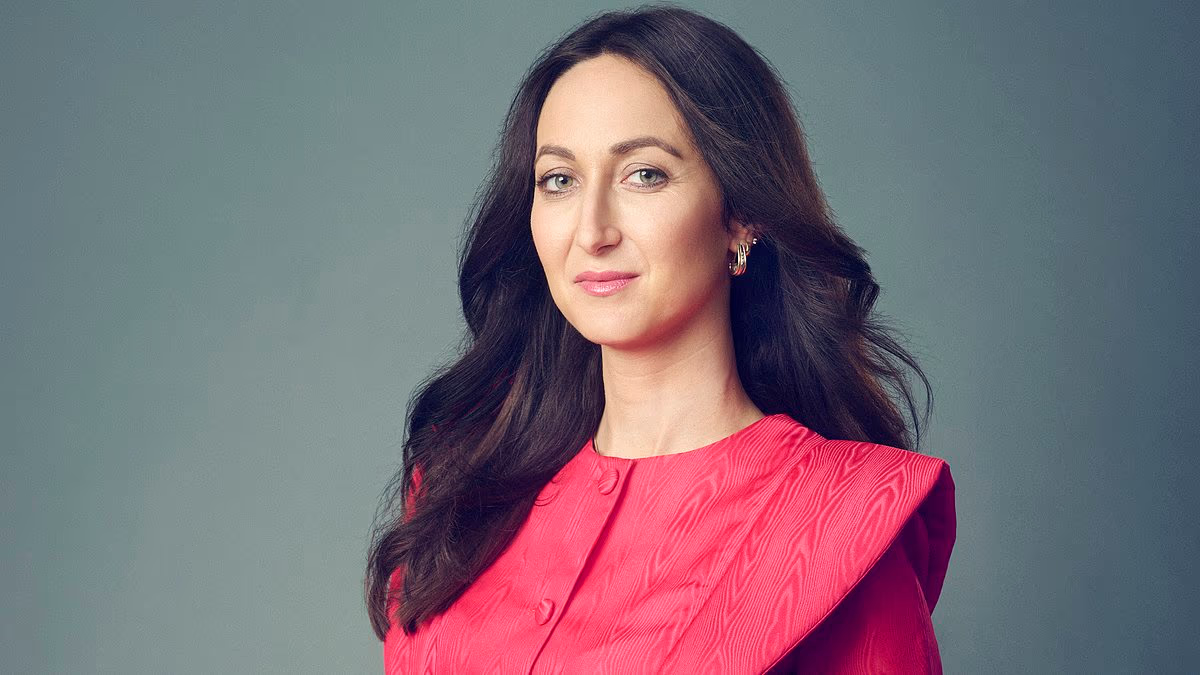
One Sunday, about five years ago, I decided to ‘leave’ my husband. Our dog was sick and he demanded that ‘for once’ it should be me that worked from home to keep a watch on him and, if necessary, make an emergency dash to the vet.These were chores I usually managed to swerve on account of being in the office five days a week. But now, he was fed up with being lumbered with the responsibility.I was outraged. He was the ‘dog person’ in the relationship – he’d craved a border terrier for years and did the lion’s share of walks and playtime.More importantly, didn’t he understand how much my colleagues depended on me? I reminded him my job wasn’t like his – a semi-remote position that mostly involved Zoom meetings and clocking off at 5pm on the dot. I co-ran this newspaper’s health desk – I couldn’t just decide on a whim to work from home.It was a cruel jibe as I knew he had struggled to get promoted, but I delivered it anyway, then stomped off to the kitchen, grabbed my keys and sped off before he could ask where I was going.I drove aimlessly around north London for most of the day, ignoring his calls and texts asking where I was.When I eventually returned home that evening, I marched straight to the bedroom and gave him the silent treatment until he reluctantly apologised before bed.It was a defeatist sorry – the sort you use when you’re not particularly remorseful, but desperate for the argument to end. We were both familiar with this routine – my infuriating stubbornness often forced him to give in. In a pivotal fight a few weeks before Eve Simmons’s husband ended their marriage, he unleashed his pent-up resentment about carrying the full burden of their life adminToday, two years after our divorce was made final, I am mortified by my ice-queen behaviour.While I’ve written before about how blindsided I was when my husband called it quits in November 2022, just six months after our wedding, and his subsequent cruel behaviour, to my shame what I haven’t yet reflected on publicly is my contribution to our demise.Indeed, in the wake of our split, my army of female friends rallied round, and spent many hours affirming my criticisms of my ex. His behaviour was unreasonable and selfish. He was never good enough for me, they said.No one dared suggest I had a role to play in his sudden apathy towards our relationship. In fairness, I’d have been horrified if they did.So in the interest of balance, and shining a light on the complex messiness of the end of a relationship, I have reflected on where I believe I went wrong.My first big faux-pas was my habit of using the silent treatment, as described above. Therapy has since taught me I have an intense fear of confrontation. I am also extremely stubborn. This combination means I can approach conflict like a child – avoiding it and opting to get in a huff instead.It happened every few months with my ex. He’d do or say something I found irritating, like scrolling on his phone while we ate dinner, or making a mean ‘joke’ about one of my girlfriends. Instead of having it out there and then, I’d clam up and withdraw – sometimes for hours on end – refusing to tell him what was wrong.Another unappealing behaviour was one I’m sure many long-suffering spouses identify with: nagging. My nags centred on my ex-husband’s health.I’m ashamed to admit the number of times I gave him a raised eyebrow for having a third slice of cake, or made a pointed remark about how he hadn’t moved from the sofa on a Sunday.It was a recurring trigger for our arguments – I’d make a well-meant but tactless remark and he’d snap back.I knew how much he hated it and, in my defence, I did make an active effort to stop. My concern was well intentioned, as my father died from cancer at 49. His illness wasn’t lifestyle related, but it left me acutely aware of the mortality of my loved ones. I wanted my future children to have the best chance of enjoying their father for as long as possible. Much of my nagging took place in the first half of our relationship, when I was recovering from anorexia. The fear of food took years to resolve, and I regret that my disordered thoughts were projected on to those I loved the most. It’s clear to me now that my anxieties hurt his feelings, but regrettably, I was too blinded by my demons to recognise the root cause and offer an explanation.Then there was my lack of interest in life admin. We had an unspoken agreement from the day we started living together, two years into our relationship, that he would be in sole charge.After a day in the office I had little brain space to compute home insurance plans or broadband upgrades.He, on the other hand, mostly worked from home, rarely worked into the evening and had a natural knack for keeping tabs on the nitty-gritty of our shared life (he is a spreadsheet whiz).I took this for granted, failing to check he was happy with our respective roles. Eve, pictured on her wedding day, says that by the end of her marriage she began to feel like her husband’s housemate, or irritating sisterHe clearly wasn’t, as was made obvious in a pivotal fight a few weeks before he ended our marriage, when he unleashed his pent-up resentment about carrying this burden.I used my work as an excuse to avoid my responsibilities, he said, and assumed he’d sort everything. Worse, I didn’t show sufficient appreciation for the time and effort he put into our shared life admin. He wasn’t wrong.My final major mistake was a faux-pas committed by most people in long-term relationships – I stopped flirting.I don’t mean under-the-table footsie and sexy text messages you might enjoy in the honeymoon period. I mean subtle ways of assuring your partner that you still desire them.It was something we were both guilty of – by the end of our matrimony, even exchanging compliments was rare.It has a destructive effect on one’s confidence. His lack of affection crushed my self-esteem – if the person who promised to love me for ever didn’t find me attractive, I must be a unique form of hideous, I thought.I began to feel like his housemate, or irritating sister. And, indeed, he may have felt the same. I now believe working on the romantic spark is as crucial as staying faithful for a successful relationship. The fire won’t magically stay burning without regular doses of lighter fluid (and by that I mean date nights, compliments, physical affection).But I’d adopted a deranged, sexist belief that it was the man’s job to make the woman feel special.Research for my book on the intriguing phenomenon of so-called ‘short-marriage syndrome’ – which explores why more and more couples are calling it quits within a year of marriage – took me to the minefield of men’s interest podcasts.I listened to hours of episodes featuring young men discussing their failed relationships. Unsurprisingly, men feeling undesired and self-conscious was commonly cited in podcast episodes as a reason for initiating a split.Today, I have an exceptionally healthy relationship with my partner of three-and-a-half years, who is the father of my ten-month-old son. It’s an honest, communicative and fully equal partnership. But it must be said, this time, sharing my life feels like far less of an effort.Perhaps I’ve grown up, or have learned from my mistakes. But there’s also a lot to be said for finding a much better match.What She Did Next: What to Do When the Life you Planned is F**ked Up, by Eve Simmons, is out now.
Now I know what really destroyed the spark in my marriage: EVE SIMMONS
One Sunday, about five years ago, I decided to 'leave' my husband. Our dog was sick and he demanded that 'for once' it should be me that worked from home.
1,306 words~6 min read