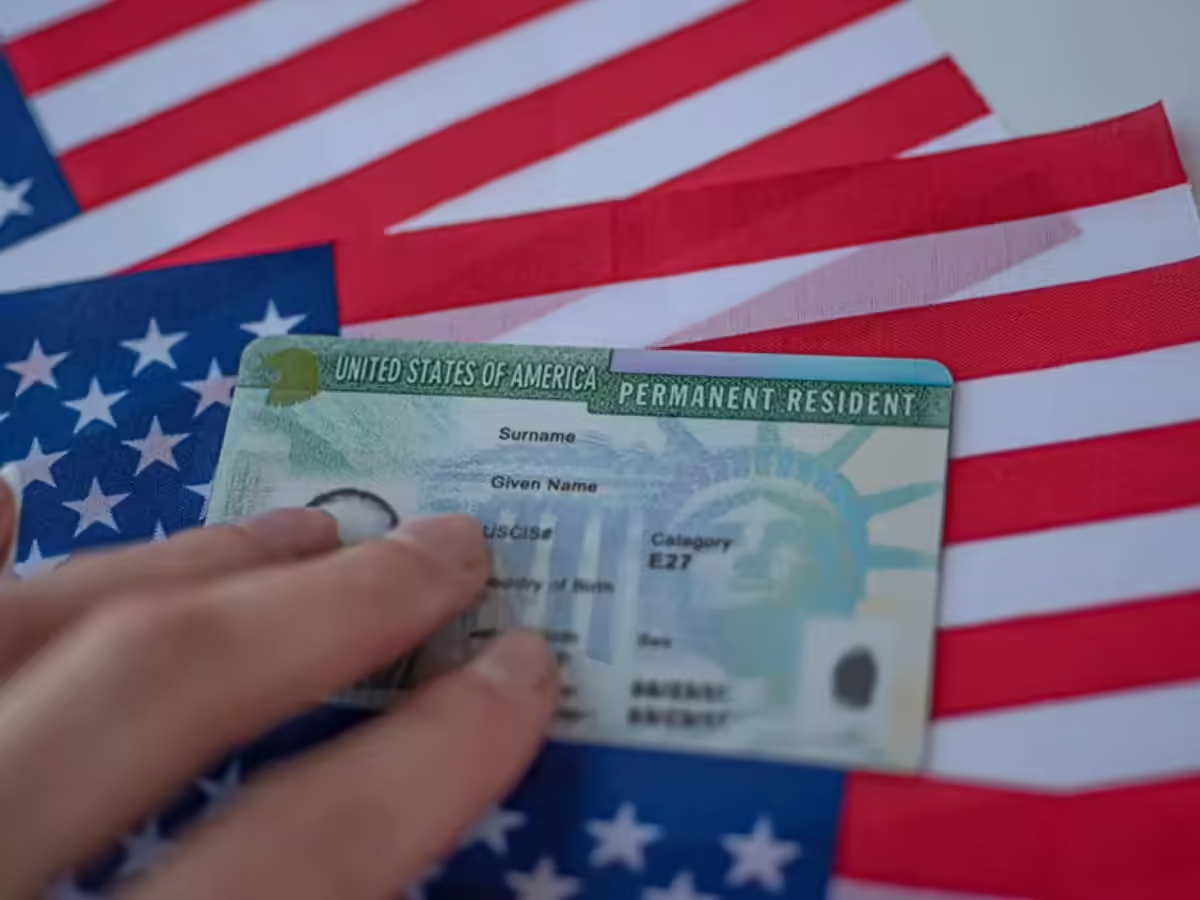
In this article, we address the questions we are hearing most frequently from clients following USCIS's issuance of Policy Memorandum PM-602-0199 on May 21, 2026, regarding Adjustment of Status applications. Our goal is to provide clear answers — including candid acknowledgment of what remains genuinely uncertain. We also provide tips on what AOS applicants affected by these issues should do. SECTION A: UNDERSTANDING THE MEMORANDUMQ1. What exactly is the New Policy Memorandum PM-602-0199?Policy Memorandum PM-602-0199 (the Policy Memorandum) is an internal guidance document issued by USCIS on May 21, 2026. It instructs immigration officers on how to exercise discretion when adjudicating Form I-485 applications for Adjustment of Status (AOS). It is not a regulation, a federal statute, or a court ruling. It represents the current administration's policy direction regarding how existing discretionary authority should be applied.Q2. Is this a new law?No. This memorandum does not create new laws, eliminate any visa category, or alter statutory eligibility requirements for adjustment of status. Congress creates immigration law; USCIS issues guidance on how it administers that law. Q3. Does this memorandum apply to pending applications?The memorandum does not expressly state that it will be applied to pending applications. Officers currently adjudicating pending I-485s may apply this guidance to their discretionary analysis. However, since this memorandum was published, we have learned that other attorneys representing AOS clients have received Requests for Further Evidence (RFEs) that ask applicants to prove aspects of their earnings, background, and community contributions, among other things, implying that they must establish their “worthiness” to be granted AOS. Q4. Can this memorandum be reversed?Yes, Agency policy guidance can be withdrawn or modified by the issuing agency or by a subsequent administration at any time. It does not carry the permanence or lasting endurance of statute or regulation. Litigation may also result in a court enjoining or invalidating the guidance. However, we cannot predict when, or even whether, reversal will occur, and you must prepare to position your case to succeed under the current rules as they stand.Q5. Why was this memorandum issued?The memorandum reflects the current administration's wider effort to expand the exercise of immigration enforcement discretion. The practical effect is to make domestic adjustment more difficult to obtain, particularly for applicants whose visa categories carry an expectation of departure.SECTION B: IMPACT ON PENDING I-485 APPLICATIONSQ6. Will my pending Form I-485 be denied because of this memo?No, not automatically. The memorandum does not mandate the denial of any application. Rather, it directs adjudicating officers to apply heightened scrutiny when evaluating discretionary factors. Applications that are thoroughly documented and supported by strong positive equities may still be approved. Positive equities are favorable considerations weighed by an officer in the exercise of discretion. Additional discussion of positive equities appears later in this article.What is important to remember is that cases that might previously have been approved with minimal scrutiny may now attract stricter scrutiny. Relying solely on a clean record may no longer be sufficient; to build a stronger case, it is important to build a record with positive equities.Q7. Should I withdraw my I-485 and refile later?In almost all circumstances, you should not withdraw your AOS application, i.e., Form I-485. Withdrawing a pending application could have devastating consequences, including resetting your priority date, eliminating approved employment authorization, and advance parole benefits. Also, re-filing does not guarantee a more favorable outcome. If you are considering withdrawal, it is best to do it under the guidance of experienced legal counsel.Q8. Should I convert my pending I-485 to consular processing instead?This requires careful, individualized analysis and there is no universal answer. Consular processing bypasses some of the domestic discretionary concerns raised by the memo, but it introduces its own significant risks — including potential inadmissibility bars triggered by departure from the United States, the loss of employment authorization and advance parole, and consular officer discretion, which is largely unreviewable. This decision must be made in close consultation with your attorney after a thorough review of your specific immigration history.Important Tip: Do not depart the United States to pursue consular processing without first consulting an immigration attorney. Departure can trigger unlawful presence bars of three or ten years for individuals with prior status violations.Q9. What happens if I receive a Request for Evidence (RFE) after this memo?An RFE is an opportunity to respond, not a denial. Officers may use RFEs to probe discretionary factors, including intent at the time of entry, ties to the home country, and the basis for choosing domestic adjustment over consular processing. You should respond comprehensively, with well-organized evidence of positive equities, and this is best done with the help of experienced legal counsel. Q10. Will this memo increase processing times?Since officers are now required to conduct more thorough, discretionary analysis, adjudication timelines are likely to be longer. The precise impact will depend on how the guidance is implemented at the service center and field office level.SECTION C: VISA-CATEGORY SPECIFIC QUESTIONSQ11. I am on an H-1B visa. How does this affect me?H-1B is a dual-intent visa. U.S. laws expressly permit H-1B holders to intend to immigrate permanently while maintaining lawful nonimmigrant status. The memorandum does not override this statutory protection. H-1B holders are among the categories most protected under this guidance. However, it is still important to develop a well-documented equity record.Q12. I am on an L-1 visa. Am I at risk?L-1 holders benefit from the same dual-intent recognition as H-1B holders. However, it is still important to develop a well-documented equity record.Q13. I am on an F-1 student visa. What is my exposure?F-1 visa holders face higher exposure under this memo. The F-1 is a non-immigrant student visa. Students are admitted to the U.S. with an expectation that they will depart the country at the end of permitted activities in F-1 status. Given the Policy Memorandum officers are expected to treat AOS applications negatively unless there are exceptional circumstances or other factors in favor of the applicant. Q14. I entered on a B-1/B-2 visitor visa. Is my exposure significant?B-1/B-2 visitors are among the categories most directly affected by the Policy Memorandum. A B visa is issued with the explicit expectation that the individual will enter the United States temporarily and depart upon completion of the authorized stay. Accordingly, applicants seeking Adjustment of Status (AOS) while in B status must establish that the intent to remain permanently in the United States arose only after entry.The Policy Memorandum signals that USCIS officers will subject such cases to heightened scrutiny, particularly where the timing of post-entry conduct may suggest a preconceived intent inconsistent with the terms of admission.Q15. I am an EB-5 investor. Does the memo affect my concurrent I-526E/I-485 filing?An EB-5 investor’s right to file a concurrent AOS application remains unchanged under the law. The 2022 EB-5 Reform and Integrity Act (RIA) expressly created a statutory right for EB-5 investors to file AOS applications while within the United States. An agency policy memorandum cannot override the legal authority of an Act passed by Congress. Despite this, we recommend building a strong, positive equity record as best practice.Q16. I have a pending employment-based preference petition (EB-1, EB-2, EB-3). How does this change my I-485?Employment-based preference applicants, particularly those in dual-intent visa categories such as H-1B or L-1, are generally better positioned than B visa or F-1 student visa holders. However, the memo may also result in a more thorough discretionary review of employment-based I-485 applications. You should ensure your file establishes affirmative positive equities in addition to statutory eligibility.Q17. What about derivative beneficiaries — my spouse and children on the same I-485?Derivative beneficiaries are generally adjudicated on the basis of the principal applicant's case. If the principal's application is well-supported, derivatives typically follow. However, each individual's entry history, visa status, and any independent adverse factors may be reviewed separately. A comprehensive case review should address each family member's circumstances, not only the principal's.SECTION D: DISCRETION, EQUITIES, AND WHAT OFFICERS WILL LOOK FORQ18. What are 'positive equities' and what specifically counts?Positive equities are favorable factors that an officer is expected to weigh in the exercise of discretion. Recognized equities include length of lawful presence in the United States; consistent employment history and economic contribution; family ties to U.S. citizens or lawful permanent residents; community involvement and civic engagement; charitable or volunteer work; educational achievement; a history of timely tax payment; the absence of any criminal or immigration violation history; and compelling humanitarian circumstances. In light of the Policy Memorandum, these must be affirmatively documented, not merely implied.Q19. What counts as a negative factor?The memo specifically identifies the applicant's Adjustment of Status application as a negative factor. Other negative factors include prior or current immigration violations; periods of unlawful presence; prior removal orders or voluntary departures; criminal history, including arrests that did not result in conviction; misrepresentation on any immigration application; and unauthorized employment. Not all negative factors are fatal to an application, but each must be addressed specifically and strategically.Q20. I have a completely clean record. Is that sufficient on its own?Under this memo, a clean record is not likely to be enough. The memorandum expressly requires affirmative positive equities. Officers are now expected to look for reasons to approve your case, not merely the absence of reasons to deny it. Tip: The standard has shifted from 'no reason to deny' to 'affirmative reason to approve.' This distinction matters significantly for how applications should be prepared.Q21. I had a brief period out of status several years ago. Does that disqualify me?Prior status violations are a negative factor but may not automatically result in a denial. The severity, duration, and circumstances of the violation will be weighed against the strength of an applicant’s positive equities in an officer’s comprehensive analysis. Full, proactive disclosure and a well-constructed legal argument can, in many cases, overcome prior status issues. Q22. Will a long wait for a priority date be considered as a positive equity?An extended lawful, compliant presence in the U.S., consistent economic contribution during that period, diligent compliance with tax requirements, and the accrual of meaningful ties to the U.S. community over many years are likely to be recognized as positive equities. SECTION E: THE HONEST UNKNOWNS Q23. How will USCIS officers actually apply this memo in practice?This is genuinely unknown. Policy memoranda are interpreted and applied with variation across service centers, field offices, and individual officers. Some adjudicators may apply the guidance strictly; others may continue largely as before. The practical adjudicatory impact of this memo will become clearer over the coming months as decisions are issued and patterns emerge. Q24. Will litigation stop or reverse this memo?Litigation challenging PM-602-0199 is expected and, according to leading practitioners, legally well-founded on multiple grounds. However, we cannot predict outcomes, timelines, or whether a court will issue an injunction pending final judgment. In the meantime, each AOS application must be framed to succeed under the current framework. Q25. Is it safer to simply wait before filing an I-485?For most applicants, waiting is not advisable. Priority dates keep changing, and the window to adjust status may close, or the wait may get longer. If you are statutorily eligible and your documentation is strong, it is best to strategically file as soon as possible under the guidance of experienced legal counsel. Q26. Could things get worse than they are now?Yes, additional restrictive policies are possible. The immigration landscape is changing quickly, and it is best to move forward with qualified and experienced legal counsel as soon as possible. SECTION F: CONSULAR PROCESSING Q27. Would I be better off departing the U.S. and pursuing consular processing?For some applicants, consular processing may be preferable to AOS. However, for many others, departure carries serious and potentially irreversible consequences. Individuals who have accrued unlawful presence may trigger three or ten-year bars upon departure. The loss of employment authorization and advance parole, the disruption to employment and family life, and the unpredictability of consular officer discretion must all be weighed carefully. Remember, consular decisions are non-reviewable, limiting legal recourse if things go wrong. Q28. How quickly do I need to act?There is no single universal deadline, but the urgency is real. Officers are already adjudicating under this guidance. A pending I-485 without proactive equities record in place is more vulnerable to an RFE or adverse discretionary outcome than one that is thoroughly documented. We recommend contacting our office within the next two weeks if you have a pending application or are actively considering filing.This list of FAQs is provided for general informational purposes only and does not constitute legal advice. The information herein reflects our understanding of PM-602-0199 as of the date of preparation and is subject to change as the law develops. Receipt of this document does not establish an attorney-client relationship. Please consult with a qualified immigration attorney regarding your individual circumstances.(Disclaimer: The opinions expressed in this column are that of the writer. The facts and opinions expressed here do not reflect the views of www.economictimes.com.)
Green card rules change: An immigration lawyer answers all your key questions - The Economic Times
A new USCIS policy memorandum, PM-602-0199, impacts Adjustment of Status applications. Immigration officers will now scrutinize applications more closely. Applicants must present strong positive equities, not just a clean record. This change affects various visa categories, including F-1 and B-1/B-2 visitors. The policy aims to make domestic adjustment more difficult. Applicants should consult legal counsel to prepare their cases effectively.
2,151 words~10 min read