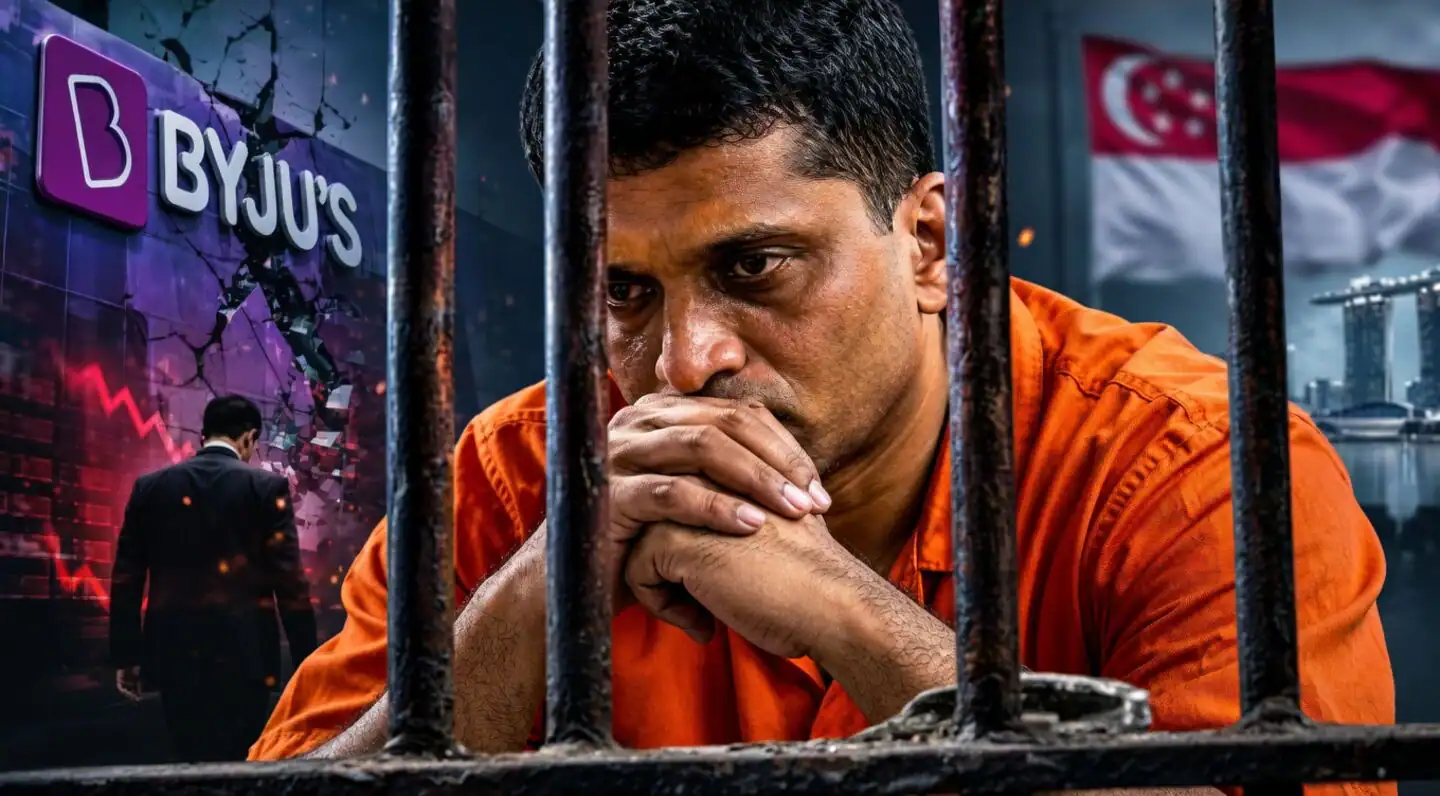
SynopsisByju Raveendran announced a settlement in principle with lenders like GLAS Trust and Qatar Investment Authority, following a Singapore court's contempt ruling. He stated the court proceedings created a misleading impression, as parties were nearing a comprehensive settlement and no wrongdoing was found on his part or other founders'.AgenciesByju Raveendran, founder, Byju'sByju Raveendran, founder of troubled edtech firm Byju’s, said discussions with lenders, including GLAS Trust and Qatar Investment Authority (QIA), have resulted in a settlement being agreed in principle, hours after Bloomberg reported that a Singapore court had sentenced him to six months in jail for contempt.In a statement, Raveendran said only “a few residual minor issues” remained to be finalised between some parties and that he had no role in those discussions. He said the Singapore court matter had been pursued and reported in a manner that created a “misleading impression” about him at a time when the key parties had “almost concluded” settlement talks.“As part of the settlement discussions, the parties have also acknowledged that there has been no wrongdoing on my part or on the part of the other founders,” Raveendran said in the statement. He added that he had not actively contested several court proceedings in recent months because the parties were working towards a comprehensive settlement.Bloomberg reported on Wednesday that Raveendran had been ordered to serve six months in jail after the Singapore court found that he had disobeyed multiple orders related to his assets dating back to April 2024. The report said he had also been asked to surrender himself, pay costs of S$90,000 and provide documents proving his legal ownership of Beeaar Investco Pte, an entity that held shares in a related company.Raveendran’s statement sought to frame the development as a pressure tactic by QIA, Qatar’s sovereign fund. “I chose resolution over confrontation,” he said, adding that QIA’s decision to continue pressing the matter appeared unnecessary at a sensitive stage of settlement talks.A person aware of the discussions said that the proposed settlement was multi-party in nature and involved GLAS Trust, QIA, and other stakeholders. The person said Raveendran’s portion of the settlement had largely been concluded, and the remaining issues were between other parties over the distribution of money, shares, or other assets, mostly related to Aakash Educational Services, Byju’s’ most-priced asset. The person also said Byju’s side had deliberately avoided aggressive litigation in recent months to avoid derailing the settlement process.One battle after another The development comes after a year of increasing legal pressure on Raveendran and Think & Learn, the parent of Byju’s. Last July, the Delaware (US) Bankruptcy Court held Raveendran in civil contempt and imposed sanctions of $10,000 per day for non-compliance with court orders. The US lenders have been pursuing the recovery of funds linked to a $1.2 billion term loan, including the disputed $533 million that has been central to litigation in the US.Separately, QIA has been pursuing recovery proceedings against Raveendran and related entities. In 2025, it moved to enforce a $235 million arbitral award against him in India. Byju’s parent also remains under insolvency proceedings in India, while disputes around Aakash Educational Services continue to be litigated across forums.Raveendran said he had acted in good faith and in the interests of Byju’s employees, students and stakeholders. He reiterated that neither he nor the other founders personally received any portion of the disputed funds and that the money was used for legitimate business purposes. ...moreElevate your knowledge and leadership skills at a cost cheaper than your daily tea.Subscribe Now
Byju Raveendran says settlement near after Singapore court contempt order - The Economic Times
Byju Raveendran announced a settlement in principle with lenders like GLAS Trust and Qatar Investment Authority, following a Singapore court's contempt ruling. He stated the court proceedings created a misleading impression, as parties were nearing a comprehensive settlement and no wrongdoing was found on his part or other founders'.
585 words~3 min read