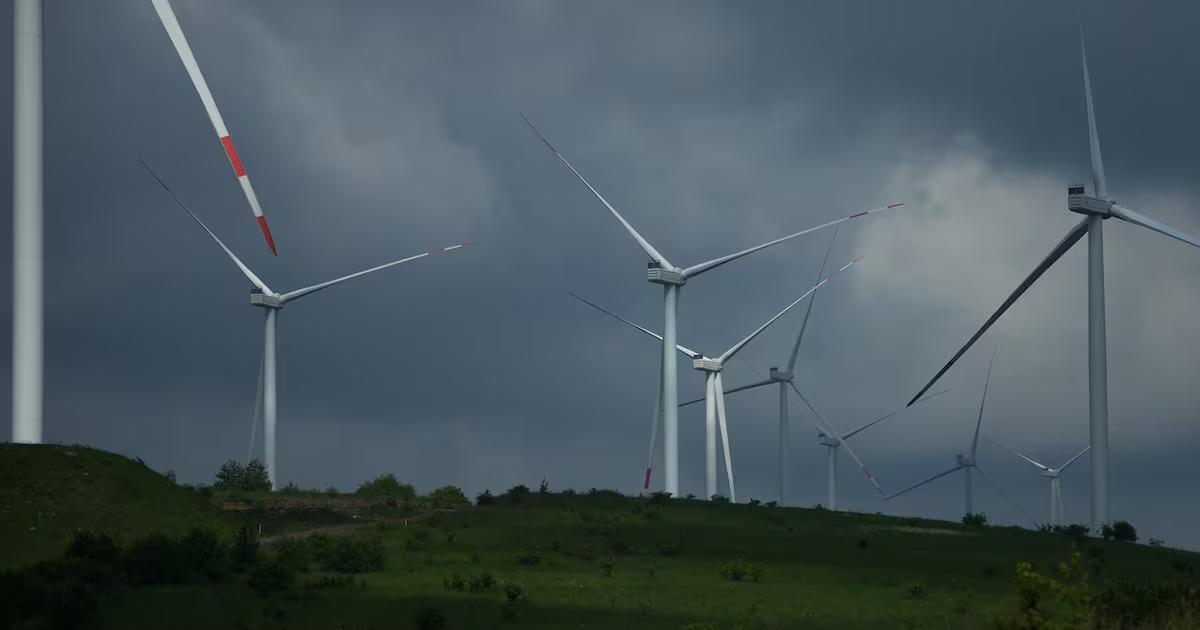
“From a local perspective, north Leitrim is fed up with being pushed around,” says Darren Sweeney, chairman of the Save Dough Mountain campaign group. Sweeney’s group is pushing back at plans to build 14 wind turbines on a hillside near Manorhamilton. “We have had issues with things like fracking, forestry and mining and all of us have been affected in some way,” he says.“We’re quiet here, that’s sort of our nature. And sometimes we don’t always speak up against things. This is not ‘Nimbyism’,” he says, referring to the “Not In My Back Yard” term applied, often unfairly, to residents who oppose any local infrastructure changes.“There are some fundamental problems with the location of these turbines.”The Lissinagroagh wind farm in question is the subject of a planning application by FuturEnergy Ireland, a joint venture between Coillte and ESB established in 2021.Considered to be strategic infrastructure, the application has gone straight to An Coimisiún Pleanála, the independent planning body. Over the coming weeks, local people have been invited to make their “observations” about the proposal.Sweeney, who farms livestock near the proposed site, says the scale of what is being planned has never been seen before. The turbines would rise as high as 185m, surpassing the Dublin Spire, which stands at 120m. “They are putting it on a very prominent mountain in the area which overlooks everything,” he says. We absolutely see the need and requirement to turn to renewables— Darren SweeneyMany objectors have also raised concerns about the potential impact on local habitat and fear the project could lead to land slippages. “An array of species and habitats would be fully destroyed if this were to go ahead,” Sweeney says.He says the turbines would “fundamentally change the landscape”.“It isn’t about being pro or against renewable energy,” says Sweeney. “We absolutely see the need and requirement to turn to renewables.” But he adds the process has come as a shock to some people in the area and feels to many like it is already in the “home straight”. There has been a long list of contested wind farm applications over recent years in Ireland. In many parts of the country, they have proven deeply unpopular with the people expected to live beside them.Yet the transition from the country’s over-reliance on fossil fuels to cleaner, renewable energy sources means these sorts of disputes are likely to continue.There have been notable objectors to various applications, both onshore and offshore.A year ago, a high-profile plan to build 30 turbines off the Connemara coast was abandoned after studies showed it was not possible to ensure its survivability for technical, weather, environmental and engineering reasons.Comedian Tommy Tiernan lent his voice to the campaign against the Sceirde Rocks Offshore Wind Farm – where the turbines would have been more than 300m high – saying there has to be more to our country “than a utilitarian exploitation of where we live”.Tommy Tiernan took part in campaign. Photograph: RTÉ Tiernan’s observation neatly summarises the essence of much opposition to wind farms.Ireland, we are continuously told, is almost uniquely placed within Europe to generate energy through wind.Wind Energy Ireland (WEI), the industry’s representative body, said a third of the island of Ireland’s electricity in 2025 came from wind energy. It claimed that in one month, December, wind farms provided 39 per cent of our power and helped bring down electricity prices.WEI talks about Ireland becoming an “electrostate”. Conflict in the Middle East has given added impetus to support for wind energy. The shock increase in the price of oil and gas has again revealed how vulnerable Irish consumers are to price shocks.Recent figures showed Irish consumers pay the highest electricity bills in the European Union.Wind farms are a key plank in the State’s efforts to pivot away from fossil fuels. The Government’s Climate Action Plan has set a target to have 80 per cent of all electricity come from wind and solar power by 2030.WEI has noted a slowdown in planning approvals this year, saying that although there are about 40 wind farms awaiting consideration, no approvals were granted in the first three months of the year. Given the mounting pressure to hit emissions and energy targets, Minister for Public Expenditure Jack Chambers said last month the Government was considering changing proposed legislation to allow offshore wind farms to be designated as critical infrastructure.Back on solid ground in Leitrim, councillors have been bypassed in the planning process.Independent councillor Eddie Mitchell notes that the council’s own climate action plan placed a big emphasis on wind power and there is “no point in saying we are against wind”.Wind power is seen as important infrastructure that can be put anywhere— Eddie Mitchell“The scale is a little bit inappropriate,” he says, however. “Some of these turbines are being planned in a pristine environment that I would expect to be protected.“But that’s the way that things have gone – wind power is seen as important infrastructure that can be put anywhere – and that the community doesn’t matter any more.”He characterises the opposition to the wind farm as being based on concerns about a lack of proper planning.Numerous wind farm plans have ended up before the courts with a seemingly significant decision handed down by the Supreme Court in February when it quashed a decision to refuse planning for turbines in Co Laois, upholding a High Court ruling in 2024.Coolglass Wind Farm Ltd wanted to build a 13-turbine wind farm at Timahoe, but planners had refused permission because the Laois County Development Plan prohibited wind farms on the site due to visual concerns. Coolglass’s argument that planners had failed to approve enough green energy projects to meet 2030 environmental targets seemed to carry some clout with the judges. The court said the commission was obliged to ensure any decision made was consistent with climate objectives.The ruling found the commission “did fail in its obligations to consider whether permission should be granted notwithstanding that it would amount to a material contravention of the development plan”.However, the ruling was made on narrower grounds than that by the High Court. The Supreme Court disagreed with its conclusion that the commission was obliged to depart from the development plan to favour development more likely to enable Ireland meet climate objectives unless it was impracticable. While putting a fresh onus on planners to consider the overall contribution a wind farm would make to State targets, the ruling leaves the door open to those who are unhappy with such planning applications.In Leitrim, FuturEnergy says it has run a “community engagement programme”, which began in 2021.As part of this, it says, all homes within 2km of the site have received brochures detailing the design process and “extracts” from the environmental impact assessment report.[ Fifty ways Ireland can leave fossil fuels behind set out to GovernmentOpens in new window ]The company says the wind farm would bring long-term investment through employment and local spending.According to FuturEnergy’s communications manager Janine Thomas, the wind farm comes with a “community benefit fund of an estimated €12.5 million over the lifetime of the project and rates of approximately €1.2 million to €1.5 million per annum”. She also says the project has evolved over the past five years and the current proposal for 14 turbines marks a reduction on the original plans for 20.As with other developments of this kind, environmental and ecological concerns have been raised during the planning process.Opponents of the Lissinagroagh plan have expressed worries that hen harriers and several other bird species are at risk. They describe as “considerable” the disruptive impact of the wind farm’s construction and operation. [ Building offshore wind farms could reduce Irish energy bills, as has happened in the UKOpens in new window ]The planning documents submitted by the company state that once mitigation measures are taken there will be no potential for adverse effects on species and habitats.The coming weeks in Leitrim appear to present the final opportunity for the plan to be fought over.Despite claims by FuturEnergy Ireland that it has sought to keep local residents fully informed throughout the process, campaigners are scathing about what they say is a lack of proper engagement.Sweeney says many of them feel the “observation” period is a “box-ticking exercise”.He says An Coimisiún Pleanála will “be pushing hard to close things off within 12 months”.Mitchell, along with his fellow councillors, will consider the draft plan at a council meeting – and their notes will then be forwarded to the planning commission. He agrees with Sweeney that the pace has picked up.“It’s all happened pretty quickly,” he says. “The formal application – we’re expecting it to be in any day now.”
A chill wind: Why are wind farms drawing so many objections in a time of climate crisis?
Potential impact on local habitat and concerns around a lack of planning fuel discontent
1,438 words~7 min read