As I stroll past Highbury Fields on my way to meet my brother, it becomes clear that I’m nervous. Or anxious, maybe. Who isn’t, I suppose. It’s the generational malaise of millennials and Gen Z – the neurological white noise of modern life. Anxiety happens in the body and is then translated by your brain into a story. That story can be helpful or not but the somatic part – the embodied experience – is felt first, explained second. We go looking for a cause for that prickling sensation in our gut. The stiffening shoulders. The increased heart rate. The body wound taut as if it might need to spring or run. Anxiety feels physically identical to excitement.Thrumming with this unpleasant vigilance and self-awareness, I pass a gambolling Great Dane on the grass – a huge, noisy guy. The rumbling “harf-harf” of his animal bass disturbs the air. His paws, the size of gravy boats, stomp in excitement as his gangling form rises lumpen and heavy into the air. The sudden boom of his big dog voice makes me jolt a little. I’m on edge and have no idea why. It’s been two years since my brother and I last saw one another. I waved him on to the bus after an event I’d been speaking at in Dublin. I was nervous then too, and he’d known it. He left his young family for an evening and got on the train to Dublin. He took photos, as if me talking to a room of people was something worth documenting. When I had to speak, I told the crowd I felt nervous – saying it aloud helps mitigate the feeling. Suddenly, a glass of water appeared on the table in front of me, my brother’s back receding silently into a group of polite onlookers. He acted like a father might have acted. I know I’ve mothered him in moments, maybe when he didn’t want me to. There’s something undignified about asking a man in his 40s in a chiding tone if he’s brought a warm enough coat. At the end of the evening, we waited a little awkwardly at the bus stop together. He was headed home to Limerick. I would return to Australia the following day. There has always been some distance between us, but it has narrowed as we age. Suddenly, I am enclosed in a tight hug. “I’m proud of you”, he mutters into my hair with immense warmth. It’s like hearing it from both a stranger and someone you’ve known all your life. Siblings can be like that – impossibly familiar and also somehow unknowable. You’re conscious of the versions of them you’ve missed; the periods you’ve spent apart, developing away from the versions one another might recognise. And then he’s on the bus, and it’s pulling away from the kerb. Fatherhood has softened my brother, I think. He’s spending his days with tiny people, and now he can see a tiny person in everyone around him. When he was young, he had the silent, jaw-clenched anger of a fatherless boy. Loss and babies have eroded the rage I remember from his youth, and left behind this softer, kinder man. The kind who brings you glasses of water when your throat sounds dry and whispers his pride into the top of your head, as if he’s depositing it there for safekeeping.I love my older brother, and I’m always a little uncertain when I’m around him. It’s just the two of us. Now that both our parents are dead, he is the only other living custodian of our shared past, and with it, the very worst versions of me. He is an archive of my failures, my weaknesses and the ill-fitting selves I tried on in my youth. He has seen the insecure child, the pompous adolescent, the self-righteous undergraduate, the misguided 20-something and whatever I am now. In his living assessment of me dwells the tween iteration who gleefully told our mother when I found condoms in his bedroom. There too is the young version of me who failed to have sufficient compassion for a young man who had been abandoned by our father, because I was focused on how it affected me. The version of me who unwittingly shaved her head on the same week as Britney Spears in 2007, and who he didn’t even taunt for it, so concerned was he by that point that my baldness was some manner of cry for help.I walk through this affluent, pretty London suburb to meet my brother, who’s over for a soccer match, after two years in different hemispheres. The tension I feel heightens as the space between my imagined concept of him and whoever I’ll actually find narrows. This is what happens when siblings grow up. You’re tethered to one another whether you like it or not. Whether you change or you don’t, there are versions of you calcified in the other person’s memory. Mummified former selves. If you’re lucky, you’ll both be able to permit the other person some breathing room to change. You won’t entomb them in the version most familiar to you. My brother is no longer an angry young man. I’m no longer an angry young woman. Our mother always said she hoped one day we’d realise that all we really had was one another. It took her death for us to learn the lesson. That’s the way of it. Children don’t listen to their parents.[ I am back in London after three years. It’s difficult to explain whyOpens in new window ]I turn a corner and he’s there, waiting. Neat and controlled, as always. Straight-backed and quiet. A little greyer, as am I, but the same really. The boy I grew up with and the man the boy became. All the versions of him coalesce into the man standing before me, and my shoulders drop. The story changes. It isn’t anxiety, but excitement. It’s my mother’s voice, reminding me that I’m simply lucky to have him, and I feel it.
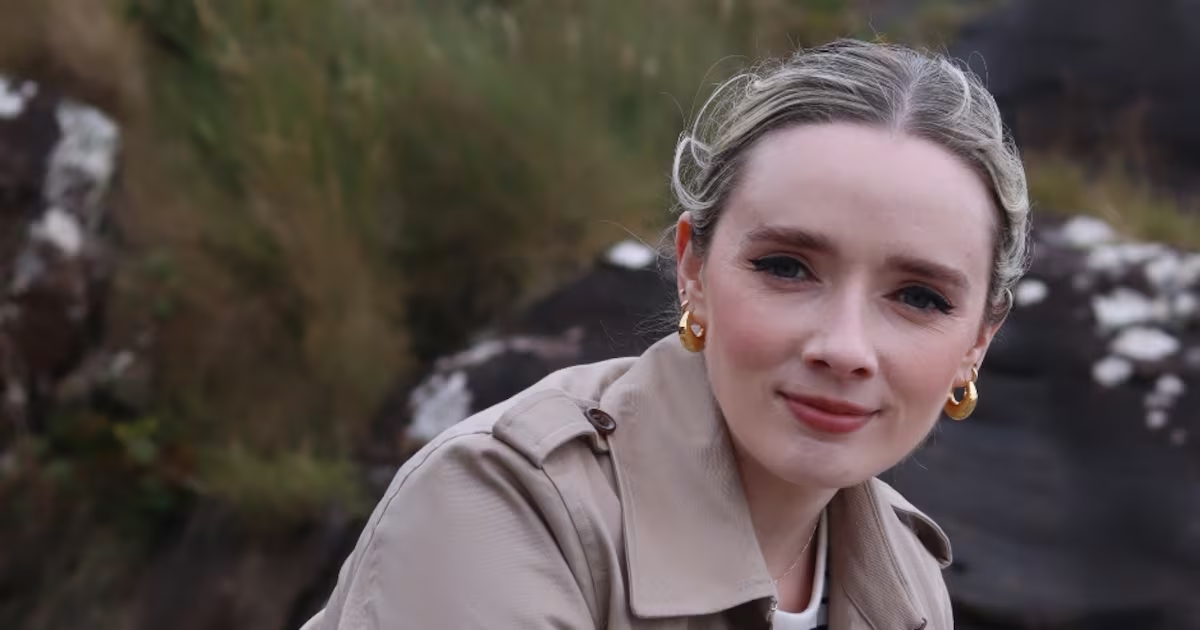
Laura Kennedy: I’m nervous meeting my brother after two years in different hemispheres
Now that both our parents are dead, he is the only other living custodian of our shared past
1,009 words~5 min read