Introduction
Good forecasts help with capacity planning and quieter alerts. But one traffic spike or memory leak can make any forecast useless. The goal is simple: prove your forecast beats a naive baseline and stays reliable under uncertainty.
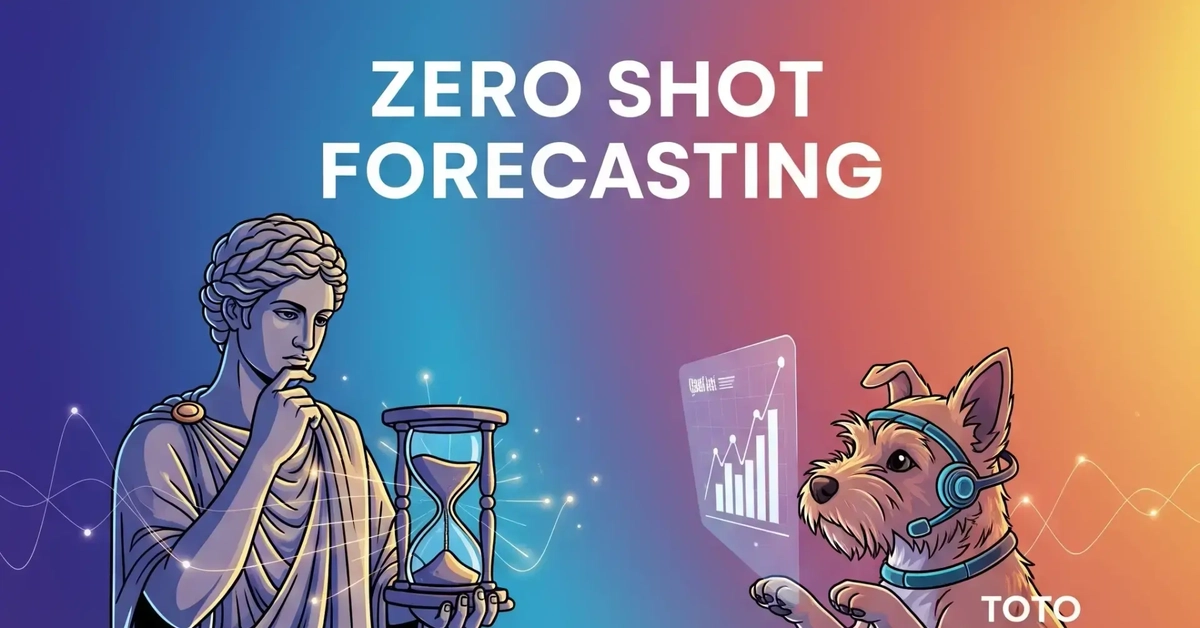
In this post, we compare two forecasting models, Chronos (Chronos‑Bolt) and Toto, on telemetry from Prometheus and OpenSearch. We judge them with two easy metrics: MASE for point accuracy and CRPS for the quality of uncertainty.
Figure: Forecast fan chart for a periodic memory signal (5m aggregation, 256-step horizon). Chronos emits calibrated 0.1–0.9 quantiles.
Long‑horizon forecasts matter for capacity planning. Teams need to anticipate storage growth, provision compute, and schedule scaling windows without constant firefighting. A longer horizon (for example, 256–336 steps) surfaces trend and seasonality far enough ahead to guide procurement, autoscaling policies, and SLO budgets.