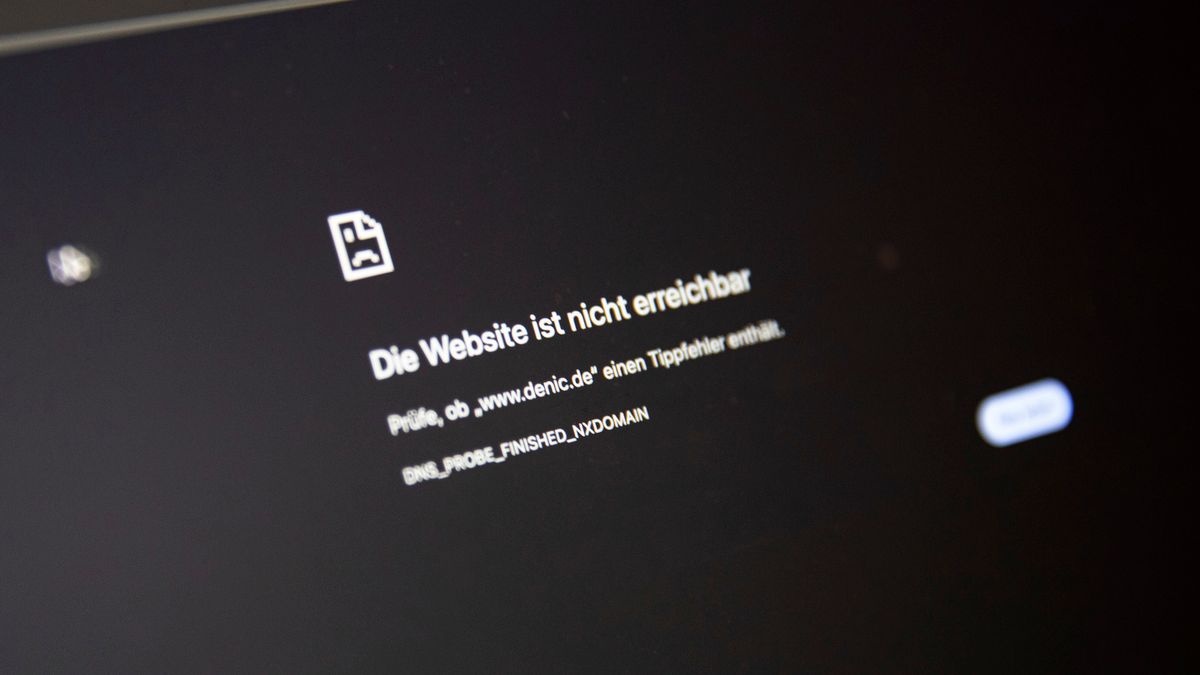
2026-05-068 min readOn May 5, 2026, at roughly 19:30 UTC, DENIC, the registry operator for the .de country-code top-level domain (TLD), started publishing incorrect DNSSEC signatures for the .de zone. Any validating DNS resolver receiving these signatures was required by the DNSSEC specification to reject them and return SERVFAIL to clients, including 1.1.1.1, the public DNS resolver operated by Cloudflare. The country-code top-level domain for Germany, .de, is one of the largest on the Internet. On Cloudflare Radar, it consistently ranks among the most broadly queried TLDs globally. An outage at this level of the DNS hierarchy has the potential to make millions of domains unreachable.In this post, we’ll walk through what we saw, the impact of these events, and how we applied temporary mitigations while DENIC resolved the issue.
How DNSSEC works
DNSSEC (Domain Name System Security Extensions) adds cryptographic authentication to DNS. When a zone is signed with DNSSEC, each set of records is accompanied by a digital signature known as an RRSIG record that lets a resolver verify the records haven’t been tampered with. Unlike encrypted DNS protocols, such as DNS over TLS (DoT) and DNS over HTTPs (DoH), DNSSEC is about integrity, not privacy. The records are visible, but their authenticity can be proven.What makes DNSSEC unique is that the signatures travel together with the records they protect. This means integrity can be verified regardless of how many caches or hops a response has passed through. A cached record is just as verifiable as a fresh one.DNSSEC is built on a chain of trust. Starting at the root zone, whose trust anchor is hard-coded into the resolvers, each zone delegates trust to child zones via Delegation Signer (DS) records. A DS record in the parent zone contains a cryptographic hash of a public key in the child zone. When a resolver validates example.de it verifies the chain: root trusts .de, .de trusts example.de. A break anywhere in that chain causes validation to fail for everything below it, which is why a misconfiguration at a TLD like .de affects every domain under it.Zones typically use two types of keys: a Zone Signing Key (ZSK), used to sign the zone’s records, and a Key Signing Key (KSK), used to sign the ZSK itself. The KSK’s public key is what the parent zone’s DS record points to, anchoring the chain of trust. Rotating a ZSK is relatively straightforward: generate a new key, re-sign the zone’s records, and wait for caches to expire. Rotating a KSK is more involved, because the parent’s DS record must also be updated, often requiring coordination with a registrar or registry.