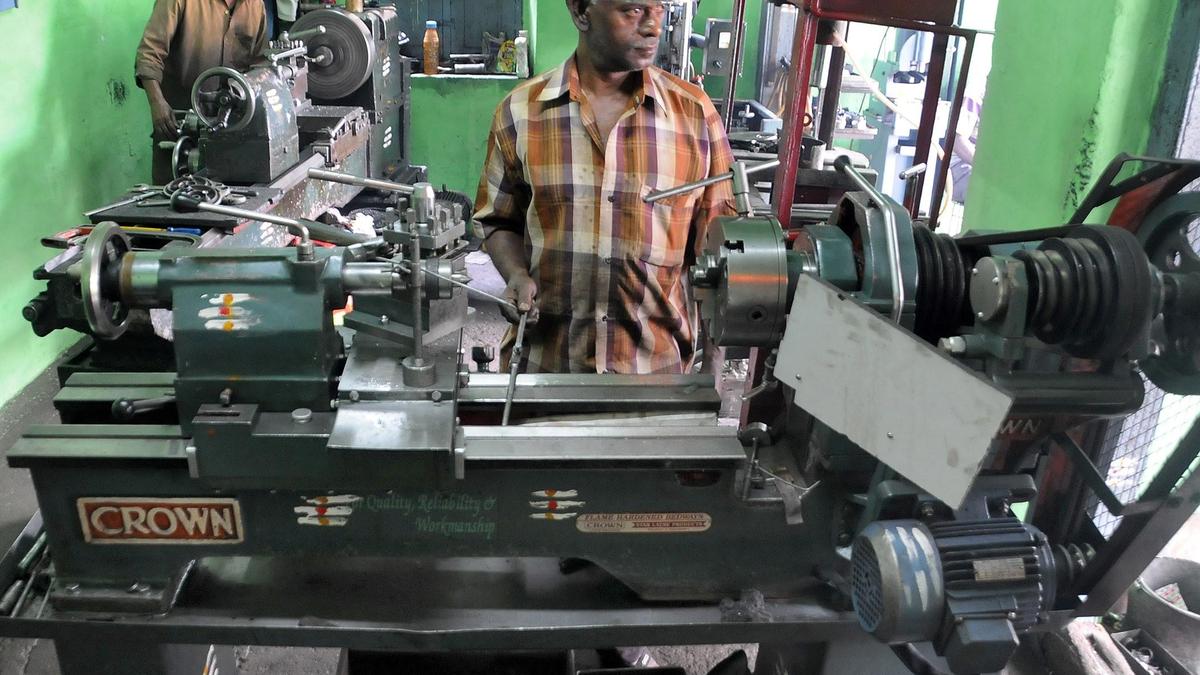
The industry also expressed concerns that the State government has dealt a double whammy on micro and small enterprises already reeling from declining orders and increasing costs.
| Photo Credit: File photo
The back-to-back fuel price hikes, coupled with the State government’s recent notification raising minimum wages by an average of 60%, have dealt a double blow to Micro, Small and Medium Enterprises (MSMEs) across the State, industry representatives said.Kamalesh Mehta, general secretary at Kumbalagodu Industries Association, said that across sectors, industries have suffered losses of around 15-20% minimum. “That’s a big one because generally the net profits are around 6% to 10%. That is completely gobbled up. Now people are simply trying to sustain until the crisis is over. Those without backup resources and capital will fall by the wayside,” he said.Cascading effectThe rise in fuel prices, which increased four times in 11 days, has had a cascading effect on MSMEs, raising logistics expenses and input costs. It has also placed an additional burden on units relying on fuel-based generators.Mr. Mehta noted that even the transportation of water has become 10-20% more expensive.“The prices of petroleum-based products have jumped up. Polymers, which you use in foam, plastics and so on, have become 40-50% more expensive. The demand is reducing. On the other hand, we are competing with Chinese products. There is no way we can sustain like this. In another 5-6 months it will be disaster,” he said.Sundaram Chandrasekaran, president of the Whitefield Area Commerce and Industries Association (WACIA) and managing director of Rajamane & Hegde Services Pvt. Ltd., said that with fuel prices rising, the electricity board may soon increase tariffs as well. He noted that while no company has shut down so far, many may have begun considering exiting the business.“All companies are internally doing everything in their capacity to increase efficiency. But it won‘t amount to much if input costs continue to increase,” he said.Delay in dispatchAccording to industry representatives, many companies have incurred not only losses but also penalties due to delays in dispatch caused by the crisis.“Several companies were unable to supply goods within the stipulated timelines, resulting in penalties, cancellation of orders, and in some cases even blacklisting by clients,” said Shiva Kumar R., immediate past president, Peenya Industrial Association.“With costs rising, many industrialists in our circles are now saying it may be better to shut down factories and lease out the premises instead, surviving on rental income rather than continuing operations,” he added.‘Double whammy’ The industry also expressed concerns that the State government has dealt a double whammy on micro and small enterprises already reeling from declining orders and increasing costs.“The Union government began increasing fuel prices soon after the Assembly elections were over. Now, the State government is also increasing labour wages. This is not the time to do it,” said Mr. Kumar.Citing increased power tariffs, higher property taxes due to the garbage cess and high EV road taxes in the State, he said that MSMEs are being hit from all sides.Industry representatives argued that while the fuel price hike has hurt businesses across the country uniformly, the steep increase in minimum wages has placed Karnataka’s MSMEs at a competitive disadvantage. “It is a death knell for small enterprises. We have to compete with other States on pricing. Until now, Delhi had the highest minimum wages, but Karnataka is set to overtake it. We will struggle to compete with neighbouring States such as Tamil Nadu and Andhra Pradesh. War is one thing, but the State government seems to be waging another war on us,” said Mr. Mehta.Mr. Chandrasekaran echoed similar concerns, noting that while companies could attempt to offset fuel price hikes by improving internal efficiencies and reducing fuel consumption, there was little room for manoeuvre when it came to labour costs.“Many companies in our association have five to ten workers. They are the mainstay of the company. They may not have much leeway in terms of reducing the labour cost. These hikes will be a deathblow to them,” he said. Published - May 26, 2026 07:29 pm IST