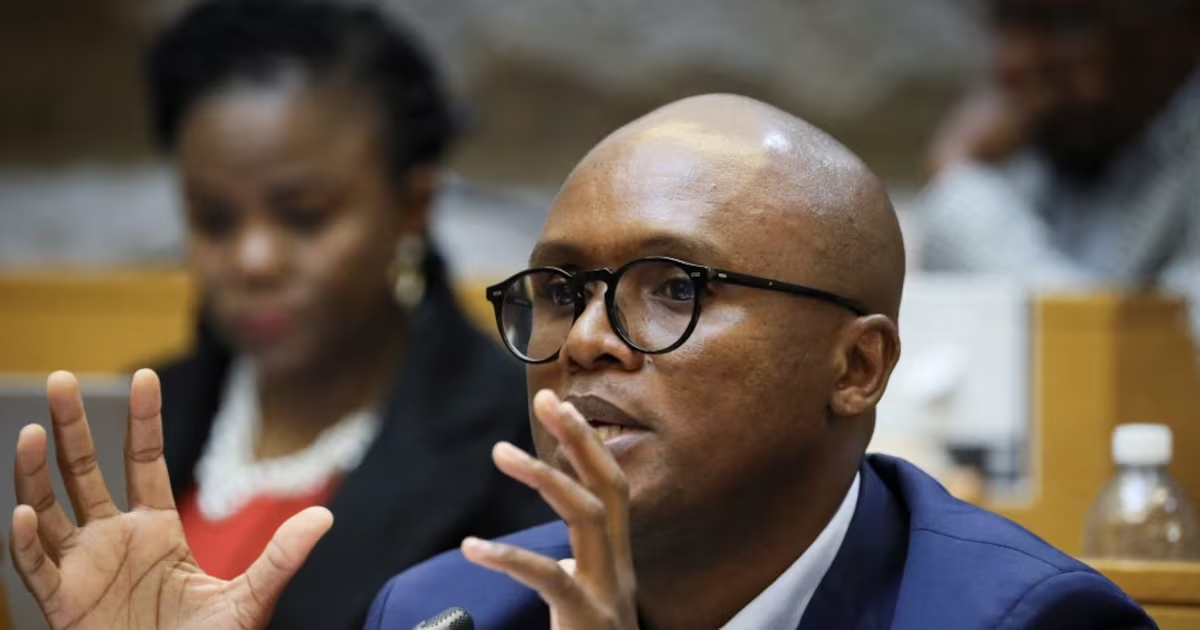
The department’s review process aims to present the updated AI policy to Cabinet by November and for public comment by January 2027. The Department of Communications and Digital Technologies (DCDT) is still targeting this financial year (2026/2027) to finalise South Africa’s artificial intelligence (AI) the policy. This, in an effort to minimise a prolonged period of a policy vacuum, said DCDT minister Solly Malatsi. The department’s delegation, including Malatsi, briefed the Parliamentary Portfolio Committee on Communications and Digital Technologies this morning, to detail reasons that led to the withdrawal of the draft national AI policy, a way forward and consequence management processes.News outlet News24 made the discovery that several of the academic journals cited in the policy document were “completely fictitious”. In the aftermath of the exposé, Malatsi and his department said they take full responsibility for the lack of “robust oversight”.As per the DCDT, the internal investigation − probing how the policy that featured as many as six AI hallucinated references was presented for public comment − is still underway, with two officials placed on precautionary suspension so far. Malatsi told MPs that as indicated in his budget vote speech, it is important for his department to begin to fix some of the fundamental errors that occurred because of the oversight. This included the move to seek experts in the AI field, governance and academia.The advisory panel, he noted, will help the DCDT in the review and authentication of the references. “We believe this is important mainly because, up until the exposé on the references, a reasonable size of the substance of the policy had not been widely contested. We issued the draft as the foundation of a document that would seek external contributions to get to the policy. “The second part is that there will still be an internal team that assists with drafting and providing support for the advisory panel, because it’s important that the department still takes a prominent role in finalising that policy. We must move with speed to minimise the prospect of having a prolonged period of a policy vacuum.“Lastly, we have finalised the terms of reference for the advisory panel and at its first meeting, it will be able to engage with the terms of reference, finalise them and roll out the project outline for the finalisation of this policy.“We are aiming to ensure we finalise and have a policy outcome by the end of this financial year, taking into consideration that there are various dependencies. Some of those dependencies involve the actual natural processes of engaging with Cabinet, engaging with timelines set out in the prescripts of publication of draft policies for public comment, and that would then eventually be able to produce a documented and AI policy that is free from any of the avoidable faults that this one fell into.”Solly Malatsi, communications and digital technologies minister. In its presentation, the department indicated the overall review process is designed to allow the revised policy documents to be submitted to Cabinet by November 2026, with a target publication date for public comment of January 2027. In addition, the DCDT is enforcing its internal responsive AI-use policy framework, which has been taken through its governance structures in the department, said DCDT director-general (DG) Nonkqubela Jordan-Dyani. Earlier this month, Malatsi said his department had appointed an independent expert review panel of astute individuals to drive the development of the country’s AI policy. Jeanette Morwane, acting deputy-DG in the DCDT, told MPs the move is to ensure the revised policy is credible, evidence-based and substantively sound.She clarified that the panel’s role will not be to draft the policy, but to be an advisory for the minister. The minister will take the panel’s recommendations, and along with a team set up in the department, the DCDT will then redraft the document.The panel will be chaired by professor Benjamin Rosman from the School of Computer Science and Applied Mathematics at the University of the Witwatersrand. The other panellists include professor Vukosi Marivate, associate professor at the University of Pretoria (UP), director of UP’s African Institute for Data Science and Artificial Intelligence, and recently-appointed member of the United Nations AI task committee; Research ICT Africa and University of Cape Town’s professor Alison Gildwald; co-head of Bowmans’ technology sector, Heather Irvine; Dr Tshepo Feela, a commissioner at the National Planning Commission; Dr Jabu Mtsweni, head of the cyber and information security centre at the Council for Scientific and Industrial Research; and advocate Lufuno Tshikalange, a legal professional at Tshikosi Attorneys. “We felt that these experts will help us ensure the policy we reintroduce later for public comments will be based on the best available evidence aligned with South Africa's priorities,” Morwane said. The panel’s mandate is advisory, and their scope is limited to the following:Assess the soundness of policy positions in the withdrawn draft, the adequacy of its evidence base and its alignment with international best practice and provided departmental framing document − that sets out the government’s strategic priorities, constitutional and legislative principles, and policy direction for the review.Identify specific sections of policy positions that require revision, expansion or removal, with supporting reasons.Recommend verified, published sources to replace fictitious citations and to strengthen the evidence base for substantive policy positions.Provide written advisory opinions on specific questions referred to by the minister.Review the draft policy document and draft discussion document at the end of the drafting phase and issue a final advisory opinion on whether the documents accurately reflect the panel’s recommendations and whether any material concerns remain.
Government sets target for ‘revised’ AI policy
The finalised AI policy is still due by the end of the financial year, after the draft was withdrawn due to “fictitious” AI input.
919 words~4 min read