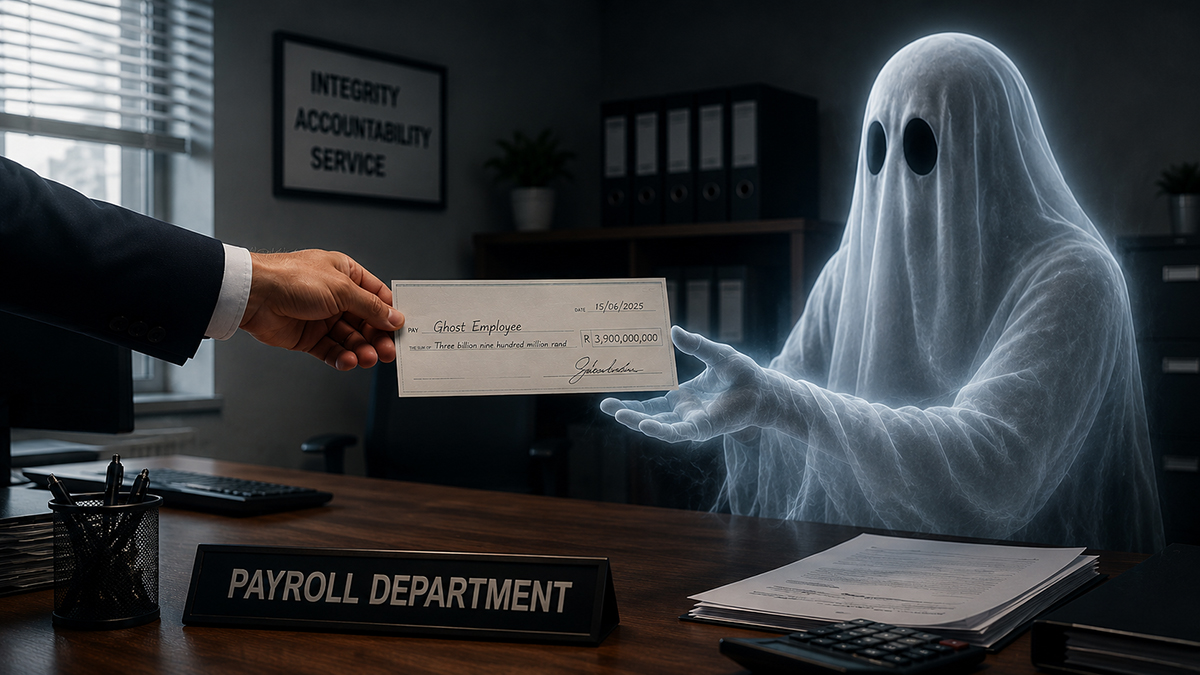
Government is not just paying ghost workers but is also dealing with broader payroll fraud and other irregularities. (Image created with GenAI) Home Affairs aims to weed out ghost employees in the civil service, which it estimates cost the state around R3.9 billion in 2025 – just under 0.5% of the state’s salary bill, ITWeb’s calculations show.A new Department of Home Affairs (DHA) platform, based on its digital identity verification capabilities and linked to the population register, is set to go live for a two-month trial period on 15 June across national and provincial departments.This move is part of a government-wide initiative to root out non-existent workers across the state, being undertaken by several departments, including National Treasury, the Department of Basic Education (DBE) and the Department of Public Service and Administration (DPSA).The “platform enables liveness tests and biometric real-time verification of employee records to ensure government personnel information is accurate, current and reliable,” the department notes in a release.Dr Leon Schreiber, Home Affairs minister, says: “If used consistently, this platform has the power to save South African taxpayers billions of rands by leveraging the power of enhanced biometric systems to identify ghost employees and others involved in defrauding government payrolls.”The DHA’s platform comes as government places more emphasis on improving the efficiency of state expenditure. Departments are now required to motivate for budgets based on evidence-based assessments rather than inflation-linked increases each year.In the latest Budget Review, tabled alongside the National Budget in February, National Treasury said: “The phenomenon of non-existent or ineligible individuals receiving state salaries has been one of the most striking weaknesses of public financial management.”Government’s 1.33 million employees cost it R852.6 billion a year. (Photograph: GovernmentZA) An audit “flagged 4 323 high-risk cases where payroll system fraud may be involved”. ITWeb’s calculations show this is about 0.33% of the 1.33 million employees just on national and provincial payroll systems – a figure derived from consolidating staff numbers in the Budget Review.The Budget Review puts the 2026/27 wage bill at R852.6 billion. Dividing this by the 1.33 million employees on the payroll gives an average annual salary of R641 000 – showing that the 4 323 cases National Treasury identified, if confirmed as phantom employees, could be costing the state R2.77 billion.The gap between this figure and Home Affairs’ R3.9 billion estimate suggests the issue extends beyond payments to non-existent individuals, to include broader payroll fraud and other irregularities.National Treasury says verified cases will be cross-checked using facial matching against the National Population Register and physical verification, in collaboration with the DPSA and DBE ghost worker projects.“The next phase of this project will integrate with the improvements to payroll systems and the rollout of a single sign-on for public servants. These changes will enable automated oversight, reduce irregularities and support more effective expenditure management,” National Treasury says.Last September, the fiscal department said it was cross-checking data with the South African Revenue Service, the DHA and other institutions to identify ghost employees, duplicate IDs, multiple salaries and unauthorised allowances using government’s payroll solution, PERSAL, as a base.Home Affairs notes the project is the latest milestone in its reform that is “anchored in driving digital transformation to build a capable, secure and modern state that uses technology to improve governance and service delivery.”
Home Affairs goes digital to catch ghosts
A biometric verification platform will launch mid-June for a two-month trial to detect ghost employees costing the state R3.9 billion.
545 words~2 min read