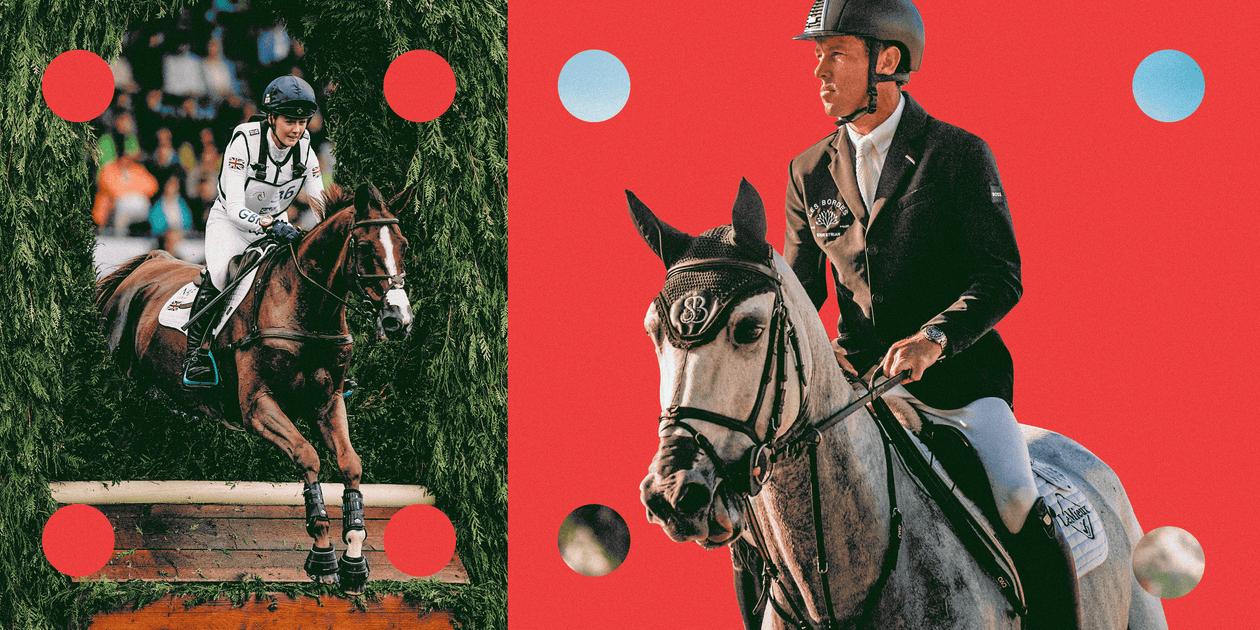
With its close connection to royalty and billionaires, it’s no surprise the general perception of equestrianism is that you need to be rich to make it to the top.Some horses sell for hundreds of thousands of dollars, even millions. Totilas, a Dutch Warmblood stallion and a dressage superstar from 2008 to 2011, was sold for $21m. At $15m, Palloubet D’Halong is the most expensive show jumping horse ever sold.While fees vary per country, British equestrian magazine Horse & Hound recently estimated it costs around £7,000 ($9,355) a year to keep a horse. Spending will go up exponentially for international events, with competitors also having to cover overseas travel, hotels, entry fees and wages for staff.As a result, it’s relatively rare for elite riders to own their own horses. Instead, horses are often owned by sponsors, investors or syndicates. Some competitors fund their careers by buying and selling horses.The presence of many well-known names in equestrian sport, ranging from Greek shipping heiress Athina Onassis, to Bill Gates’ daughter Jennifer Gates and Bruce Springsteen’s daughter Jessica Springsteen, may give the impression money rules. But many riders from far less opulent backgrounds have reached the pinnacle of the sport.Take Yasmin Ingham, a 2022 world champion in eventing with Banzai du Loir, a horse co-owned by the late Sue Davies and her daughter, Janette Chinn. Ingham grew up on the Isle of Man, a small, windswept island off the west coast of Britain with a population of around 85,000. Her mother, Lesley, who managed the local equestrian center, helped get her started on ponies and organized trips to the UK mainland for competitions.“I come from very much a working-class family,” Ingham, 29, told The Athletic. “My parents both work full time, they work incredibly hard and worked incredibly hard back then when I was younger to give me the opportunities to have a horse, because in this day and age, it’s really expensive.”Yasmin Ingham with Banzai du Loir ahead of the Paris Olympics. (Graham Chadwick / Getty Images)Living on the Isle of Man, with ferry journeys to the mainland reliant on the notoriously unpredictable UK weather, posed its own set of challenges. “It wasn’t just a case of loading the pony up onto the truck and driving an hour or two,” she said. “They sail only under a certain wind in miles per hour, so (when) it would be too windy, then you’d be stuck.”Knowing the effort her parents were making made Ingham more driven to succeed.“The ferries were £400 or £500 return, which was extortionate,” Ingham said. “So whenever I went over to the UK to compete, I did feel a bit of pressure to be successful, because of what had (gone into) that and how many sacrifices mum and dad had made for me to be able to do this. It really mattered to me, it certainly made me really think about it harder, and train harder to make sure that when we did take the trips, that we were successful.”After excelling in pony eventing as a teenager, Ingham was looking for the next step up but didn’t have the resources required. That’s where Davies, who owned Archie, the horse ridden famously by one of Britain’s best eventers, Mary King, came in. Ingham’s mother wrote to Davies asking if there might be a chance for Yasmin to work with her.A meeting over coffee, just after Ingham had won the pony European championships, led to her leaving the Isle of Man aged 16 to work at Davies’ yard in Cheshire, a county in the north west of England. While Davies watched her protégé become a world champion nine years later, she passed away in January 2023 after a long battle with cancer. Six months later, Ingham reached another milestone when she became the first Briton to win the eventing at the prestigious CHIO Aachen event in Germany.“Without Sue and Janette, I simply would not be in this position,” said Ingham, who now runs her own yard.Double Olympic champion Scott Brash grew up in the Scottish town of Peebles, where his father ran a building company. His parents helped fuel his passion in every way possible, including ferrying him to events.While Brash was already a good rider, winning the World Cup in Canada in 2011 on Bon Ami, a phone call soon after from British show jumping great David Broome changed everything. Broome, a five-time Olympian, approached Brash on behalf of two wealthy British families, Lord and Lady Kirkham and Lord and Lady Harrison, who wanted him to ride a horse they planned to buy for the 2012 London Olympics.That horse was Hello Sanctos, a Belgian-bred bay gelding. Together, the pair won team jumping gold for Britain in London and three years later, Brash became the first — and still only rider — to win the Rolex Grand Slam of Show Jumping, partnering Hello Sanctos to victory in three successive “majors,” in Geneva, Aachen and Spruce Meadows.“I’ve been so lucky in my life to meet them,” Brash said about the partnership with his benefactors, who each made their fortunes in furniture retail.“They understand that horses aren’t machines and they understand that I know what I’m talking about when I tell them that I feel X, Y or Z about the horse. They’re not the sort of owners that say ‘You’ve got to go here, you’ve got to go there’. They really let me treat the horses like they’re my own.”Scott Brash riding Hello Sanctos. (Dean Mouhtaropoulos / Getty Images)The 64-year-old King retired in March after 46 years as a professional and a career which took her to six Olympic Games, where she won three medals.“I was fortunate,” she told The Athletic. “I didn’t come from a money background. I always just had this inner drive to try and succeed. And obviously things went my way to make it happen.”As a teenager, King spent three years under the guidance of Sheila Wilcox, a former three-time winner at Badminton — a prestigious competitions held in England — who ran her own yard. Her time working with Wilcox, where she learnt about stable management, care and training of the horses, instilled in her the discipline and drive needed to succeed.“I learned a huge amount. It was really tough, hard work, but it was a great base,” said King. “Maybe some younger riders who maybe have more money (from) parents to help them at the start … they’ve got, I feel, a narrower base of knowledge.”After leaving Wilcox to set up her own yard, King said she did almost every job to make ends meet, including a butcher’s delivery round and cleaning campsite toilets. She soon realized owning her own horses did not make financial sense.“It’s just too expensive,” King said. “So I rode all my life for owners and sponsors.”While money matters, hard work and self-belief are as important when it comes to succeeding in the sport.
From cleaning toilets to wooing sponsors, versatility is key to making it in equestrianism
Not every elite rider in equestrianism comes from enormously wealthy backgrounds.
1,150 words~5 min read