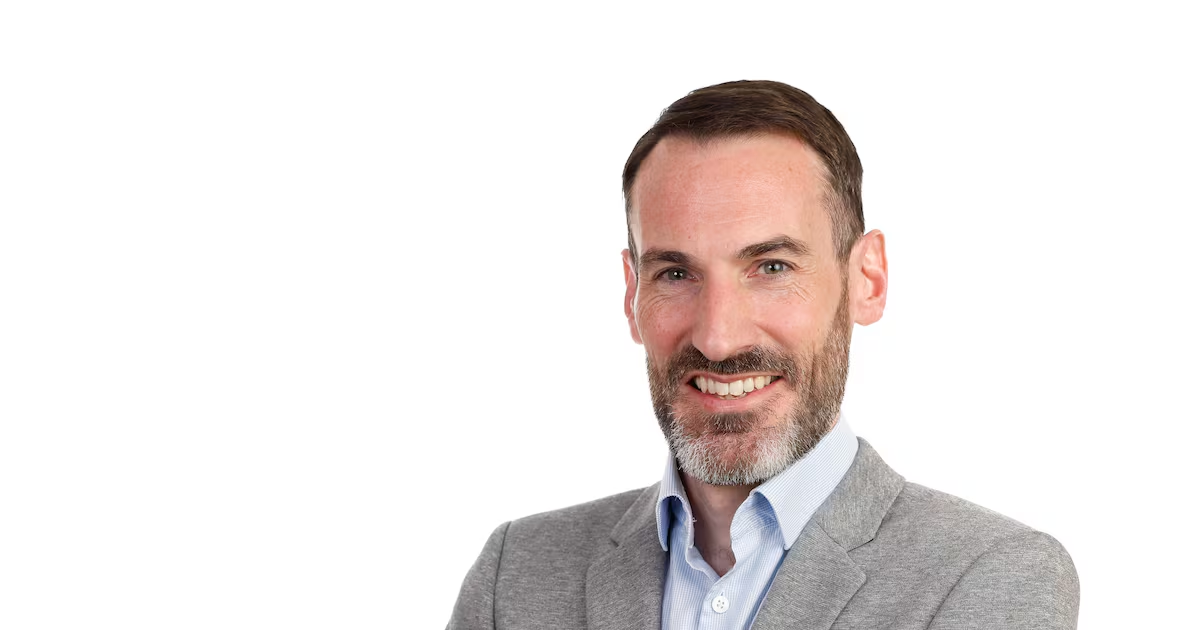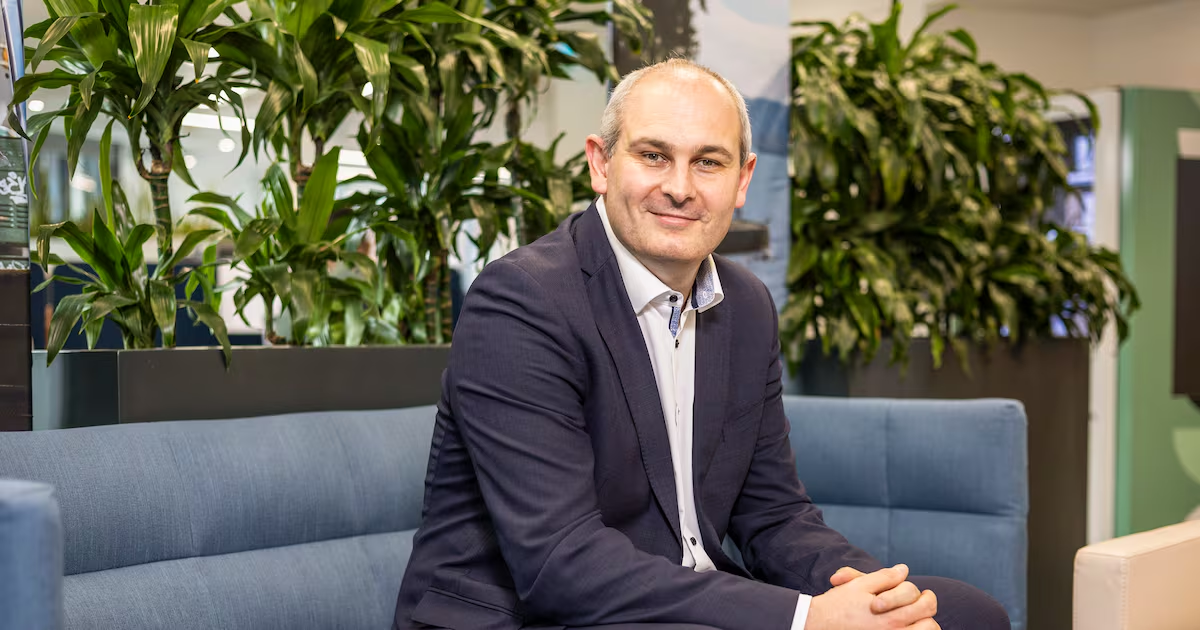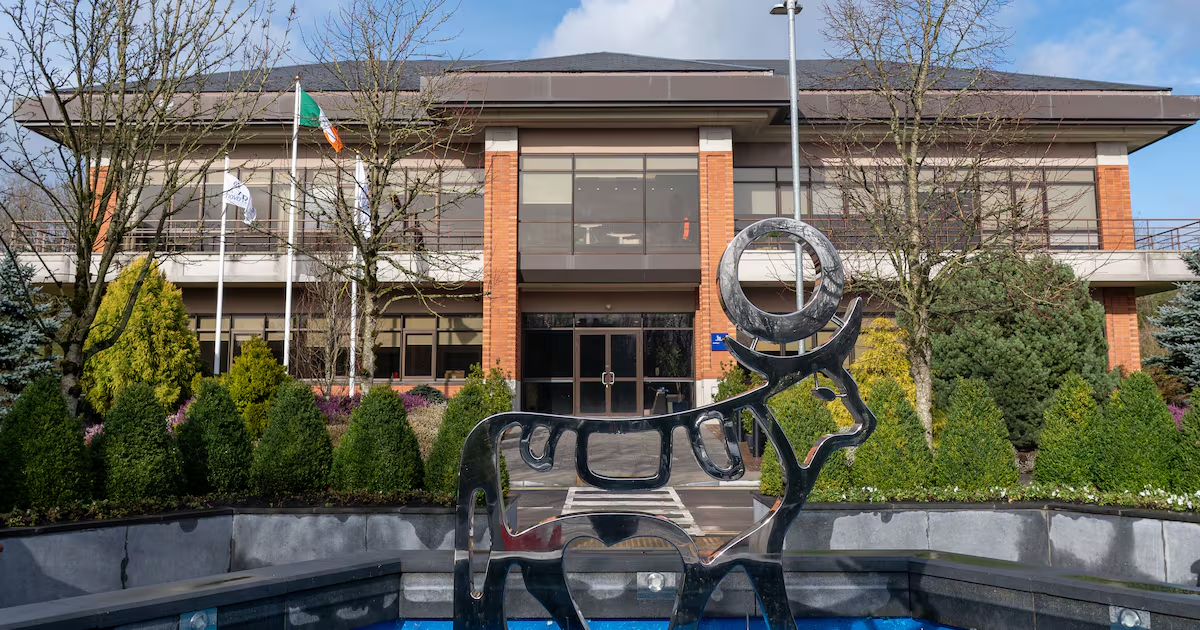
“Our economists continue to expect Ireland to remain among the most dynamic economies in western Europe, a position it’s held many times over the past five decades”.That was the assessment from Antony Jancic, chief executive of Bank of America Europe and country executive for Ireland. He was speaking at the American Chamber of Commerce Ireland’s (AmCham) Global Business Conference in February, where the strength and future potential of the two-way US-Ireland business relationship was a central theme.Reflecting on Ireland’s importance to the US and beyond, he said: “As we all know Ireland is a critical partner for the US and a vital player in the global economy.”Speaking at the conference, which was sponsored by Bank of America, Jancic also highlighted the two-way nature of the transatlantic relationship, noting that, “yes, the US remains a vital source of foreign investment into Ireland ... but Ireland is well established among top 10 investors in the US and an especially big driver of new investments”.Antony Jancic, chief executive of Bank of America Europe and country executive for Ireland The significance of the US market to Irish companies cannot be overstated as highlighted by Mark Christal, executive director, sectoral and client solutions at Enterprise Ireland.“The US is a hugely significant market for our clients,” he said. “Many of our companies are key employers in the United States ... so it’s very much that two-way relationship. I think we see huge opportunity for more and to expand on that.”Reflecting on the factors that have enabled Irish companies to scale successfully in the US, Catherine Keogh, chief corporate affairs officer at Kerry Group, pointed to the foundational role the market played in the company’s growth.“The US was formative – massively important for us in the beginning,” she said. “The sheer access to the scale and the ability to grow and thrive in an environment that was very investment friendly, that was very innovative.”That early opportunity has now been translated into a significant footprint today. “We have about 5,500 employees across the US. We have six different plants right across the US, in the heartland.”While Kerry Group is one example of this success, the scale of the broader US-Ireland economic relationship is reflected in AmCham’s 2026 report, A Partnership that Delivers, which shows that Irish companies employ more than 200,000 people across all 50 US states and have invested $390 billion (€336 billion) in the US economy.On the other side of the Atlantic, US companies directly employ about 245,000 people in Ireland and in 2024 spent €42.3 billion in the Irish economy. This investment is underpinned by decades of Ireland providing a stable, pro-enterprise economy.Paul Sweetman, chief executive of the American Chamber of Commerce Ireland and Edward S Walsh, US ambassador to Ireland That strength was reflected in discussions at the conference, where, speaking during a fireside chat with AmCham chief executive Paul Sweetman, US ambassador to Ireland Edward S Walsh said that for business, “I’m not sure there is a better time in Ireland’s history.” That strength is driven by what Ireland offers as a location for investment. “What people get when they come to Ireland,” said AmCham president Mark Cockerill, “is very simply not only an educated workforce, not only the only English-speaking common law jurisdiction in the EU, but they get a group of people who have done it and seen it and experienced it.”Stability remains another key differentiator. As Feargal O’Rourke, chairman of IDA Ireland, said in a keynote address: “In a sea of turmoil, Ireland is an oasis of stability – and that stability is a real positive at the moment.”Reflecting on Ireland’s success in attracting FDI, he said, “We are world class as a country in attracting FDI, we are the envy of many, many other countries.” However, he cautioned that while Ireland has enjoyed a “monumentally successful decade”, now is “not the time to rest on our laurels” with further progress needed in areas such as regulation and simplification to ensure Ireland has “another fantastic decade”.At a European level, regulatory complexity was a key topic of discussion. Marjorie Chorlins, senior vice president for European affairs at the US Chamber of Commerce pointed to a “build up, layer upon layer of regulation” over the past decade that makes it increasingly expensive to do business in Europe. “That’s why it is so important for Ireland to leverage its upcoming presidency of the European Council to really drive forward this effort on regulatory simplification,” she said. “We have always looked at Ireland as a voice of reason at the European decision-making table, now is really the time for Ireland to step up, sustain that activity and really drive it forward.”This was echoed by Thibaut L’Ortye, chief policy and public affairs officer at AmCham EU: “We need to make it easier to do business in Europe because it’s in Europe’s interest.”Moderator Colm O’Callaghan, director of public affairs and advocacy, American Chamber of Commerce Ireland; Catherine Keogh, chief corporate affairs officer, Kerry Group; Michael Lohan, chief executive, IDA Ireland; Marjorie Chorlins, senior vice president for European Affairs, US Chamber of Commerce; and Mark Christal, executive director, sectoral and client solutions, Enterprise Ireland Ensuring Ireland’s talent pool has the skills in place to meet emerging technologies such as artificial intelligence (AI) was another topic of discussion at the conference.Deirdre Lillis, president of Technological University Dublin (TU Dublin), highlighted the challenge for universities in keeping pace with rapid technological change: “It is really challenging for a university because the people that are there to impart the skills are struggling themselves, not only to get up to speed, but to get out ahead of it.”She pointed to further collaboration between industry and academia as a critical solution. “A large part of the way we do it certainly in TU Dublin is the conversations with industry” which “keeps us all up to date”, she said.Joe Bolger, vice president, factory and co-general manager at Intel Ireland, acknowledged that with regard to AI adoption, Ireland is not facing a “talent problem” but a “scale and a speed problem”.However, he said that as a small country, Ireland “can be nimble and we can collaborate together; and we do. We can leverage that to our advantage and we can be a leading light then in Europe by accelerating and demonstrating speed.”Moderator Aoife O’Brien, communications manager, American Chamber of Commerce Ireland; David Riggs, associate vice president, medical and scientific capabilities, Eli Lilly; Joe Bolger, vice president, factory and co-general manager, Intel Ireland; Deirdre Lillis, president of Technological University Dublin; and Jonathan Hyland, chief technology officer, Workhuman Emma Redmond, associate general counsel and head of OpenAI Ireland, highlighted that when it comes to AI adoption, while Ireland has the “fundamentals in our favour”, including a “fusion of tech and talent” and a culture of innovation, Ireland must now “take it up another level”.She said that Ireland must now focus on “what can we specifically get out of [AI adoption]”. She emphasised that partnerships between Government and industry will be key. “If Ireland could do that on a kind of national basis and think about what partnerships may work ... that could be really, really profound.”AmCham’s Global Business Conference will return to Croke Park on Wednesday, February 24th, 2027. AmCham members can book their tickets at members.amcham.ie. Bank of America sponsored the 2026 conference, the US Chamber of Commerce was AmCham’s 2026 US conference partner and The Irish Times was AmCham’s 2026 official media partner.
US investment in Ireland: ‘I’m not sure there is a better time in Ireland’s history’
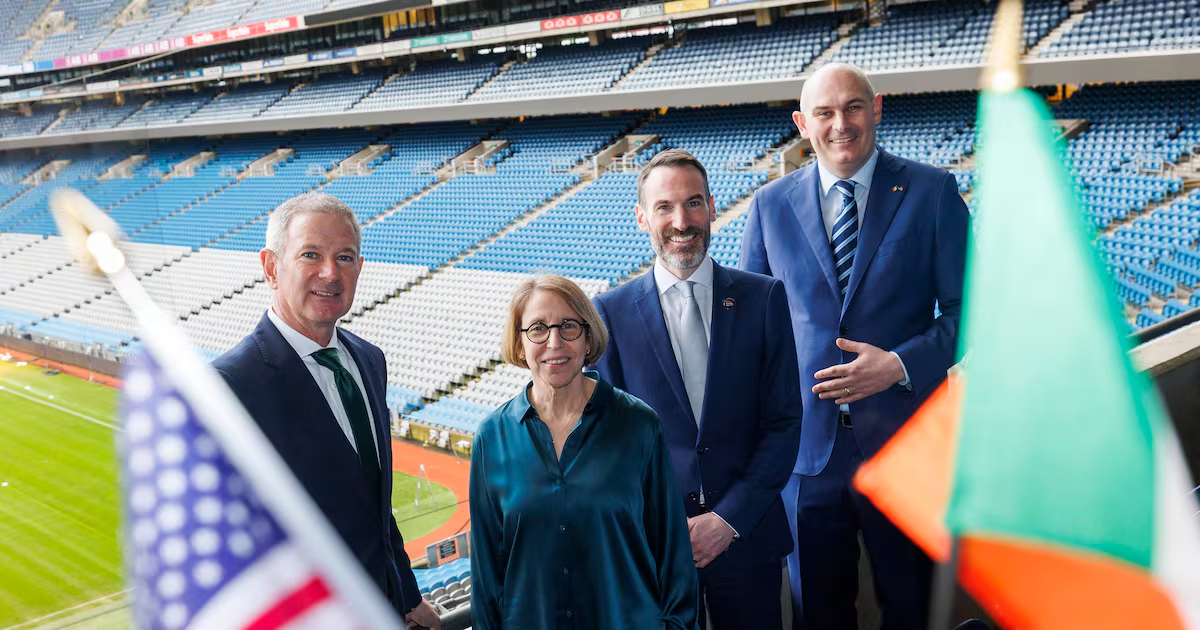
The American Chamber of Commerce Ireland’s Global Business Conference will return to Croke Park on Wednesday, February 24th, 2027
1,239 words~6 min read