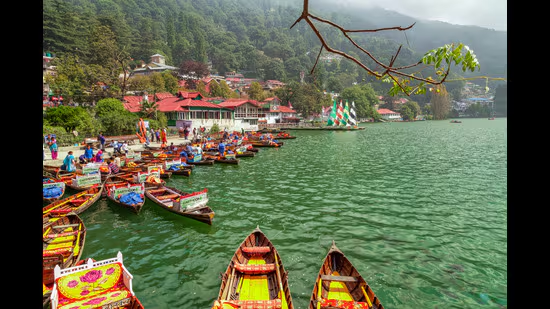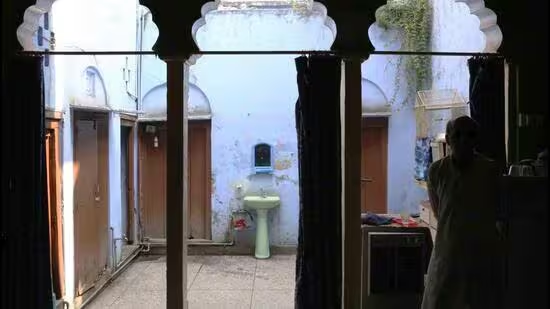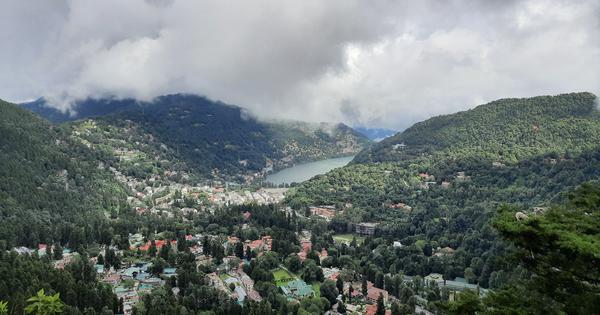
One imagines life in a small mountain town to be laid back and slow-paced. And it is. Yet, small towns are also abuzz with idle chatter – ranging from world events to the most local affairs. Affairs of the heart, drunken brawls, witty repartees, household intrigues, club gossip, government dealings, lawyers’ protests, cleanliness drives, cross-country runs, mountain biking, local fairs, silent protests, ghost stories and endless tittle-tattle are the only interruptions in the clockwork routine of a Nainitalwala’s life.Back in the day, social etiquette and cordial hill culture were adhered to with utmost attention. Discerningly monogrammed, handwritten invitations, delivered by couriers, were the norm. A few old timers still follow that tradition, though most have now switched to WhatsApp invites – overrun with emojis! One’s social calendar was always full: morning walks, sailing practice, boat races, at-home elevenses, Sunday tennis matches with cucumber sandwiches paired with a pot of tea – my grandmum’s pick was always Darjeeling or the fragrant orange pekoe. If the governor made it to a tennis match, it was a grander affair (most homes had a tennis court, thanks to the Brits’ meticulous town planning). Lunch parties, flower competitions, dog shows, fancy dress competitions or a game of housie – there were ample social engagements to pick from. There were also picnics at Chorkhet’s gushing spring, back then still untouched by tourists and forest cookouts at the Kilbury Dak Bungalow. Evenings would be spent tending to one’s garden, enjoying a theatre performance at Chalet Hall, or a film at Capitol Cinema or Ashok Talkies, then taking a quick stroll down to the Boat House Club for a game of rummy or bridge, a bit of billiards and finally ending the day with a glass of local ale at the charming bar lounge. The Boat House Club bar was a world unto itself. A crackling fire, a piano tucked away in a smoky corner playing soulful melodies, and oil-lit lanterns hanging from the wooden rafters bathed the room in a warm glow. The pine wood pillars reeking of turpentine varnish stood tall beneath sailing shields hung on the glossy walls. The bar has seen many a men raise a celebratory toast and just as many falls from grace.The entrance door of the Boat House Club bar lounge bore a conspicuous sign in bold letters: CHILDREN NOT ALLOWED. A rather imposing rule that made us shudder even at the thought of stepping into the bar. We would crane our necks in through the heavy door to catch a glimpse of the Burra Sahibs chugging on their drinks and smoking cigars. Today, my mates are happy to have crossed the Rubicon – straight onto the barstools themselves.I must admit that our parents’ generation was full of fascinating personalities, and one of them was Wing Commander Pratap Singh Negi from the Indian Air Force (IAF). He was a creature of habit and so were his golden retrievers, who waited for him outside the club entrance stairs every evening. At the stroke of 6 pm, just as he finished his second peg of a chota whisky in the Humms Corner of the bar, his dogs would begin to bark – an unfailing signal that it was time for their master’s retreat home to Pilgrim Cottage. Reminiscing about those days, the late Kunwar Madhav Prasad, a philanthropist from Pilibhit, recalled, “The club had a strict steward, Mr Clark, who saw to it that no children were seen in the club after 7 pm. Entry to the bar lounge in the evenings required a coat and tie and he enforced the dress code without exception. An awkward situation arose when he objected to a Mr Kedia entering in Indian dress. The matter escalated, reaching all the way up to Chief Minister Sampurnanand, who decreed that Indian dress for the bar-lounge should include a sherwani or a closed collar coat.”The Grand Hotel still stands where it was a century ago – on the Mall Road facing the lake. Though the colours of the building’s facade have faded with time, Geeta Pande, wife of second-generation owner Aju Pande, takes special interest in retaining its exact shade of green. It’s an arduous process of mixing colours, one that only she has perfected. In 1976, disaster struck. There was a fire in the hotel caused by a careless guest who failed to extinguish the fireplace before leaving his room. One of the smoking pieces of wood rolled onto the pinewood flooring and the rest was history. The blaze was eventually brought under control and the Pande family lovingly restored the hotel to its glory. Today, electric heating offers a safer alternative in this charming space. Geeta Pande’s daughter, Devika Pande, recounts a moment of high drama that took place at the Grand in the late 1980s – one that has since entered the town’s local lore. “A sudden commotion had broken out among the staff; we heard shouts of ‘Ghora gir gaya, Ghora gir gaya!’ We rushed in and saw the unbelievable sight of a horse, with two riders, that had fallen off the Upper Cheena Mall straight onto the first-floor landing of our hotel. Miraculously, the horse and the riders were unhurt. Soon, scores of horsemen and the public gathered at the hotel to watch this bizarre spectacle. The terrified horse kicked furiously until it was blindfolded, which calmed the animal down for a bit. Then ‘mission horse’ was set rolling. To get the horse down to the ground floor, it had to be walked through the back door of a bathroom into the bedroom, across the sitting room, then onto the front landing of the hotel. From there, the animal was led through the entire length of the corridor, its aged mosaic flooring covered with tons of towels to prevent it from slipping. The trickiest bit was to make the horse walk down two wooden staircases. With much effort, the horse was guided down, forced to make a turn and walk again till he came out via our reception staircase onto the driveway and out of the hotel gate onto the road. The horse’s departure drew resounding cheers from all the onlookers, delighted by the day’s share of comic relief.”The British engineered the Mall Road to their convenience. Along the lakeside, they paved a kuccha road a few metres above the lake’s water level as the lower Mall meant for “Indians and Dogs”, and a 10-feet high path above the lower Mall reserved for the “Gora Sahibs and Memsahibs”. It was a constant reminder of their brutality. That was pre-independence India. Today, we are far removed from that past. The high street now bustles with vehicles, cycle rickshaws and people filling both levels of the road. In 2021, the lower road facing the Grand Hotel collapsed into the lake – a sign of the strain modern traffic places on hill roads that were designed primarily for pedestrians. The Mall Road continues to be a hive of activity. If you have a couple of hours to spare, you could grab a perfect espresso with the fluffiest pineapple pastry at Sakley’s, enjoy a mug of chilled beer at Café Lakeside or slip into my favourite haunt – Narain’s Book Store.There, the ever-polite and erudite Pradeep Tewari will guide you through his now rather modest but compelling book collection, all the while gracefully handling his ever-lit cheroot. Just a few steps away lies the matchbox-sized iconic beauty salon, Good Luck. Once known for its neat haircuts and a 1970s-style champi, it now offers a Shahnaz Husain diamond facial. In the old days, a whiff of the buttery popcorn from the machine right outside Good Luck would mean you went back home munching on some. Next to the popcorn station, and a climb past the clutter of the wooden toy shop, will lead you to Virdi, the only piano tuner in Nainital. A violin teacher at All Saints’ School, he is just as likely to be found playing the Raag Tilak Kamod on his sarangi. Ever so often, he comes to Abbotsford to tune our German Steingraeber & Söhne upright piano. Hand-pulled rickshaws once plied the Mall until the early 1980s. I remember using them often, travelling from Mallital to Tallital. In 1942, 10 three-wheeled cycle rickshaws were launched, which have since swelled in numbers. Used extensively by the locals, they are an efficient, eco-friendly remnant of the past. More recently, energy-efficient, battery-run e-rickshaws have been plying from one end of the lake to the other – yet another milestone in the inevitable cycle of change. The cycle of transformation has not spared even the Naina Devi temple. Dedicated to the Goddess Narayani of the Naini lake, the temple was first erected in 1842 by Lala Motiram Sah, a banker and a contractor, beside the Hindu dharmsala set up by Perambar Baba, a revered fakir, in 1840, a year before Barron’s discovery of Nainital. The temple even appears in an 1865 photograph by Samuel Bourne, where two modest domes can be seen nestled among the willows. Tragedy struck in 1880 when a massive landslip destroyed the temple. In 1883, his son Amarnath Sah reinstated the temple at a new site which is where the present Naina Devi Temple stands. Today, the temple with its traditional hexagonal red dome and saffron flags fluttering in the Himalayan wind, is visible from afar – a symbol of both devotion and resilience.Excerpted with permission from Nainital: Through Memory, Stories and History, Janhavi Prasada, Roli Books.
In a new book, a writer captures the thrills of a scenic, slow-paced life in her hometown, Nainital
An excerpt from ‘Nainital: Through Memory, Stories and History’, by Janhavi Prasada.
1,590 words~7 min read