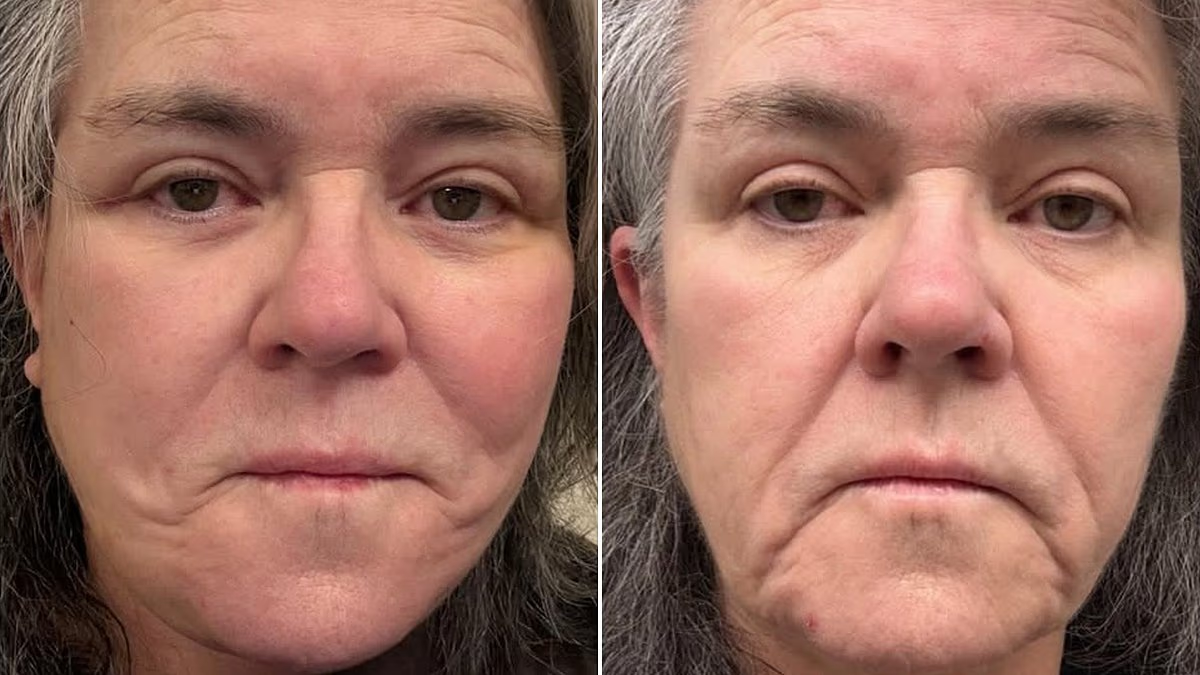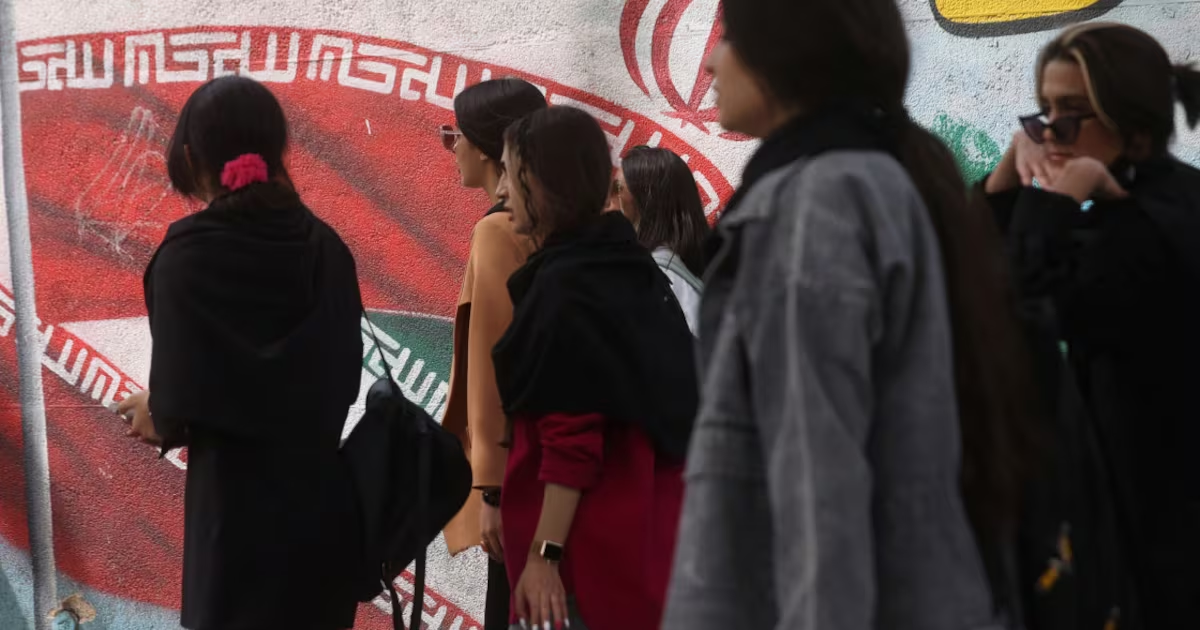
Plastic surgeons often say that the hardest part of a rhytidectomy (the medical term for a facelift) is not the procedure. It’s getting the patient to look honestly in the mirror beforehand.That’s after the surgeon has checked that the underlying facial structure is sound.Feminism faces the same, if somewhat more fundamental, problem.The mirror is there. The patient’s reflection is unflattering. Its underlying structure is unsound. That vital, once-magnificent, women’s liberation movement has been averting its eyes for decades.Consider what feminists don’t want to see: imagine a movement dedicated to women’s liberation that responds with silence to the mass rape and genital mutilation of women and young girls; a movement that, in its more creative moments, responds to evidence with elaborate theoretical frameworks explaining why the perpetrators are victims.You might call it a farce, a misuse of language, an ethical conundrum dressed up in academic jargon. Or you might call it the global feminist movement.The rot is not uniquely Western, though Western feminists are the noisiest participants in their own undoing.Demonstrators light candles during a protest in Athens, Greece, after the death of Mahsa Amini in Iran in this file photo taken on October 29 2022. ((Reuters, Louiza Vradi)) It defines the global feminist response to the Hamas-led mass rape of October 7 2023 in southern Israel and to the Iranian protests that began with the death of Mahsa Amini in September 2022, with women still risking their lives in one of the 21st century’s most viscerally brave rebellions.Women have torn off their hijabs in Tehran’s streets and refused to sing the national anthem. They’ve been hanged (not executed, which implies a fig leaf of legality) publicly from cranes by the Islamic Revolutionary Guard Corps (IRGC) for the “crime” of wanting to live in a free society.The mullahs’ use of sexual violence as an instrument of state is not new. A fatwa attributed to Ayatollah Khomeini in 1988 held that virgin women could not be executed since, in their theology, virgin martyrs go directly to paradise. The regime was unwilling to bestow that reward on its enemies.The IRGC had a solution, as documented in the memoir of Khomeini’s designated successor, Hossein Ali-Montazeri: prison guards defiled virgins by raping them the night before killing them. The next morning, their families received a box of sweets, celebrating their daughter’s “marriage”.The practice did not die with Khomeini.During the 2022 Woman, Life, Freedom uprising, Amnesty International documented the rape of protesters as young as 12 by IRGC and Basij paramilitary forces (street-level thugs with religious sanction). Detainees reported sexual assault during protests in January 2026, crushed with organised brutality.The feminist movement’s response globally? The sound of one hand clapping. No Instagram carousels, candlelit vigils, declarations of solidarity from former Harry Potter stars or marches through central London.These feminists are occupied elsewhere, mostly with Gaza. They stayed silent even after the extent of Hamas-led sexual atrocities on October 7 became known.British historian Simon Sebag Montefiore, writing in The Atlantic on October 27 2023, compared October 7 to “a medieval Mongol raid for slaughter and human trophies — except it was recorded in real time and published to social media”.Hamas apologists “belong to the same tradition as leftist intellectuals who supported Stalin and peace activists who excused Hitler, but worse”, Montefiore wrote.Joan Smith, former chair of the mayor of London’s Violence Against Women and Girls Board, documented the evidence in forensic detail in UnHerd in December 2023. She named the response what it was: industrial-scale rape denial.In March 2024, UN special rapporteur on conflict-related sexual violence, Pramila Patten, found “credible evidence” of rape and gang rape at multiple October 7 locations. In November 2025, UN special rapporteur on violence against women, Reem Alsalem, (pause for the irony of her title) posted on X that “no independent investigation found that rape took place on October 7”, directly contradicting her colleague’s findings.The hashtag, #MeTooUnlessYouAreAJew, that followed October 7 wasn’t coined by the right. It was bitter recognition by women told with elaborate politeness that their rape did not happen; did not count.The evidentiary landscape shifted decisively on May 12 2026, with the publication of the landmark report titled “Silenced No More” by the Civil Commission on the October 7 Crimes by Hamas Against Women and Children — CC07 for short. It’s an Israeli NGO with international focus, led by attorney and international law expert Dr Cochav Elkayam-Levy.Its report is the first to assemble, verify and analyse systematically the evidence on sexual atrocities during the October 7 terror attack and in captivity. It draws on uniquely constructed, independently secured war crimes archives.‘Rape is resistance’Researchers reviewed more than 10,000 photographs and videos, more than 1,800 hours of footage and more than 430 testimonies. They identified 13 recurring patterns: rape, gang rape, sexual torture, forced nudity, postmortem abuse, public display of victims and deliberate filming and dissemination of sexualised violence.They also documented largely overlooked sexual violence against men and boys and coined the word “kinocide” for deliberate destruction of family bonds as a weapon of war.The report concludes that sexual violence was “systematic, widespread, deliberate and integral”. Their 70-page legal section argues that the documented acts support prosecution for war crimes and crimes against humanity across 52 nationalities.US psychologist and clinical supervisor Zain de Ville has a dark perspective on October 7.On Substack, May 22 2026, De Ville argues that the evidence, including repeated postmortem sexual acts, genital mutilation, burning and staged arrangement of corpses, cannot be explained as battlefield chaos, individual pathology or the conventional psychiatric profile of necrophilia.It was “corpse-directed sexual violence that became collectively permitted, psychologically reinforced and integrated into ecstatic group violence”.What emerged was not simply “violence continuing beyond death, but an elaborate sexual process in which death itself is central”.That was not private deviance. It was organised obscenity. It “collides violently”, De Ville writes, with the humanitarian language through which the Palestinian cause is framed and defended.An example of that collision: anti-Israel protestors supporting Hamas with posters declaring “Rape is resistance”.The CC07 report is endorsed by, among others, David Crane, founding chief prosecutor of the UN Special Court for Sierra Leone; former US secretary of state Hillary Rodham Clinton; and former Israeli Supreme Court president Aharon Barak.Their endorsement alone should silence those who would dismiss it as partisan.It won’t, because the silence is not absence of evidence; it is prior commitment to a conclusion dressed in the language of scepticism. Thus, prosecutors will study the report, professors will ignore it, lawyers will cite it in The Hague and TikTok will dismiss it.That is not cynicism. It is pattern recognition.One torch-bearer of that pattern is named in the CC07 report: Judith Butler, distinguished professor of comparative literature at the University of California, Berkeley.One might have expected Butler, one of the most influential gender theorists of the past half century, to lead the feminist charge against the sexual violence of October 7. One would be serially disappointed.In December 2023, Butler publicly demanded “documentation” for October 7 rape crimes, whose victims were largely dead. In March 2024, at a Paris roundtable, she called October 7 “armed resistance, not a terrorist attack … not an anti-Semitic attack”.She declared that “feminism, queer mobilisation, trans mobilisation have to all be in solidarity with Palestine now”.When challenged, Butler said that she had condemned the massacre immediately after October 7. That’s true, and it makes her subsequent remarks a reveal, not a retraction.No acknowledgment of sexual violenceThe global feminist establishment’s response remains a masterclass in silence and denialism.South African feminists have mostly followed suit, despite the country’s dubious distinction as one of the world’s rape capitals, with gender-based violence (GBV) so endemic, it has been declared a national crisis.Its ANC government, whose women’s league loudly campaigns against GBV at home, launched a genocide case against Israel at the International Court of Justice within weeks of October 7, without even vaguely acknowledging the sexual violence that helped trigger Israel’s war against Hamas.At the moment of reckoning, the country that built its moral authority on the apartheid struggle chose to see only one set of victims.The feminism of the ANC Women’s League has clear terms and conditions: Jewish and Iranian women need not apply. Neither should Congolese women.In Democratic Republic of Congo, nearly 40,000 women were treated for sexual violence in North Kivu province in 2024 alone, according to Doctors Without Borders (MSF). The record rose into 2025. The perpetrators were soldiers and militia from multiple warring factions.The ANC government that rushed to The Hague to prosecute Israel stayed silent.In Tablet magazine in May 2026, UK journalist Nicole Lampert and historian Zoe Strimpel ascribe the silence to feminism’s historial, structural “Jewish problem”.Their magisterial article links feminism’s fracture to converging forces: feminism’s absorption into Soviet-era “Zionology” from the 1970s — a Cold-War strategy fusing Nazi-like ideas about Jews with anticolonialism language; the rise of identity-based feminism; and social conformity.This gave the global left a framework in which Zionism equals racism and Jewish women equal the enemy, they say. It created an oppression hierarchy with Palestinians above Jews and decolonisation above sexual violence, rendered October 7 ideologically “inconvenient”, and made condemning the silence professionally damaging.They report the testimony of Freya Papworth, a non-Jewish psychotherapist with FiLiA (a UK feminist group), who found herself watching women argue over whether a young Israeli woman’s bloodied crotch indicated rape or handcuffs.Her verdict: “This wasn’t feminism, or at least a feminism I recognised.”“Recognised” is the operative word. Feminism has become unrecognisable not to its enemies, who caricature it, but to the women who built it. As Lampert and Strimpel concluded: “Sisterhood — if that ever truly existed – still can’t seem to get over its problem with the Jews.”Into this landscape strolls Sophie Lewis, German-British US-based author of an essay in Salvage magazine, “Some of My Best Enemies Are Feminists: On Zionist Feminism”, in March 2024.Lewis dismisses documented October 7 sexual violence as “femonationalist” propaganda and concludes, without apparent irony, that “treachery to Zionism is loyalty to humanity”.She says nothing new, just updates an old playbook with better footnotes. She spreads the peculiar notion that women who are Zionists cannot be feminists.Israeli-American journalist-activist Emily Schrader saw that coming in the Jerusalem Post in 2020. She argues that Zionism and feminism are “two sides of the same coin”, because both are movements for the self-determination of historically persecuted groups.October 7 proved that in the most devastating way imaginable.Feminism, fortunately, was never exclusively Western. Egyptian feminist Huda Sha’arawi removed her veil in 1923. ANC women fought patriarchy alongside apartheid. Iranian women marching today, Sudanese women central to the revolution against Omar al-Bashir, Afghan women teaching girls in secret — these are all feminists.Their courage makes Western academia’s theoretical disputes a luxury problem at a safe distance from consequences.The Iranian uprising slogan says it all: “Zan, Zendegi, Azadî (Woman, Life, Freedom)”. It translates “Jin, Jiyan, Azadî”, the Kurdish liberation movement’s rallying cry.Iranian and Kurdish women, separated by language, ethnicity and borders, found a common tongue of resistance, without any Western NGO, Instagram carousel or university panel discussion.Feminism needs more than a facelift. It needs a reckoning with its contradictions, selective solidarities and limitless capacity to look away when victims are the wrong kind of women.Because right now, a woman in Tehran is risking her life for the right to take off a headscarf. And the movement that should be her loudest advocate is explaining why the real problem is Zionism.That is not feminism. It is feminism’s obituary.
BIG READ | Feminism fails victims who are the wrong kind of women
The movement is silent over sexual violence in Israel, Iran and the DRC
1,901 words~9 min read