Mango economy worth over Tk 400 crore projected, up from Tk 350 crore last year
13 May 2026, 10:06 AM
Ahmed Humayun Kabir Topu
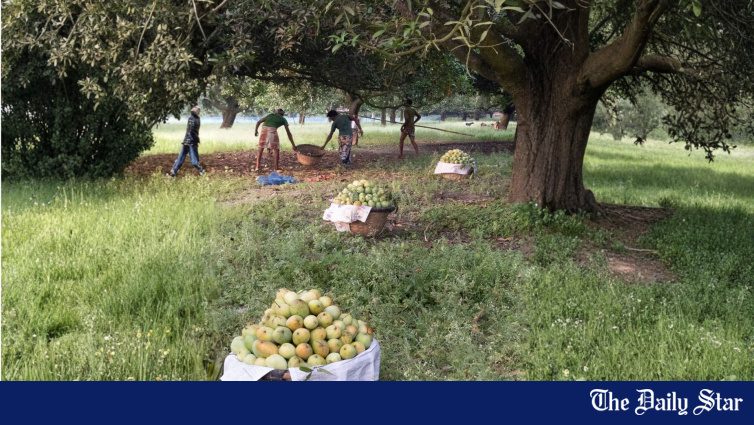
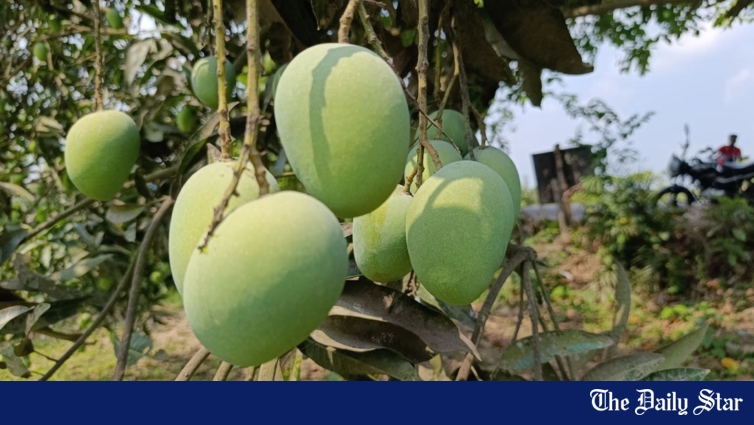
In villages like Gouripur, Gopalpur, and Mominpur, the abundance of fruit is so significant that branches are drooping close to the ground. Photo: Star
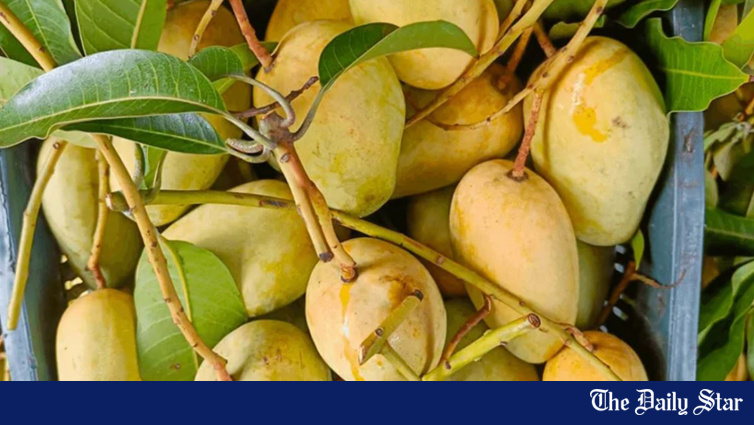
After a disappointing season last year, mango growers across four upazilas of Natore are heading into this year’s harvest with renewed hope. Trees that stood half-bare twelve months ago are now heavy with Gopalbhog, Langra, Khirshapati, and the earliest ripening local variety, Aati.In villages like Gouripur, Gopalpur, and Mominpur, the abundance of fruit is so significant that branches are drooping close to the ground."Last year, half of my trees yielded nothing," said Md Israil Hossain, a college teacher-turned-mango farmer from Lalpur. "This year, over 70 percent are full of fruit. We are expecting at least four to five maunds per tree."Israil knows optimism comes at a cost. Bringing a mango crop to this stage requires careful fertiliser and pesticide management, costing around Tk 27,000 to Tk 30,000 per bigha. But with healthy fruit across his orchard, he expects to earn at least Tk 1 lakh in profit per bigha.Md Hamidul Islam, another farmer from Mominpur village in Lalpur, is equally buoyant. He has cultivated mangoes on about 10 bighas of land. Of his 450 trees, 350 are laden with fruit. He has already sold four trees to a trader for Tk 30,000 -- each yielding over five maunds.“Last year, we barely saw any profit due to poor output,” he said. “While a bigha of mango orchard sold for Tk 1.5 to 1.8 lakh last year, expectations have risen to Tk 2.5 to 2.8 lakh this season.”According to Natore's Department of Agricultural Extension, 5,693 hectares have been brought under mango cultivation this season. Officials have set a production target of 68,316 metric tonnes -- projecting a mango economy worth over Tk 400 crore, up from Tk 350 crore last year.Deputy Director Md Habibul Islam Khan believes even that target may be exceeded.“Natore has become a leading hub -- now the fourth-highest mango-producing district in the North,” he said. “Cultivation has grown rapidly over the last two decades.”