Bittensor has fundamentally rewired how its network distributes rewards. The upgrade, called Taoflow, replaces the old price-based emission system with one that tracks actual capital moving in and out of subnets in real time. Subnets that can’t attract and retain staked TAO don’t just earn less. They earn zero.
How the new emission model works
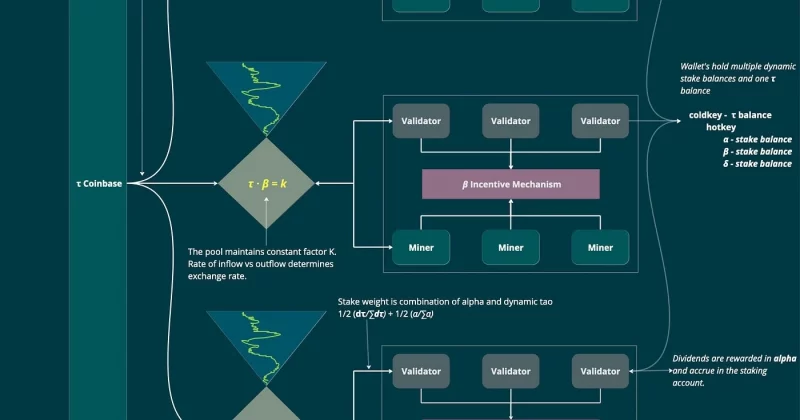
The Taoflow upgrade, which activated in November 2025, sits within Bittensor’s broader Dynamic TAO (dTAO) framework. That framework originally launched on February 14, 2025, introducing subnet-specific alpha tokens and automated market maker pools that let stakers swap TAO for individual subnet tokens.
The original dTAO setup gave stakeholders direct influence over which subnets received emissions by letting them allocate capital through AMM-based staking. Taoflow takes that logic further by making net staking flows the sole determinant of emission shares.
Instead of looking at the price of a subnet’s token to decide how much TAO it should receive, the system now measures whether money is flowing into or out of that subnet. It uses an exponential moving average with roughly a 30-day half-life to smooth the signal, preventing short-term manipulation from gaming the results.