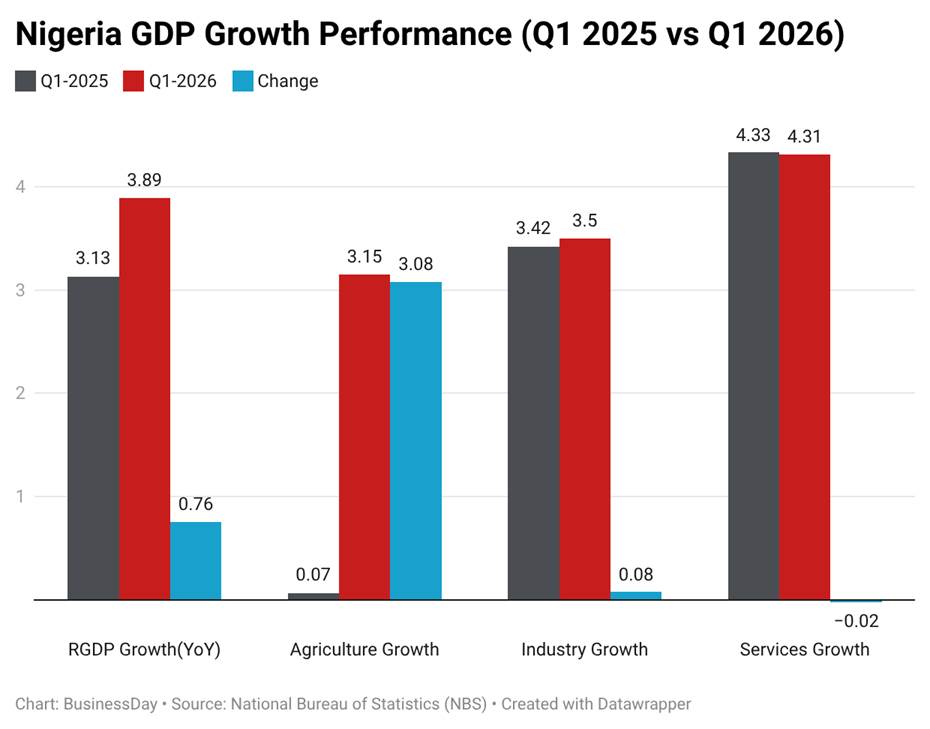
adsNigeria’s economy expanded by 3.89 percent in the first quarter of 2026, according to the latest GDP report released by the National Bureau of Statistics on Monday, broadly in line with BusinessDay Economics’ April projection of 4.0 percent, with a marginal deviation of 0.11 percentage points. The outcome reinforces a growing view among economists that Nigeria’s reform programme is beginning to deliver measurable economic gains.
But the most consequential detail in the report was not the headline figure. It was the shift in the underlying drivers of growth.
For much of the past three years, agriculture had been one of the weakest links in Nigeria’s economic performance, constrained by insecurity, rising input costs and persistent disruptions across key farming regions. Historical data in the report show agricultural output expanded by just 0.07 percent in Q1 2025, effectively stagnating in a sector that remains one of the country’s largest employers.
The latest numbers mark a decisive reversal.
Agriculture rebounded to 3.15 percent in Q1 2026, emerging as one of the strongest turnaround stories within the real economy and helping to broaden growth beyond its recent narrow base. But it was not the only driver.adsads