By Lisa Wang / Staff reporter, in Hsinchu City
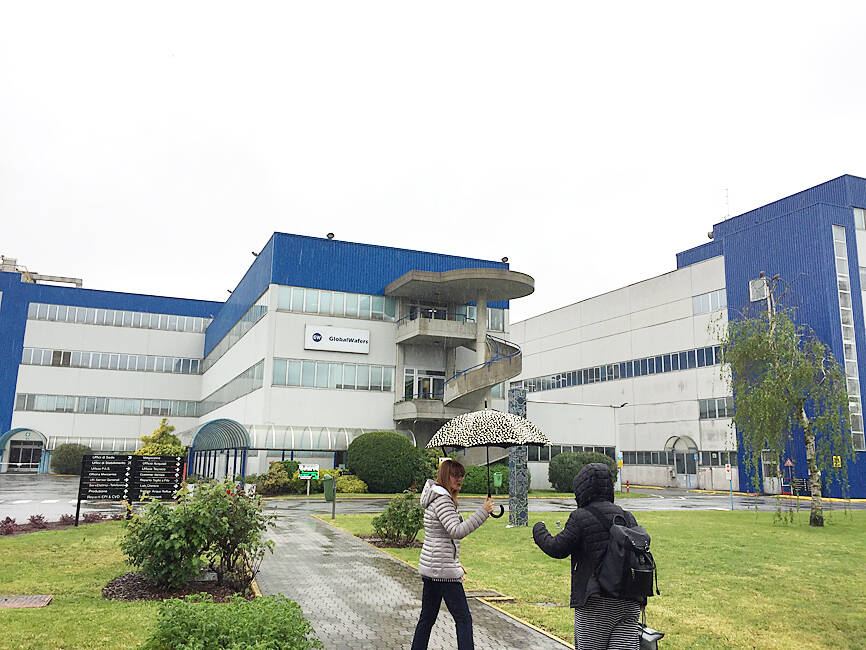
GlobalWafers Co (環球晶圓), the world’s third-largest silicon wafer supplier, yesterday said it is seeking to raise wafer prices in the second half of this year, as geopolitical tensions drive up manufacturing costs. GlobalWafers operates 18 silicon wafer manufacturing sites in nine countries around the world. The company has been facing rising raw material, manufacturing and labor costs over the past few months. COST PRESSURES
GlobalWafers Co chairwoman Doris Hsu poses for a photograph at a media gathering in Hsinchu City on Jan. 21.
The war in the Middle East has pushed up energy and shipping costs, GlobalWafers chairperson Doris Hsu (徐秀蘭) told reporters on the sidelines of the company’s annual general meeting in Hsinchu City. Electricity prices in the US are 20 percent higher than the company had estimated, Hsu said.
Raw material costs are also surging, including for the special oil used in wafer slicing, much of which is imported from Iran, she added. Surging manufacturing costs cannot be absorbed through improvements in manufacturing efficiency and cost savings, as the company has done before, Hsu said. “The pressure is huge. It is hard to swallow the cost increases entirely,” she said. “We are proactively communicating with our customers and hoping to see some improvement in the second half.” Rising demand across the board provides another reason for the proposed price hikes, the company said. GlobalWafers has seen full factory utilization at its 12-inch facilities and some small-diameter plants in Taiwan, Malaysia and China, it said. A year ago, it was a totally different story, Hsu said, recalling that market demand was strong for advanced 12-inch wafers used in artificial intelligence (AI) applications versus flagging demand for small-diameter, such as 8-inch and 6-inch wafers.“In 2026, besides AI, demand for traditional semiconductor applications is picking up following a year of stagnation,” Hsu said. “Demand for automotive, industrial devices and the electricity grid is gradually coming back.” GlobalWafers has three months of order visibility for small-diameter wafers, she said. Improving fundamentals are driving the company’s revenue growth each quarter this year, but rising manufacturing costs and increases in depreciation and amortization costs are eating into its profitability if wafer prices stay flat, Hsu said, adding that the trend in average selling prices would be crucial this year. The company’s data showed that depreciation and amortization costs accounted for about 16 percent of its total revenue in the first quarter, up from about 13 percent in the previous quarter, as more new factories and manufacturing equipment came online. SUBSIDIESThe company said government subsidies would help ease pressure from depreciation and amortization costs to a certain degree. GlobalWafers said it received US$200 million in government subsidies last year and US$11 billion so far this year. Shareholders yesterday approved a cash dividend distribution of NT$7.7 per share. That represented a payout ratio of 50.36 percent, based on earnings per share of NT$15.29 last year.