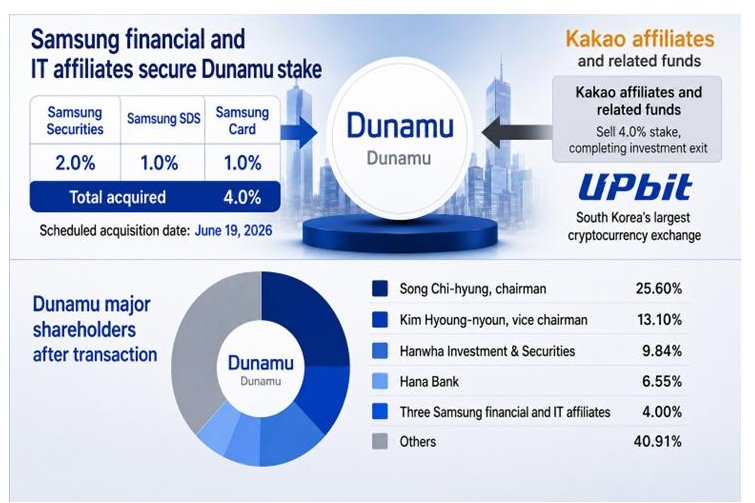
Hana’s W1tr Upbit bet reflects banks’ fight to stay central in digital payments (123rf) Hana Financial Group's recent 1 trillion won ($662 million) bet on Upbit operator Dunamu was not just a crypto investment. It was a wager on whether banks can keep their place at the center of money as finance moves onto digital rails.Korea has yet to finalize who can issue won-backed stablecoins or how exchanges and fintechs can participate. But financial groups are not waiting. They are moving to secure the exchanges, card networks, wallets and remittance channels that could decide whether won stablecoins become usable financial infrastructure, not just digital tokens.Hana’s planned purchase of a 6.55 percent stake in Dunamu, operator of Korea’s largest crypto exchange Upbit, is one of the clearest signs yet of how banks are positioning themselves. Upbit gives Hana access to a platform with 13.26 million cumulative users as of the end of 2025, while Dunamu’s Giwa Chain could provide the group with a foundation for on-chain transactions, where payment and transfer records are processed on blockchain infrastructure rather than only through traditional bank ledgers.The move also aligns with Hana Financial Group Chairman Ham Young-joo’s broader vision for stablecoins. Ham has said the group does not intend to remain a passive participant in the changing financial landscape, but instead aims to become “an architect of the market” by building a full ecosystem spanning issuance, distribution, usage and circulation.“I believe new growth opportunities can be found in stablecoins,” Ham said during an earnings conference call in January. “Simply issuing coins will not create opportunities. We need to create new rules and lead the market amid the changing landscape.”Hwang Suk-jin, a professor at Dongguk University Graduate School of International Affairs and Information Security, said Hana's move appears to be a strategic bet on who will set the standards in Korea's future digital-asset ecosystem."Crypto firms have strong technology, but they do not yet have a high level of trust within the regulated financial system," he said. "Banks have trust and funding power, but their pace of innovation is relatively slow. This kind of combination can complement the weaknesses of both sides."The move reflects both ambition and anxiety. Globally, stablecoins have often grown outside traditional banks, led by crypto-native issuers, exchanges and payment firms. In Korea, however, banks are expected to play a central role because of their regulatory standing, deposit base, anti-money laundering systems, and experience handling payment and settlement infrastructure.Hwang said banks are moving early to defend their existing role in payments and deposits. If big tech firms or private platforms dominate stablecoins, bank deposits could move into digital wallets, he said, making it necessary for banks to secure a foothold in the digital-asset market.That is why other financial groups are also moving before the law is finalized. KB Financial Group recently completed a proof of concept, or PoC, with KG Inicis, Kaia and Open Asset for won stablecoin-based payments, merchant settlement and overseas remittances. The trial included QR payments at a local cafe and a Vietnam remittance model that converted won tokens into dollar stablecoins, cutting transfer time to within three minutes and reducing fees by about 87 percent.Shinhan Financial Group is taking a different route through global payment networks. Shinhan Card has tested stablecoin-based overseas payment and settlement structures with Visa, Mastercard and the Solana Foundation, while linking to outside wallets such as MetaMask and Phantom. With about 14.5 million individual credit card members, Shinhan's edge lies in connecting stablecoins to existing consumer payment channels.Woori Financial Group is preparing through consortium building, wallets, B2B settlement and overseas remittances rather than a single headline deal. In a recent interview with Edaily, Vice President Ok Il-jin, Woori Bank's head of AX Innovation Group, said that "the key is to create clear use cases from the customer's point of view," adding that once the law is passed, "all players will start from the same line."The race is also spreading beyond the four major banking groups. Mirae Asset Group's move to acquire Korbit and Korea Investment & Securities' reported review of a Coinone investment suggest brokerages see exchanges as an entry point into the digital asset value chain. BC Card and K bank add a payments-remittance angle, with BC Card testing stablecoin-linked prepaid cards for overseas visitors and K bank working with Ripple on blockchain-based overseas remittances.For banks, the risk is moving too early in a market whose rules are still unclear. The bigger risk may be moving too late."Banks cannot just sit back because there is no law yet," Hwang said. "The law will eventually come, and they need to have at least the minimum preparations in place to respond when it does."
Korean banks race to defend turf ahead of stablecoin rules
Hana Financial Group's recent 1 trillion won ($662 million) bet on Upbit operator Dunamu was not just a crypto investment. It was a wager on whether banks can k
779 words~4 min read