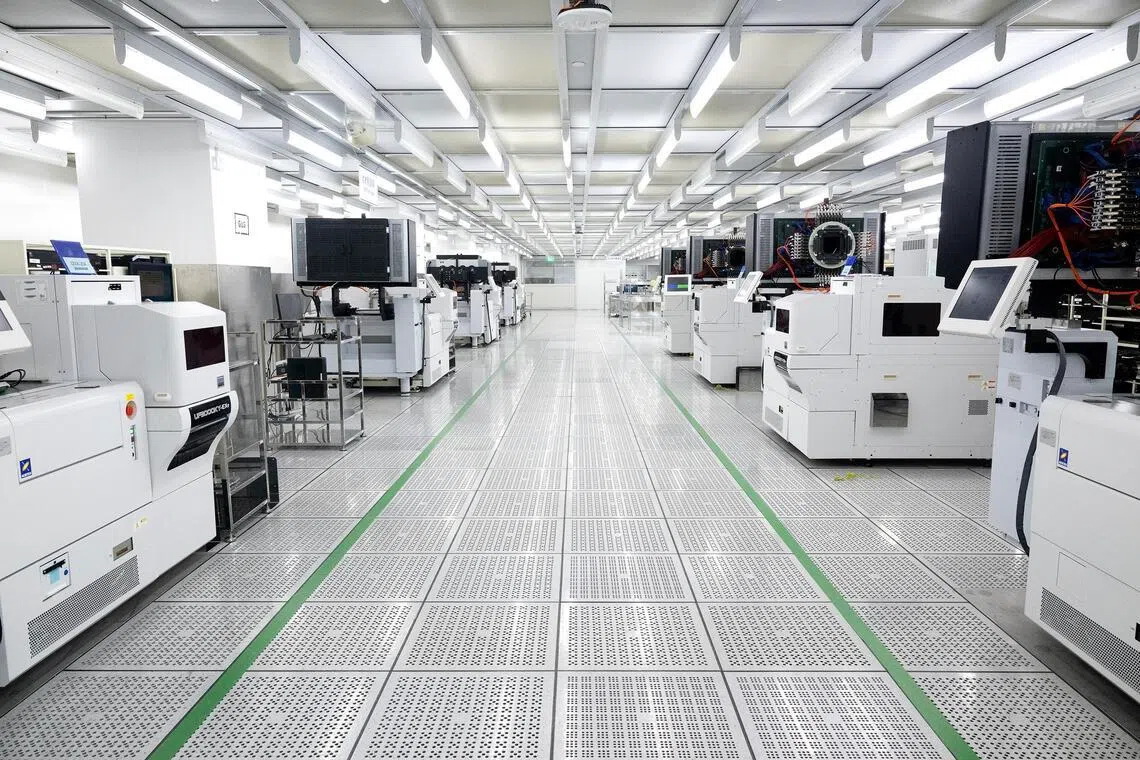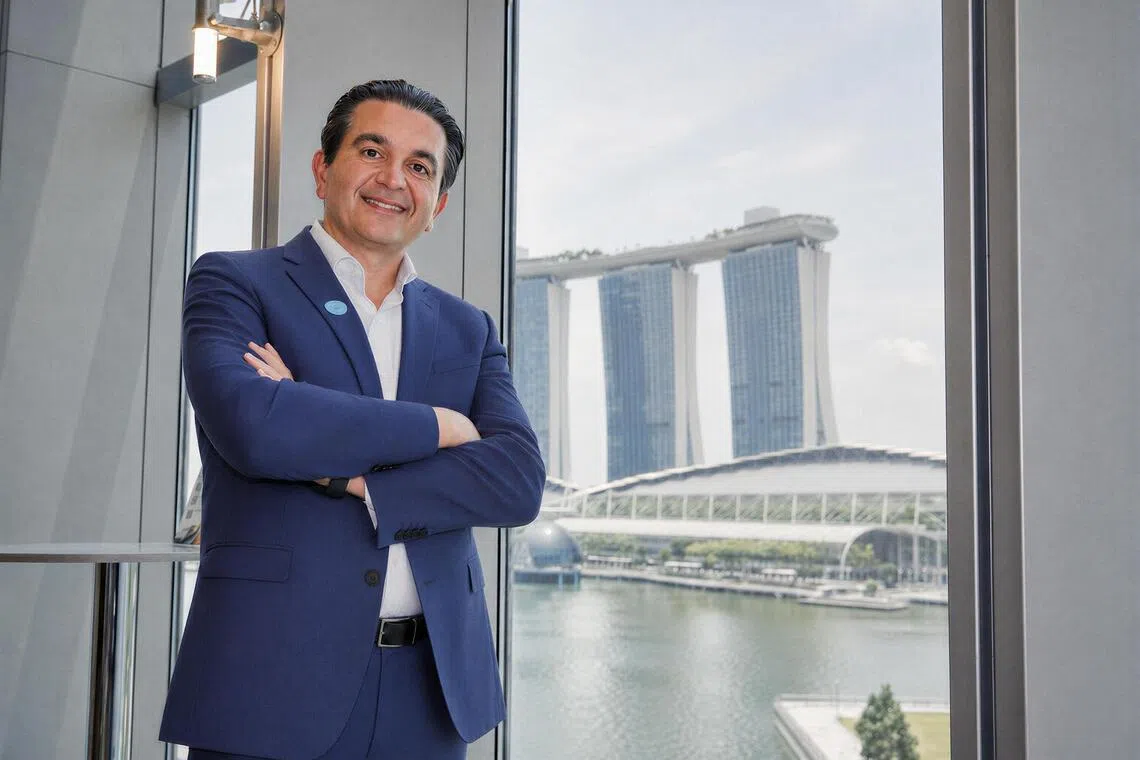
SINGAPORE – When Mr Samer Kabbani, chief executive of AEM Holdings, cancelled his daughter’s US$200 (S$256)-a-month subscription to ChatGPT after discovering she had signed up for it without telling him, the response was swift. Within minutes, footsteps came hurrying down the stairs. “Why did you cancel it? My life depends on it!” he was told.Meanwhile, his teenage son, who had been wanting a calorie-counting app, was challenged to build it himself instead of buying one. Using an artificial intelligence coding platform, the 16-year-old was able to create a working prototype that could analyse food photos and estimate calorie intake, despite having no programming background.His other daughter used AI to generate an instant guided tour while walking through the ruins of Greece’s Parthenon during a family holiday, brushing aside the tour guides offering their services around the attraction.“She simply pointed her phone at the ruins and asked ChatGPT to explain what she was seeing,” said Mr Kabbani, who uses AI regularly to brainstorm for ideas and refine talking points, among other things.In the Kabbani household, AI is already woven into daily life in many different ways – in terms of learning, fitness, travel, productivity and entertainment.To Mr Kabbani, who runs the Singapore firm testing the high-performance AI chips that enable these applications, this says something important about where the world is heading.“AI is now becoming a part of life, just like electricity, water and the internet,” he told The Straits Times in an exclusive interview.The growing use of AI, from generating memes and entertainment content to supporting mission-critical transport and medical systems, is fuelling a massive demand for high-performance computing chips, as well as the data centres and computing infrastructure needed to run the technology at scale.This has driven trillions of dollars in investments in the sector and triggered a rally in AI stocks from Singapore and Korea to the US and China.Singapore-listed AEM, which runs the systems and equipment that test these chips before they are deployed, has not been left behind.Since the start of 2026, its shares have surged around 450 per cent, from below $2 in January to $9.56 at the close of trading on May 22, as the company rides a wave of investment in AI infrastructure.Unlike traditional standardised components, AI chips are now configured differently depending on the customer and intended use, Mr Kabbani explained.A chip designed for Meta may prioritise AI model training, for example, while another one meant for China may be configured differently to comply with export controls. Some are optimised for memory-heavy workloads, and others for processing speed or energy efficiency.As more is demanded of them, chips are also becoming physically larger, hotter and increasingly complex, and testing them before they are deployed is now a critical part of the semiconductor manufacturing process.Chipmakers such as Intel and Advanced Micro Devices (AMD) typically need to prove to customers like Meta that their chips can operate reliably under extreme temperatures, such as 90 deg C. “Our mission is to keep the temperature at 90 deg C during that test at all times,” Mr Kabbani explained.He said AEM’s strength lies in advanced thermal technologies that can maintain constant temperatures under testing more effectively than competitors.“That’s very important because as you’re testing these chips and putting them under a high amount of stress, they heat up, and you have to control the temperature of that chip during testing. If you don’t, it can catastrophically blow up.”Another of its key advantages is the ability to test chips at much higher volumes simultaneously.“We have the equipment to test dozens of chips simultaneously while tightly controlling temperatures under extreme heat and power. We were testing 30 or 40 at a time, while others were testing eight,” Mr Kabbani said.He added that speed and efficiency have become increasingly valuable in the AI era, where chips can become obsolete within two years as newer, faster versions emerge. The ability to meet the full suite of testing requirements needed is AEM’s third advantage.“Customers no longer have the luxury of stitching together testing solutions from multiple vendors. They want someone that can provide the whole solution quickly.”AEM has invested heavily over the past six years to move beyond testing PC chips for Intel and position itself to support AI and high-performance computing (HPC) chips made by firms like Nvidia, AMD and Taiwan Semiconductor Manufacturing Company (TSMC).In 2025, the company said it had begun ramping up production for a second customer focused on AI and HPC chips. That customer is expected to overtake Intel as AEM’s largest customer in 2026.At the same time, Intel itself is also evolving into a foundry business that manufactures chips for external customers such as hyperscalers and large technology firms that build AI infrastructure and cloud computing systems. These companies include Meta, Amazon and Microsoft.That means AEM’s customer exposure through the Intel foundry is potentially also becoming more diversified, Mr Kabbani said. He added that there is room for AEM to expand further into testing advanced memory chips, which are high in demand because AI systems require huge amounts of memory to process data.In 2025, AEM announced that it had secured one of the world’s three major memory chip companies – Samsung Electronics, Micron Technology and SK Hynix – as a customer and expects testing to begin towards the end of 2026.“We now have three different customers with three different profiles. They’re highly diversified. They have different market cycles too, so it helps stabilise fluctuations for us,” Mr Kabbani said.AEM’s latest breakthrough came in March, when it announced a partnership with Taiwanese semiconductor giant ASE Technology Holding, one of the world’s largest outsourced semiconductor assembly and testing providers.Such firms work closely with foundries such as TSMC to package, assemble and test chips before they are shipped globally.Mr Kabbani said AEM deliberately courted ASE because of its dominant market position and deep ties to TSMC. He added that winning over ASE took more than a year of engagement as AEM introduced its technologies and manufacturing ecosystem to Taiwan’s semiconductor industry.ASE eventually invested about $12 million in AEM to support its expansion in Taiwan and integrate AEM’s technologies into ASE’s manufacturing operations, with further investments tied to future revenue milestones.AEM hopes the partnership will help it reach more global AI chip customers and hyperscalers, and has revised its revenue guidance range upwards by approximately 20 per cent to $550 million to $600 million for 2026.There are risks, of course. For one thing, the AI chip boom may not sustain its current pace if demand swings sharply and hyperscalers cut spending, or if the trillions in AI investments fail to generate expected returns.While the firm has successfully diversified beyond Intel, order delays or technology shifts by a major customer, or competitors catching up technologically, could impact revenue at a time when AEM’s share price has already surged and investor expectations are high.But what is clear is that as AI becomes more embedded in daily life, demand for far larger and more complex chips will continue to rise, creating new engineering challenges and fuelling demand for the specialised equipment needed to test them, Mr Kabbani said. He noted that an estimated US$7 trillion is being poured into the infrastructure needed to support AI applications ranging from generating itineraries and videos to personalised recommendations and coding, adding that “the sky is the limit” for what these chips will eventually be capable of.“These are precisely the conditions where AEM’s technologies deliver their greatest value,” Mr Kabbani said.
AI chip testing: AEM Holdings' vital role
Discover how AEM Holdings is at the forefront of AI chip testing, a critical component in the rapidly growing semiconductor industry. Read more at straitstimes.com. Read more at straitstimes.com.
1,242 words~6 min read