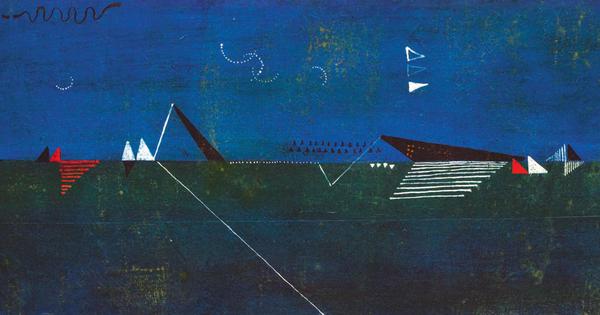
Imagine a little boy and a huge river. A land seemingly folded into water, the two merging as one. Plants, animals, and fish are all part of a seamless environment, with the water overwhelming the lush green of the land. A quiet quotidian life, with its seasonal rhythm, lived out on the banks – with the boy both a witness and an eager participant in its unfolding.This is chapter one of Ganesh Haloi: Colours of Home, a graphic biography written by Likla Lall and illustrated by Eva Sánchez Gómez. The latest in the “The Art Exploration Series” by ART1ST Books, published in association with Kiran Nadar Museum of Art and Akar Prakar, it follows biographies of Abanindranath Tagore, Jamini Roy, Somnath Hore, SH Raza, Ambadas, Meera Mukherjee, Ram Kumar, and Ganesh Pyne.The artistHaloi is one of the most distinguished artists of independent India, one of the few surviving from the generation that witnessed the Partition and was profoundly shaped by its aftermath. He is primarily known for his abstract landscapes and innerscapes. He has also been a beloved teacher (from 1963 to 1993) at the Government College of Art and Craft, Calcutta, an institution where he studied in the early 1950s. Beginning his practice by copying murals at Ajanta, he would move on (among other things) to sketch the street life of the city he made his home and the places he travelled to within the country, and then gradually shift away from figurative and representational to abstract art – the “when” and “why” of which remains unfathomable to his critics, beyond the fact that the transition happened over time and became his signature style.Haloi turned 90 on February 9 and Colours of Home is perhaps a child’s best introduction to him.A page from the book. | Illustrated by Eva Sánchez Gómez.Colours of Home is divided into two parts: the first describes his life, and the second has art exercises for young readers. The first part has five sections that pertain to the five distinct phases of his life: growing up in East Bengal, being forced to flee to the other side of the border and living as a refugee in West Bengal and Bihar, studying art in Calcutta, copying Ajanta frescoes for seven years as an ASI artist, and then coming back to Calcutta and making it his home.Each of these sections are colour-coded in the book: blue for East Bengal, to convey the numerous rivers and their centrality to the life there; yellowish-brown and reddish-orange, colours of the soil, to depict a land divided, offset against the un-relieving grey of refugee tents; pink-red-maroon for the bustling metropolis of Calcutta, the once colonial capital of the British Raj; grey-green for the Ajanta caves and its surrounding forests; and the green universe of Haloi’s paintings.The writer, Lall, corroborated by saying, “It was very important for me to arrive at a strong conceptual base for the book as a whole. What struck me about Ganesh Haloi’s journey was that there were… distinct places (each filled with particular colours, memories and emotions) that made him who he was as a person and an artist. We were inspired by the vibrancy of his works and the secret language that appears in his paintings. I began to imagine a museum of his life in snapshots and tried to trace their connection to his art. Eva brought alive the distinct colours of each place… with her magical colour pencil techniques.”The graphic narrative is premised on the natural curiosity of a child to find out things and her delight in discovering them. The use of flaps is the principal tool employed to achieve this. All five sections of the narrative have them. But the first and third accomplish an elaborate version of it, as does a later segment – with several extensions opening up and out from a single double-page spread.For East Bengal, the double-page spread first opens up like two arches – giving us the architecture of a home, as it were, encompassing both land and water. The upper arched portion carries scenes from land; the lower rectangular one, of water – the river Brahmaputra, as seen from the banks of a small village, Jamalpur, in erstwhile undivided Bengal. There are boats on the surface and fish underneath. Further opening out the page, on the right and left, we get an entire canvas of four panels – the land merging with the water, the hugeness of the river conveyed by apportioning it three-fourths of the spread. There’s a gigantic fish, underwater, at the centre, and the small body of a boy tumbling beside it. The upper inner-arches give vignettes of the land – the extreme right and left panels being framed by vegetation and the odd animal, a middle showing a boy on a roof, looking out at the river in the distance.Ajanta is a meta-arched frame in four spreads, its arch-within-arch layering the perspective from which to view the young artist – at times gazing in wonderment, at others meticulously copying the crumbling murals. Several pages leave us with just the architecture of the caves, without text, a powerful reminder of our heritage, surviving and defying the ravages of time.The chapter, “The Green Catcher”, is the showstopper of the book. Asking the reader “How many shades of green can you find in Ganesh’s paintings?”, it gives a colour wheel of 16 shades of green, accompanied by six of Haloi’s paintings – one on the adjacent page of the wheel; which first opens right, horizontally, with two different paintings; and then vertical with another two; finally ending horizontally again with a double-page diptych. All these paintings, with their details, are listed at the back. Adults might be interested in looking them up, but most children would be simply curious to follow the cues given – as captions with each painting – to aid their visual understanding of colours in general: “What happens when green meets its neighbours blue and yellow”? “Do the grass and the tree share the same green? Look outside to find out.”Interactive engagementWhile the sections dealing with East Bengal, Ajanta and Haloi’s paintings involve the most innovative flaps, there is a very sensitive use of secondary sources in the other two sections (about Haloi’s refugee life in successive camps and his coming to Calcutta to study art) – where these traumatic experiences are distilled into age-appropriate text for children.“Was this home now? Cooper’s Camp, a place without hope. Where death and stillness were near neighbours, clothed in the haunting smells of bleach and phenyl.Surrounded by people too depressed to move or work or live, Ganesh knew he had to paint his own hope.He filled his papers with the memories and colours of home. They inspired him to look ahead. He transported rice to the camp on his starved, scrawny shoulders to earn some money for his future.Ramdashi, his mother, sold the last of her jewellery and gave her blessings – to leave this place of decay and follow his dreams to be an artist. Seeking hope pushed him forward. This time, leaving was a choice. “You can go to art college”, they told him. “The only way is ahead.”This was home for a moment. An address to put on a college application: Ganesh Haloi, Eager Young Artist, Platform 12, Howrah Junction.”One of the most striking features of the graphic narrative is that four of its five segments are prefaced with Haloi on a train. They have been very important in his life, after all. He had made several landmark journeys on them: East to West Bengal (1950), Bihar (Mokamoy) to Calcutta (1951), Calcutta to Maharashtra (Ajanta Caves, 1957), and then returning to Calcutta (1964). The last was the only one in the reverse direction – coming back (to what would become) home. All the others were going away from temporary shelters; outward journeys – forced, aspirational, and marking the beginning of a long career.A page from the book. | Illustrated by Eva Sánchez Gómez.We see Haloi perched on the roof of a train – as a boy, a teen, a young man, and an adult. But the posture and body language are markedly different in each. The boy sits precariously on the edge, frog-like, holding on to the roof, scared he will fall off otherwise; the teen sits across the same edge with his back straight, looking ahead, cradling a sketch-book and pen on his lap; the young man is kneeling, with his legs and arms in forward position, almost ready for a sprint; and the adult is self-assured, relaxed, as he sits casually with one arm resting on his thigh and one leg hanging from the edge of the train-roof.The officially stated aim of Art1st books is to explore “the artists’ work and philosophy, approach and methodology, success and failure, in a story format, to engage and inspire children to in turn create their own art”. The latter part is manifested in the second half of Colours of Home, where the reader is encouraged to “Think like an Artist” and “Create like an Artist”. While the flaps in the first half ensured the interactive engagement with the graphic narrative, the “Think…” and “Create…” segments in the second half offer a direct involvement.“Create like an Artist” has three fascinating segments, designed for those who love to draw: Recreating Ajanta (with exercises involving completing the details of a painting); Moving lines (a playful ploy to look at Haloi’s painting of the Ghats of Banaras differently); and a reminder to the reader of being attentive to the invisible around us.There is much to learn from this children’s book, much to enjoy. It is bound to be a delightful possession for anyone – child or adult – who loves art, and particularly those who admire Haloi.Ganesh Haloi: Colours of Home, Likla Lall, illustrated by Eva Sánchez Gómez, ART1ST.
‘Colours of Home’: This graphic biography of artist Ganesh Haloi for children is a treat for adults
Written by Likla Lall and illustrated by Eva Sánchez Gómez, the book not only describes the artist’s life but also includes art exercises for children.
1,652 words~8 min read