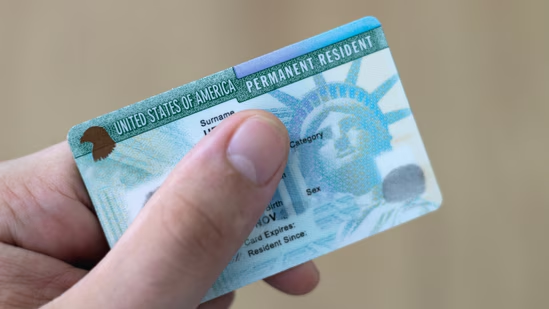
Indian professionals already facing decades-long Green Card backlogs say the proposed changes have added to uncertainty over their future in the United States.
| Photo Credit: Representational image
The Trump administration’s latest changes to Green Card and immigration procedures have triggered anxiety and uncertainty among thousands of Indian professionals and students living in the United States, including many families from Andhra Pradesh and Telangana.The new policy, introduced through a memo issued by the U.S. Citizenship and Immigration Services (USCIS), requires most non-immigrants, including temporary workers and students, to leave the U.S. and apply for permanent residency through consular processing in their home countries instead of adjusting their status within America.For many Indian software professionals already grappling with decades-long Green Card backlogs, the development has come as a major emotional setback.“I suddenly feel unsure about the future I had carefully planned,” says Maddela Srinivasulu, a software engineer from Kadapa now living in California. Mr. Srinivasulu moved to the U.S. in 2016 and filed for a Green Card in January 2018. His I-140 petition was approved in September that year, placing him in the second stage of the three-step employment-based Green Card process.After spending nearly a decade in the country on an H-1B visa, Mr. Srinivasulu says the tightening of immigration rules has left him deeply worried about the future of his family. His wife and two children are dependent on H-4 visas.“This new law has shocked and shattered me. Things are clearly going downhill. I have given some of the best years of my life to this country, contributing to its economy as a taxpayer. Now, I feel used and cheated,” he says, adding that stricter immigration policies are creating fear among Indian professionals who have spent years building careers and contributing to the American economy. “By bringing in stricter immigration rules, the U.S. wants to keep us away from this land,” he adds.The anxiety is not limited to working professionals alone. Parents in Andhra Pradesh who invested heavily in their children’s education abroad are also worried about the future.Bulusu Janardhan from Andhra Pradesh says he regrets encouraging his only son to pursue higher education in the U.S. Like many middle-class families, he had taken loans in the hope that his son’s foreign education would eventually help improve the family’s financial condition.“I thought sending my son to the U.S. would help him become financially independent and also help us clear the debts we accumulated for his education. But the situation now is frightening,” he says.Mr. Janardhan says his son endured several hardships to complete his studies, only to face uncertainty over employment and immigration prospects. “The U.S. has been ruthless towards international students lately. Despite all the hardships, my son completed his course and had just started thinking about employment when this news came,” he says.However, not everyone believes the new rules will drastically alter the situation immediately. Maddela Ramakrishna, another software professional from Kadapa based in California, says Indian nationals already face long employment-based Green Card wait times because of per-country caps.“EB-2 and EB-3 queues for Indians often stretch to 15 to 20 years or more, with some estimates projecting wait times of over a century for new applicants,” he says, adding that Indian professionals have long been accustomed to uncertainty in the immigration system.Meanwhile, Vemuri Ravi Kumar, Chairman of the AP Non-Resident Telugu Society (APNRTS), says the organisation is closely monitoring the developments. According to him, of the estimated 40 lakh Non-Resident Telugus worldwide, nearly eight lakh live in the United States.“The new law may not have much impact on existing applicants. We are waiting for greater clarity,” he says, adding that several companies likely to be affected are preparing legal challenges against the policy in U.S. courts. Published - May 24, 2026 07:29 pm IST