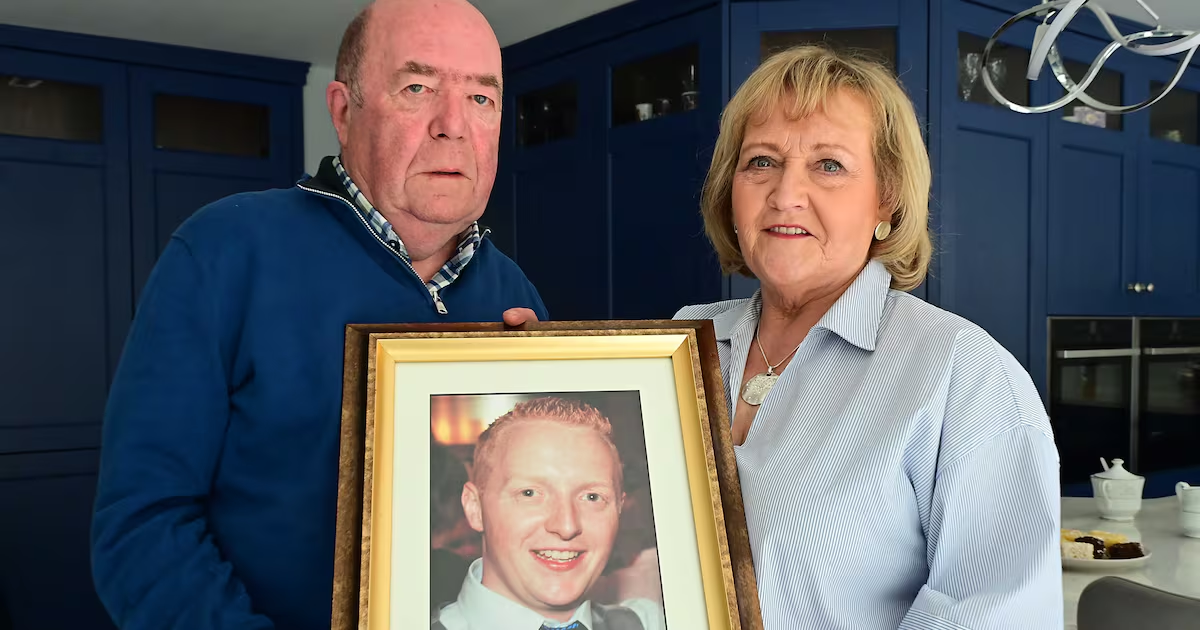
Eithne Bell emerges from the kitchen of her Co Down home with plates of home-made wheaten bread and cups decorated with a striking red-headed bird.This is the Newry house where her twin sons, Kevin and Brendan, had their first birthday two days after the family moved in 39 years ago.The enormous blue-panelled kitchen (a walk-in larder room was built after they won £1 million on the UK lottery in 2017) was half the size back then, Eithne says.“We couldn’t move away, with all our neighbours here,” she says, smiling.She points to a corner of the room where she and her husband, Colin, set up a charity with “pen and paper” in memory of Kevin after their son’s sudden death in New York.“For the first two years, it was all run from the kitchen table and a filing cabinet,” she says.Kevin Bell (26) was killed in a hit-and-run incident in the Woodlawn area of the Bronx in June 2013.One of seven children, he was “our only redhead” and he “loved life”, says his mother.Kevin Bell was one of seven children. Photograph: Arthur Allison/Pacemaker Press “He was a great set dancer and céilí dancer. Any adjudicator would have said, ‘the wee redhead fella, he has the feet’.”Within a week of the tragedy, £150,000 (about €175,000) was fundraised to bring Kevin’s body home; the couple put aside the money to help other bereaved families when their son’s US employer paid the cost of transporting his remains.“The next thing, it just snowballed,” recalls Eithne.The Kevin Bell Repatriation Trust now operates globally.It is the only organisation of its kind in the world; almost 2,500 bodies have been brought home by the charity to families across Ireland.Every repatriation is paid for by the trust.There’s “not a parish in Ireland we haven’t touched”, says Colin.The couple have invited The Irish Times to their home after announcing they are stepping back from the day-to-day running of the charity.“It’s got too big,” says Eithne.They insist, however, they will remain “very much involved”.Women who experience miscarriages abroad have been among those supported by the trust.“We’ll bring the baby home,” says Eithne.The oldest person repatriated was a 104-year-old west Belfast man who was brought back to Clonard from Spain last week.Colin points to his mobile phone – it beeps repeatedly over the next 90 minutes – and shows photographs of him receiving a cheque in Knocknagashel, Co Kerry.He scrolls to another picture.“That’s where I was yesterday, in Listowel, to collect a cheque for €20,000. Another €7,000 was raised in Killarney.“That’s cheque presentations every day. I’m going to Lurgan later, then the Cross Keys Inn at Toomebridge and schools in Omagh and Dungannon.”When we meet on a Monday morning, the retired schoolteacher and former Down GAA minor player has just returned from the Whitegates Community Business Park in Newry, where the trust has been based for a decade.The couple employed a director of operations nine months ago to work with another staff member in the Newry office.“After the first two years, we employed a part-time secretary, Mairead Lynam. She was invaluable,” Colin explains.Updates on repatriations flash up on his phone screen.“This is what is going on the at moment ... New York, Australia, London, Thailand, Malaga, Crete, New Zealand, Kenya. Those are all in progress.“We are doing 30-35 a month. Once a family contacts us, they don’t have to do anything else.”The phone continues to ping.“That’s the beauty of it, now we have someone who can take the calls,” says Colin.“It releases us to meet people and do cheque presentations.”A Belfast woman who contacted the trust after her son’s sudden death says the support given “was like a weight being lifted off our shoulders”.Niall McCullough (27) died from a brain injury following an accident in Wolverhampton four years ago.“Colin asked me where Niall was. He told me to leave it in his hands,” Margaret McCullough says.“It wasn’t just the financial aspect of it, it was knowing what doors to open, how to deal with all the red tape. We didn’t have to do any of that. It’s a bad enough time without having to get your family member home.”Eithne Bell: 'It's about the importance of getting your loved ones home.' Photograph: Arthur Allison/Pacemaker Press The McCullough family organised a fundraiser and met Colin for the first time afterwards.“I went to shake his hand and instead he gave me a hug,” she recalls.“He was such a humble, calm man,” adds Billy McCullagh, Niall’s father.For Eithne, the charity’s success is linked to its location.“This could only happen in Ireland. It is about the importance of getting your loved ones home.”She taps her cup with the decoration of a goldfinch; the songbird is the trust’s official emblem.“We picked it because it has a red head and birds like to come home to nest,” she says, blinking away tears.“The last thing Kevin bought me was a bird table. We would do Kris Krindle at Christmas. He picked my name out and he asked me for some ideas. I said I would love the table ... and he got it.”A goldfinch is the official emblem of the Kevin Bell Repatriation Trust. Photograph: Arthur Allison/Pacemaker Press. The couple reflect on the early months of the charity as they struggled with their grief.“It kept Kevin with us, that’s what your days were consumed with,” Eithne says.Some repatriations can take weeks, with costs rocketing to thousands of pounds depending on the country – the repatriation bill for the US is up to $15,000 (nearly €13,000).Neither the UK nor Irish governments cover the expense.The return of their son’s body was the “quickest ever”, according to the couple.“Kevin died at quarter to three on a Sunday morning. His postmortem took place on a Sunday afternoon,” says Colin.“His body was released to the undertaker on Monday and he was on a flight home on Tuesday night. He was in our house on Wednesday at lunchtime. Unheard of. It was just miraculous.”They recall a moment during his wake when they realised they wanted to create a trust in his name.“More fundraising was coming in and I remember we were in the sittingroom. We looked at each other and I thought, ‘Kevin’s not the first and he won’t be the last’,” says Eithne.“At that stage, we had decided we were going to make this Kevin’s legacy,” adds Colin.Kevin lived in New York for 10 months before his death.“Initially, he was just going for three months; then he rang me one day and said, ‘Mummy, I’m going to stay’,” she says, crying.“He loved it. It was big enough for him.”During one visit to Woodlawn five years after his death, the couple were left speechless when a Palestinian taxi driver produced Kevin’s memory card.“We were getting a taxi back into Manhattan and the driver asked what we were doing out here. We told him about a fundraiser for our son,” says Eithne.“He pulled down his sun visor and took Kevin’s memory card out and said, ‘I had your boy in my taxi many times’.”“That’s the type of person Kevin was – if you met him, you felt as if you always knew him. He was a great character.”The couple’s six surviving children are the charity’s trustees and “adamant they want to be a part of it”, according to Colin, who turns 73 next month.“We want the Kevin Bell Trust to still be there in 40 years, in 80 years. We’re putting everything in place so it will continue on.”Eithne is approaching her 70th birthday and is proud of what they have achieved.“We’ve seen parts of Ireland we never knew existed; we’ve got visiting Australia, America, met fantastic people and made really good friends. We’ve been at weddings of people we’ve helped.”The couple agree their son “would be in his element” at the trust’s success. “Kevin always wanted to be famous,” adds Colin, laughing.“To be honest, we’re probably the luckiest charity in the world – the support we get.”
How a son’s death in New York has led to almost 2,500 grieving families being helped
Kevin Bell was 26 when he was killed in the US. Amid their grief, his parents created a unique organisation which continues to help people who’ve lost loved ones overseas
1,321 words~6 min read