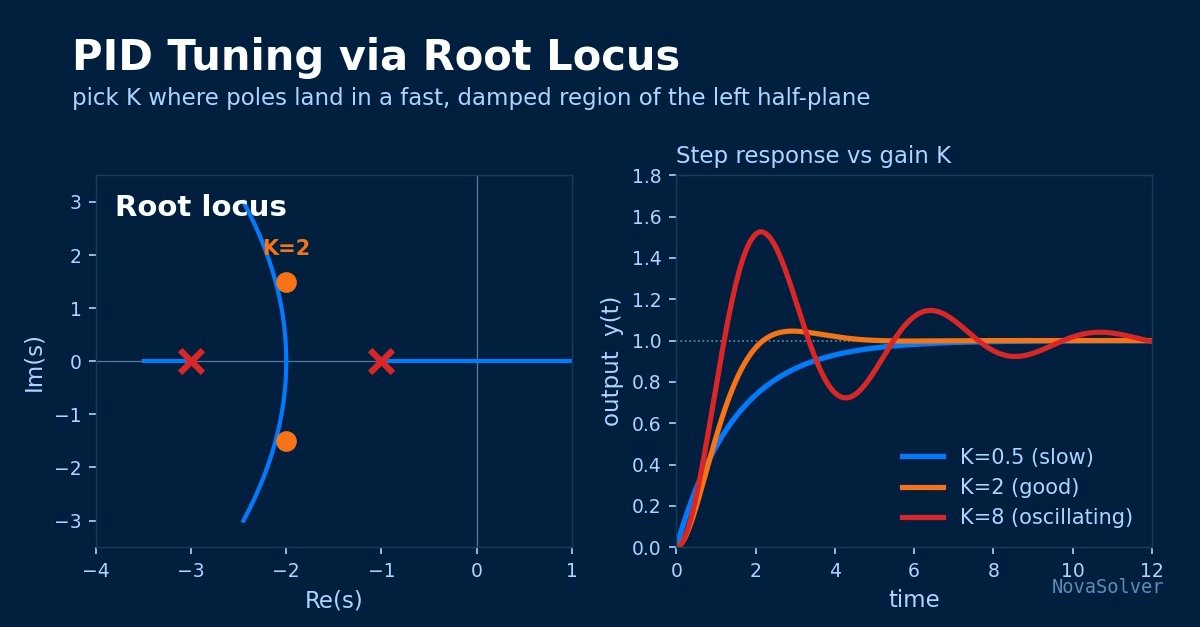
The PID controller is the workhorse of industrial control. It runs temperature loops, motor drives, flow valves, and flight surfaces. The algorithm itself is three terms and a line of arithmetic. The hard part has never been the controller — it is choosing the three gains. Set them too low and the system crawls toward its target. Set them too high and it oscillates, or worse, runs away. "Tuning" is the craft of finding the gains that land in between.
This article covers two complementary ways to tune a PID loop: the empirical Ziegler-Nichols method and the graphical root locus view — and shows how they describe the same boundary from different sides.
Why this calculation matters
An untuned loop is not a minor inconvenience. A sluggish temperature controller wastes energy and product. An oscillating position loop hammers the mechanics and shortens equipment life. An unstable loop is a safety incident. Between those failure modes sits a band of gains that gives a fast, well-damped response — and tuning is how you find that band on purpose rather than by trial and error at the plant.
The two methods matter because they suit different situations. Ziegler-Nichols needs only a simple experiment on the real system and no model. Root locus needs a model but, in return, shows you the whole stability picture at a glance. A capable engineer reaches for whichever the situation allows.