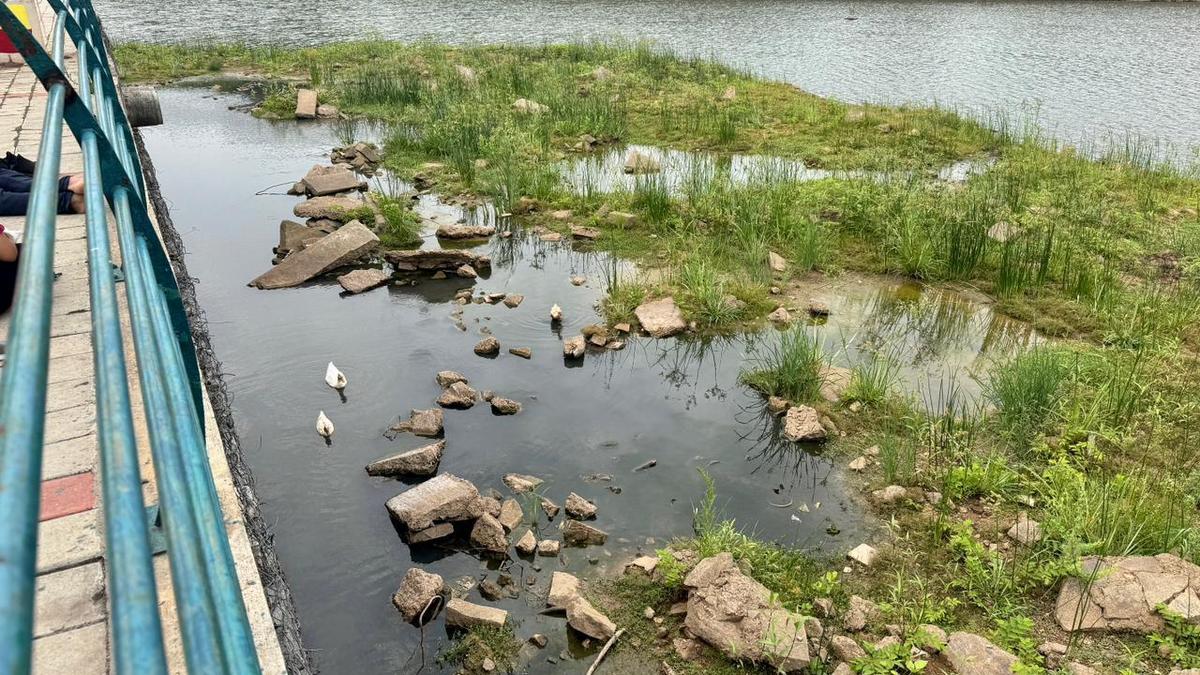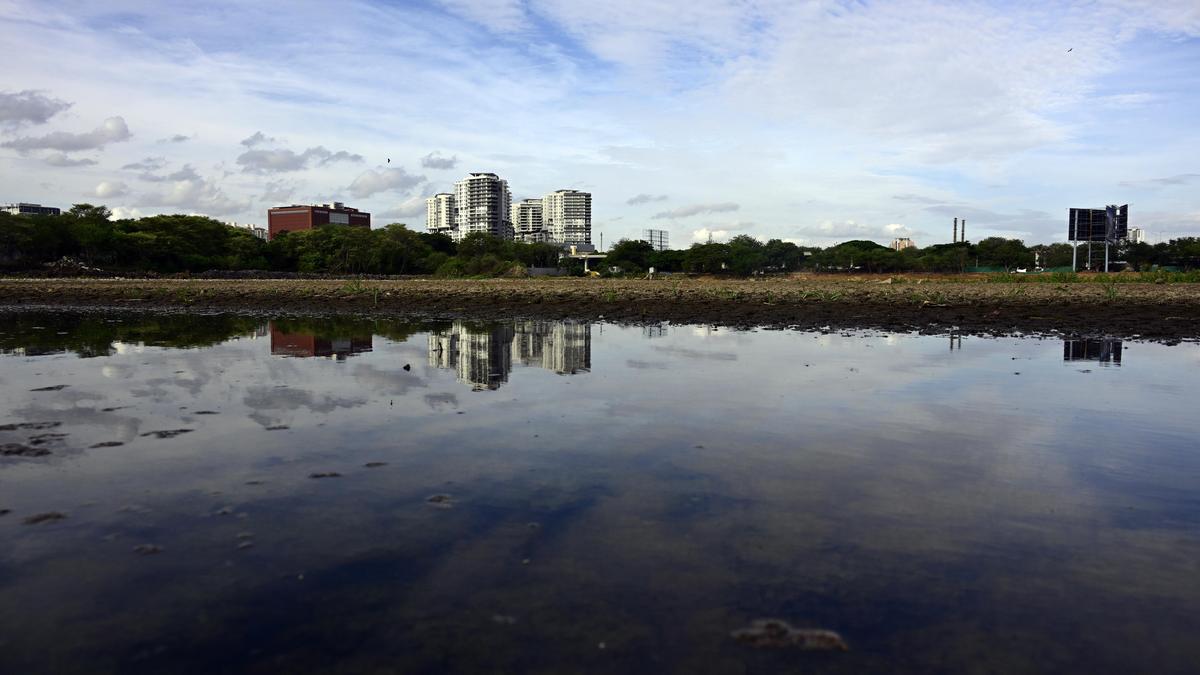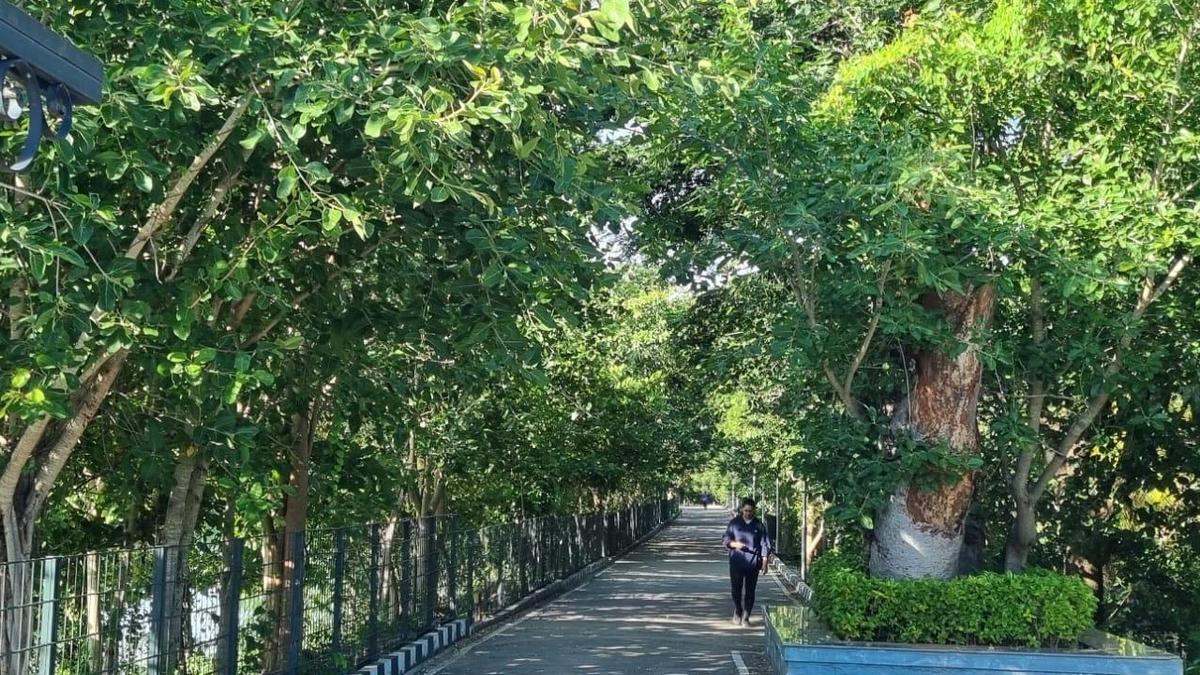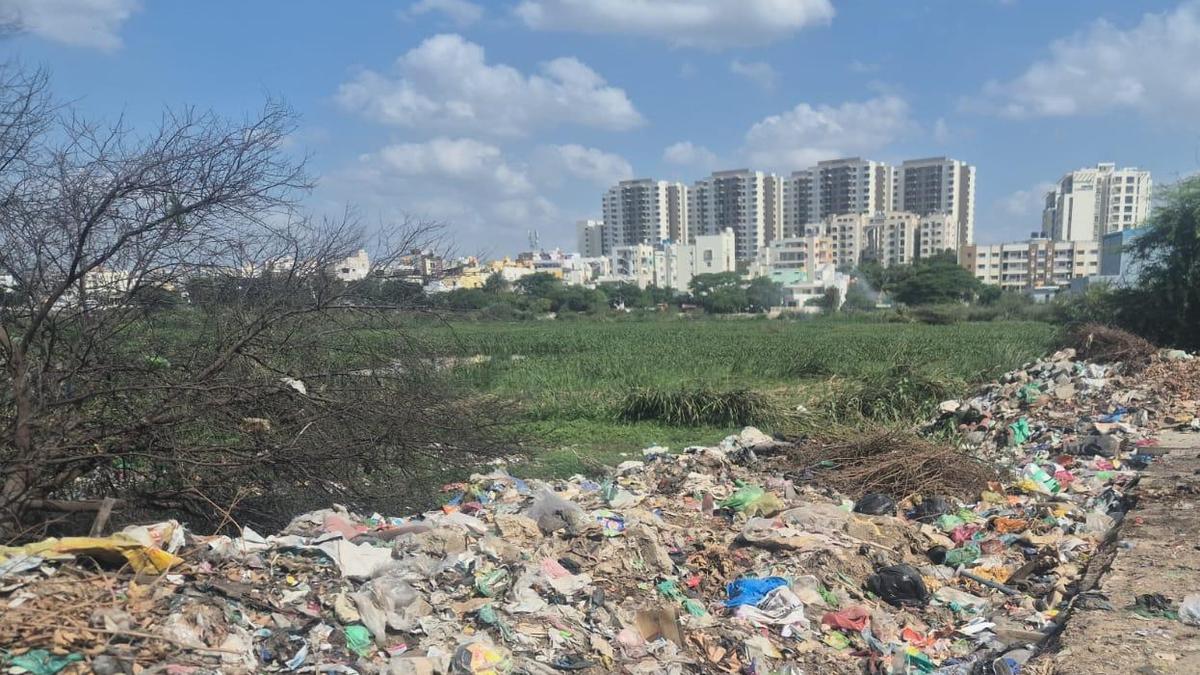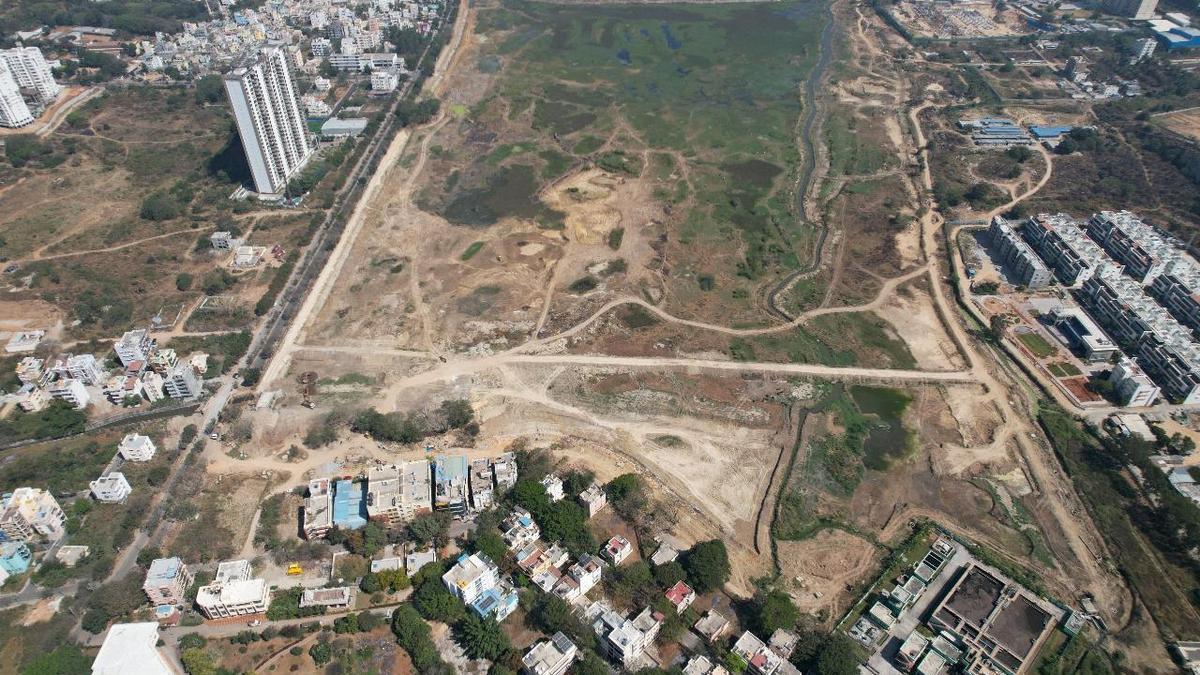
Hulimavu Lake in Bengaluru.
| Photo Credit: File Photo
Communities living around Soulkere and Hulimavu lakes have flagged concerns over the Bangalore Water Supply and Sewerage Board (BWSSB) planning to construct new Sewage Treatment Plants (STPs) inside the lake beds of these lakes. The Federation of Bengaluru Lakes, a coalition of stakeholder communities around lakes in the City, too has petitioned the BWSSB to reconsider the location. BWSSB is planning to build a 40 MLD STP at Soulkere and a 15 MLD STP at Hulimavu Lake. Work has already begun at Soulkere. “Lake bed is a protected zone where no construction activity is permitted. Multiple NGT orders have emphasised the need to maintain buffer zones around lakes. Wetlands (Conservation and Management) Rules, 2017 prohibit permanent construction within a defined distance of the lake bed (around 50 metres) allowing only minimal, non-intrusive activities,” FBL said in its letter. “STPs should not compromise the ecological integrity and original water holding capacity of the lake itself, thus leading to flooding. STPs must be located outside the lakebed either in the buffer zones or at upstream sewage interception points,” it further said. Communities raise concerns “Soulkere has been one of the sites for birdwatching, featured on the Great Indian Bird Count, every year and has exceptionally good biodiversity. STP on three of the 10 acres of the lakebed will kill the lake . BWSSB has been aggressively filling up this area with mud to build a STP. We have flagged encroachment of buffer zones repeatedly and even GBA Chief M. Maheshwar Rao inspected it. But there has been no action on the ground for years. Now saying the buffer zone is encroached, and building a STP on the lakebed is unacceptable,” said a resident living around Soulkere. Another resident living around Hulimavu Lake said that the lake was meant for flood mitigation. The lake has breached, leading to floods multiple times, the latest being in 2019. “If the lake has to act as a flood mitigation tool, it needs to have water retention capacity. But BWSSB wants to encroach the lake bed, build an STP and keep the lake full all the time. Hulimavu lake already has a 10 MLD STP built in 2021, which they had said can be enhanced. But now they say it cannot be done and are building a new STP of 15 MLD capacity on the lake bed,” he said. V. Ramprasad, President, FBL, said the Federation appeals to BWSSB to reconsider its decision. “We are not opposed to STPs and we want to work with the Board. But the ecological integrity of the lake bed is a priority. If the Board persists, we are open to approach the World Bank and Japan International Cooperation Agency (JICA), using whose funding these projects are being taken up, to flag damage to the lakes,” he said. Buffer zones encroachedSources said that BWSSB was forced to opt for building STPs on wetlands, lakebeds where buffer zones have been completely encroached and developedBWSSB Chairman V. Ram Prasath Manohar said that the Board was not violating any norms and their DPRs were approved by the Karnataka Tank Conservation and Development Authority. “These lakes are in a critical condition and STPs are being built to save them. We have decided to desilt these lakes to compensate for the carrying capacity lost due to the STPs,” he said. Published - May 23, 2026 11:36 pm IST