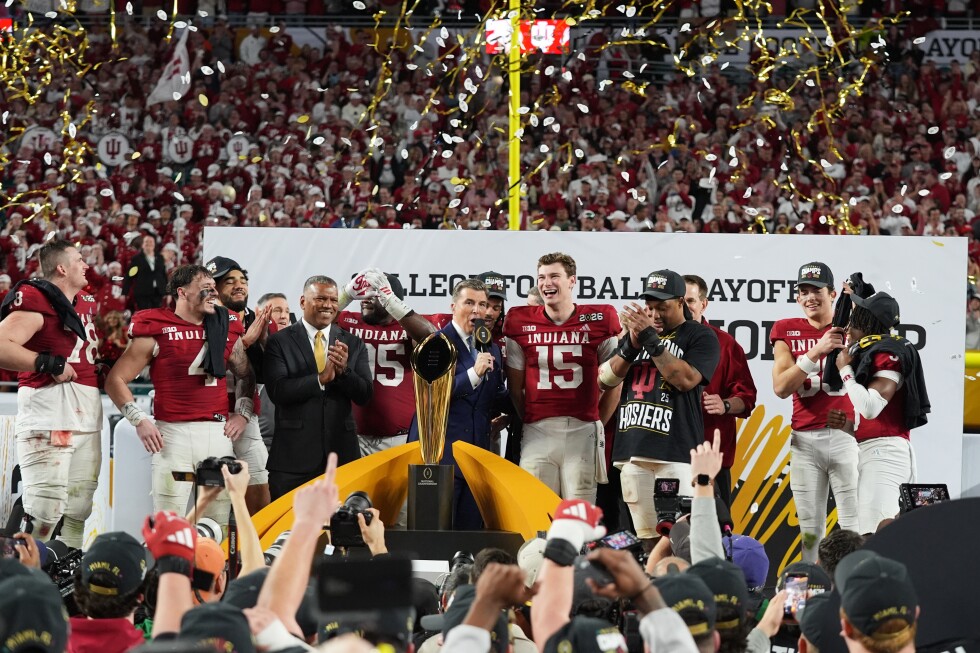
RANCHO PALOS VERDES, Calif. — When the Big Ten shifted to nine conference games in 2016, former commissioner Jim Delany demanded his football teams also schedule an additional game against a power-conference opponent.The Big Ten used its strength of schedule as a moral high ground as it pushed for recognition from the College Football Playoff selection committee. Despite the SEC and ACC scheduling eight league contests and most of their teams playing only nine power-conference opponents, the Big Ten’s scheduling philosophy rarely earned the benefit of the doubt when it came to the CFP rankings. So, the league abandoned it as an official policy.This fall, the SEC and ACC both shift to nine league games with every team in those leagues playing at least 10 power-conference opponents. Every Big 12 team plays 10, too, if the matchups with Pac-12 leftovers Washington State and Oregon State are counted. The Big Ten is now the outlier in this debate, with four teams — Indiana, Penn State, USC and Nebraska — facing only nine Power 4 opponents. And there’s no interest from the league office to require its teams to play 10 power opponents.“We’re happy to help assist and promote and direct where possible, but after we got away from that 10th game, we have not jumped back into the deep end of bringing that back at this time,” said A.J. Edds, the Big Ten’s vice president of football administration. “There’s some that do it, there’s some that have not, and therefore we’re not in the position of moving right back into it right now.”Big Ten teams have won the last three CFP titles, and each champion played only nine Power 4 opponents during the regular season. For Michigan (2023) and Ohio State (2024), those schedules were outliers. For Indiana (2025), it was a choice made by coach Curt Cignetti. Penn State has a two-year scheduling blip but returns to 10 Power 4 opponents in 2027 when it plays Syracuse. USC’s inability to reach a deal with rival Notre Dame prompted its scheduling issue, while Nebraska dropped a series with Tennessee.Cignetti hinted he might adjust in the future after dropping games against Louisville and Virginia upon his arrival in 2024.“One day, when the dust settles, you’ll see a lot of changes in college football, and you’ll see conferences with some cross-scheduling and stuff like that,” Cignetti said. “I think you’ll see a lot of changes in the next five years.”The Big Ten formerly shifted conference games to the season’s opening week in 2017, 2021 and 2022, but it doesn’t plan to revisit that strategy anytime soon, Edds said.“If we have two programs that are of the opinion that getting together early in the season serves purposes for them in the way they’re organizing their nonconference, then we’ll give that a good, hard look every time,” Edds said.
What we heard at Big Ten meetings: No push to mandate 10 Power 4 opponents amid CFP talks
Every SEC, ACC and Big 12 team will play 10 Power 4 opponents in 2026, but four Big 10 teams will only play nine.
1,310 words~6 min read